






Best eSIM for Las Vegas 2026: Stay Connected on the Strip, in the Desert, and Beyond
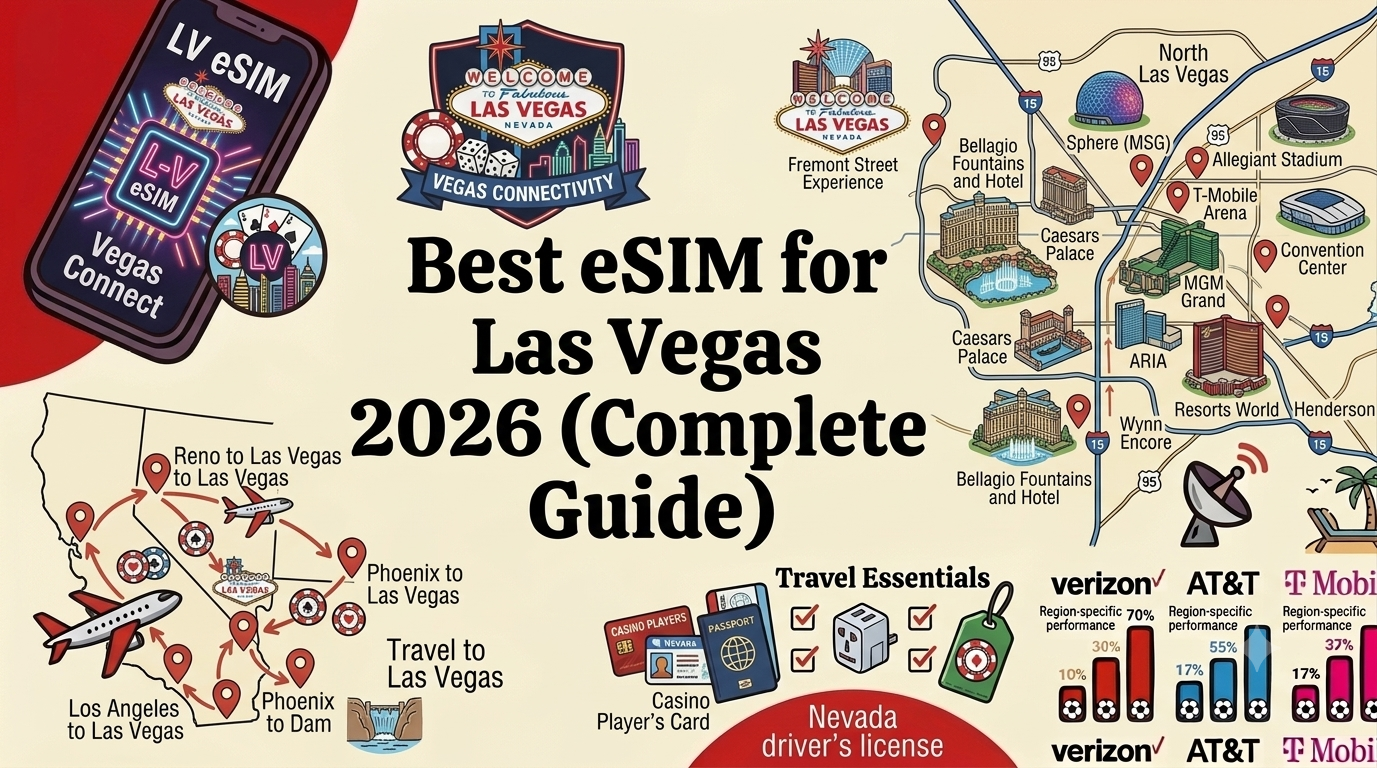
Las Vegas is one of the most visited cities in the world by international tourists, drawing approximately 40 million visitors per year from every corner of the globe. It is also one of the most data-intensive travel destinations on the planet. The moment you land at Harry Reid International Airport (LAS), you will use your phone to book a ride to your hotel, check your reservation, find the best buffet on the Strip, navigate the casino floor, and post your first casino photo to Instagram — all before you have even checked in.
For international visitors, Las Vegas is simultaneously one of the easiest cities in the US to stay connected in (the Strip has phenomenal wireless coverage) and one where the surrounding region can become surprisingly patchy (venture 30 miles outside the city toward Red Rock Canyon or Valley of Fire and coverage drops significantly). The day trips that most Las Vegas visitors take — Grand Canyon, Hoover Dam, Zion National Park, Death Valley — each have their own coverage story that is worth understanding before you get behind the wheel of a rental car.
This guide covers the best eSIM options for Las Vegas in 2026, including which networks perform best on the Strip, what to expect at major casinos and venues, how coverage holds up on the day trips, and how much data a Las Vegas visit realistically requires.
TLDR: eSIM for Las Vegas at a Glance
- Best networks on the Strip: T-Mobile and Verizon both excellent; AT&T strong
- Las Vegas Convention Center: All three networks strong for business travelers and convention attendees
- Grand Canyon South Rim: Limited coverage; download offline maps before leaving Vegas
- Hoover Dam: Good coverage on the Nevada side
- Zion National Park: Good in Springdale (gateway town); patchy inside the canyon
- Death Valley: Very limited; treat as offline
- Top visitor markets: Canada, Mexico, UK, Australia — all served by international travel eSIM plans
- Recommended data: 8GB to 15GB for a week in Vegas; more if doing multiple day trips
Why International Visitors Need an eSIM for Las Vegas
Las Vegas's top international visitor markets include Canada (the single largest source of international tourists to the city), Mexico, the United Kingdom, Australia, and Germany. For visitors from all of these countries, roaming charges on a home-country SIM can be punishing — Las Vegas is a data-heavy city where the average visitor uses their phone constantly.
The city's major casinos are not just gambling venues. They are full entertainment campuses with multiple restaurants, nightclubs, shows, and attractions all requiring apps to book, navigate, and pay. The MGM Grand app, the Caesars app, the Wynn app — each major property has its own digital ecosystem. Booking a dinner reservation at a Strip restaurant the same day often requires OpenTable or Resy. Getting from one end of the Strip to the other by rideshare uses Uber or Lyft. Even the free tram services between some casino properties have apps showing real-time schedules.
A travel eSIM from Esimify gives you a US data plan that works from the moment you land, with no carrier store visit, no US billing address required, and no risk of the roaming bill shock that comes from using a home-country SIM in the US for a week.
Las Vegas Network Coverage: T-Mobile, AT&T, and Verizon
Las Vegas is a surprisingly well-served market for all three major US networks. The concentration of high-value commercial real estate on and around the Strip has driven enormous carrier infrastructure investment. Every major casino property has extensive indoor coverage from distributed antenna systems (DAS) installed within the buildings. The open desert air and flat geography of the valley also makes above-ground coverage excellent across most of the metro area.
T-Mobile in Las Vegas
T-Mobile offers outstanding 5G coverage across the Las Vegas Strip, downtown Fremont Street area, the Convention Center corridor, Henderson, Summerlin, and North Las Vegas. The network is consistently fast on the Strip even during busy weekend evenings when tens of thousands of visitors are simultaneously uploading content. T-Mobile's low-band 5G extended range coverage keeps you connected on the approaches to the city along I-15 from California and on the I-515 and US-95 corridors. For day trips, T-Mobile maintains good coverage on US-93 toward the Hoover Dam and the Arizona border, and reasonable coverage along I-40 east toward the Grand Canyon area.
Verizon in Las Vegas
Verizon has strong 5G on the Strip and performs particularly well inside the major casino properties, where its DAS agreements with casino operators give it an edge for indoor coverage. Verizon's broader rural LTE coverage is an advantage for day trips: on routes toward Zion National Park and Bryce Canyon via I-15 north into Utah, Verizon often maintains a stronger signal than T-Mobile in the rural Nevada and southern Utah stretches. For visitors planning extensive off-Strip activities, Verizon's wider footprint is worth considering.
AT&T in Las Vegas
AT&T has strong coverage throughout the Las Vegas metro including the Strip, Convention Center, downtown, and the suburban residential areas. Its 5G footprint on the Strip is solid and its performance in most casino interiors is competitive. AT&T's mid-band 5G deployments in Las Vegas have expanded significantly since 2024, narrowing the gap with T-Mobile for raw speed in urban areas.
Las Vegas Coverage by Location
| Location | T-Mobile | AT&T | Verizon | Notes |
|---|---|---|---|---|
| Las Vegas Strip (casino corridor) | Excellent 5G | Excellent 5G | Excellent 5G | All three tier-1; some of the densest coverage in the US |
| Fremont Street / Downtown | Excellent | Strong | Strong | T-Mobile leads slightly; all three solid |
| Las Vegas Convention Center | Excellent | Excellent | Excellent | One of the best-connected convention venues in the US |
| Harry Reid International Airport (LAS) | Excellent | Excellent | Excellent | Strong throughout terminals and arrivals hall |
| Red Rock Canyon NCA | Good near entrance | Good near entrance | Good near entrance | Signal fades in the backcountry trails; 15 miles from Strip |
| Hoover Dam / Boulder City | Good | Good | Strong | All three usable; solid along US-93 |
| Valley of Fire State Park | Weak | Weak | Fair | Download offline maps; 50 miles from Vegas |
| Grand Canyon South Rim | Limited (rim only) | Limited (rim only) | Limited (rim only) | No coverage below the rim; download maps before leaving |
| Zion National Park (Springdale) | Good | Good | Strong | Signal in town; drops inside the canyon and on trails |
| Death Valley National Park | Very limited | Very limited | Very limited | Treat as fully offline; Furnace Creek has limited AT&T |
| I-15 to Los Angeles (through Mojave) | Good to strong | Good | Good | Some gaps in the Mojave Desert; generally well covered |
The Las Vegas Strip: A Connectivity Ecosystem Like No Other
The 4.2-mile stretch of Las Vegas Boulevard South known as the Strip is one of the most wireless-dense areas in the United States. Every major casino resort — the Bellagio, Caesars Palace, MGM Grand, the Venetian, Wynn Las Vegas, Encore, Mandalay Bay, Park MGM, New York-New York, Aria, Vdara, Cosmopolitan, Resorts World, and Circa, among others — has invested heavily in in-building wireless infrastructure to keep the millions of guests connected at all times.
The practical reason: casinos need guests to be connected to their apps. The MyVegas app, the Caesars Rewards app, the MGM Rewards app, the Wynn app — all of these loyalty and booking platforms require a live data connection to function. Casinos want you using their apps to book restaurants, reserve pool cabanas, buy show tickets, and order bottle service. They have every incentive to ensure their properties have excellent wireless coverage, and they have delivered on it.
On the Strip itself, outdoor coverage between casino properties is excellent on all three networks. The elevated Monorail system that runs along the east side of the Strip (from MGM Grand to the Convention Center) maintains coverage throughout. The free people mover trams between Mandalay Bay and Luxor, between Bellagio and Park MGM, and between the Venetian and the Palazzo all have outdoor coverage throughout.
Las Vegas for Business Travelers: Conventions and Conferences
Las Vegas hosts more major conventions and trade shows than any other city in the United States. CES (Consumer Electronics Show), NAB Show (National Association of Broadcasters), SEMA (Specialty Equipment Market Association), AWS re:Invent, Salesforce Dreamforce's occasional Vegas editions, and hundreds of other industry events bring millions of business visitors annually.
The Las Vegas Convention Center (LVCC) is one of the most well-connected convention venues in the world. All three major networks have excellent indoor coverage throughout the facility's 4.6 million square feet of space. The West Hall expansion (opened 2021) has particularly robust coverage. Business visitors who need to run video calls, access corporate VPNs, download large files, and maintain Slack and Teams throughout long convention days should have no connectivity issues on any of the three networks.
The Convention Center's underground Loop system (operated by The Boring Company) connects the South, Central, and West Halls via electric vehicle tunnels. Coverage is maintained in the Loop stations and vehicles on all three networks, a genuine engineering achievement given the underground environment.
Formula 1 Las Vegas Grand Prix
The Formula 1 Las Vegas Grand Prix has become one of the signature annual events on the global sports calendar since its inaugural race in 2023. The Las Vegas Street Circuit runs along a 3.8-mile course through the center of the city, with the main straight running down Las Vegas Boulevard — past the Bellagio fountains, the Caesars Palace grandstands, and the Sphere. The race typically takes place in November and draws an international audience comparable to Monaco and Silverstone in terms of prestige.
For F1 visitors, connectivity during the Grand Prix weekend is essential for checking session schedules on the F1 app, navigating between circuit viewing areas and casino properties, and accessing digital grandstand tickets. Coverage throughout the race circuit area is exceptional — arguably some of the best in-event wireless infrastructure of any race circuit globally, given that the entire circuit runs through the heart of the most wireless-dense commercial district in North America.
Day Trips from Las Vegas: Connectivity Planning
Most Las Vegas visitors take at least one day trip. The city sits within driving distance of some of the most spectacular natural landscapes in North America, but several of those destinations have significant connectivity limitations that require planning ahead.
Hoover Dam and Lake Mead (30 miles from the Strip)
Hoover Dam is one of the most visited landmarks in the United States and a natural addition to any Las Vegas itinerary. The drive from Las Vegas on US-93 maintains solid coverage on all three networks throughout. At the dam itself, coverage is good on the Nevada side. The Lake Mead National Recreation Area has variable coverage depending on your specific location along the lake. Download offline maps for the Boulder City and Hoover Dam area before leaving Las Vegas.
Red Rock Canyon National Conservation Area (15 miles from the Strip)
Red Rock Canyon is the closest major natural attraction to the Strip and receives nearly 2 million visitors a year. The 13-mile scenic drive has coverage near the visitor center and in the early sections. As you move deeper into the canyon and approach the backcountry hiking areas, coverage drops significantly. Download AllTrails offline trail maps for any hiking you plan to do inside the NCA.
Valley of Fire State Park (50 miles from the Strip)
Valley of Fire is Nevada's oldest and largest state park, with extraordinary red Aztec sandstone formations. Coverage is limited throughout the park on all three networks. Download offline maps and the park's trail information before leaving Las Vegas. The drive along Nevada State Route 169 to the park entrance has reasonable coverage in the early sections but fades as you approach the park interior.
Grand Canyon (275 miles from the Strip)
The Grand Canyon is one of the most common day trips or overnight excursions from Las Vegas, typically done by rental car via US-93 through Kingman, Arizona and then north on Arizona Route 64. The drive itself has coverage for most of the route, with some gaps in the Arizona high desert between Kingman and Williams. At the South Rim of the Grand Canyon, coverage exists on the rim walkways on AT&T and Verizon in some sections. Below the rim on any trail — Bright Angel Trail, South Kaibab Trail — there is essentially no coverage.
Download offline Google Maps for the Grand Canyon South Rim and the highway route from Las Vegas before departing. Grand Canyon Village has limited AT&T signal and public Wi-Fi at Bright Angel Lodge. If you are hiking into the canyon, let someone know your plan and expected return time before you lose signal.
Zion National Park (160 miles from the Strip)
The drive from Las Vegas to Zion via I-15 north passes through St. George, Utah, where all three networks are strong. The gateway town of Springdale has good coverage on Verizon and reasonable coverage on T-Mobile and AT&T. Inside Zion Canyon itself, signal drops significantly. The canyon's towering sandstone walls block direct line of sight to towers, and coverage in the main canyon corridor (on the Zion Canyon Scenic Drive) is limited. Download the NPS Zion app and AllTrails offline maps for every trail before entering the park.
Death Valley National Park (120 miles from the Strip)
Death Valley is one of the hottest and most remote places in North America and one of the most reliably offline destinations you will encounter near Las Vegas. Coverage is essentially absent throughout the park interior. Furnace Creek, the main visitor services area, has limited AT&T signal. Anywhere else in the park — Badwater Basin, Artist's Drive, Zabriskie Point, Racetrack Playa — should be treated as fully offline. Always travel with full water reserves in Death Valley (at minimum 4 liters per person for any hike) and let someone outside the park know your itinerary.
How Much Data Do You Need for Las Vegas?
- Weekend trip (3 to 4 days) on the Strip only: 5GB to 8GB. Casino apps, rideshare, restaurant booking, social media from the shows and pool decks.
- Week in Vegas with convention attendance: 10GB to 15GB. Business data use (Slack, email, Zoom), convention venue navigation, plus evening Strip entertainment.
- Week including Grand Canyon and Zion day trips: 8GB to 12GB. Most of the day-trip hours are offline; data used mainly in Las Vegas before and after.
- Formula 1 Grand Prix weekend: 8GB to 12GB. F1 app, circuit navigation, show ticket booking, heavy social media posting from the grandstands.
- Month-long stay: Unlimited plan. Extended leisure use, streaming shows in the hotel room, video calling family, convention attendance adds up fast over a month.
Tips for Using an eSIM in Las Vegas
- Download casino apps before you arrive: The MGM Grand, Caesars, Wynn, and Venetian apps all offer mobile check-in, digital room keys, and restaurant reservations. Download them before you land so you can use them on your eSIM the moment you arrive.
- Extreme heat planning: Las Vegas summer temperatures exceed 110°F (43°C). Your phone may overheat if left in direct sunlight, which can temporarily disable cellular functions. Keep your device in shade or a bag when outdoors for extended periods. Download the National Weather Service Las Vegas app for heat advisories.
- Uber and Lyft have designated pickup zones at casinos: Most major casino properties have specific rideshare pickup areas that are separate from the taxi areas. Check the casino's property map (on their app) for the rideshare pickup location before you order — walking to the wrong exit on a busy weekend night wastes time.
- Fremont Street Experience has strong coverage: The famous LED canopy covering five blocks of Fremont Street in downtown Las Vegas does not block cellular signal. Coverage throughout the Fremont Street Experience pedestrian area is good on all three networks.
- Las Vegas has no public transit between the Strip and downtown: The Deuce and SDX bus lines connect the Strip to Fremont Street but take 30 to 45 minutes. Most visitors use rideshare for this route. Your eSIM data is essential for booking rides.
- Grand Canyon requires a full offline preparation: If doing the Grand Canyon day trip (the most popular excursion from Las Vegas), download offline maps the night before in your hotel room on Wi-Fi. The drive, at 275 miles each way, is a full day with very limited stops.
Real-World Scenarios: Las Vegas Visitors
The Canadian Couple for a Long Weekend
Canada sends more international visitors to Las Vegas than any other country. A couple from Toronto flying in for a four-day weekend wants to stay at the Cosmopolitan, see a Cirque du Soleil show, dine at multiple restaurants on the Strip, and take a day trip to Hoover Dam. They need data for the Cosmopolitan app, OpenTable, Uber, and continuous Instagram posting. A 6GB to 8GB plan covers the long weekend comfortably.
The British Stag Party
A group of eight from London spending five days in Las Vegas for a stag (bachelor) party. Heavy use of group chat apps (WhatsApp), constant social media, Uber rides between venues, booking pool cabanas and club tables through casino apps, and streaming sports in the hotel room. Each person needs at least 8GB to 10GB for the week. Group members can each purchase individual eSIM plans from Esimify before departing the UK — no need to sort SIM cards at the airport.
The Australian Convention Attendee
A tech professional from Sydney attending CES or AWS re:Invent for a week. They need reliable data for Slack, corporate email, Zoom, downloading product demos, and navigating between the Convention Center and Strip hotels for evening events. A 12GB to 15GB plan handles a week of professional use. The LVCC has strong coverage on all three networks for the day sessions.
Frequently Asked Questions: eSIM in Las Vegas
What is the best eSIM network for Las Vegas?
T-Mobile offers the best overall 5G performance on and around the Strip. Verizon performs particularly well inside major casino properties and has broader rural coverage for day trips. AT&T is a strong alternative for the Strip and Convention Center. Any of the three will serve a Strip-focused visit well.
Does my eSIM work inside the casinos?
Yes. The major casino properties on the Las Vegas Strip have invested heavily in indoor distributed antenna systems. All three major networks maintain strong coverage inside the gaming floors, hotel lobbies, restaurants, and entertainment venues of properties like the Bellagio, Caesars Palace, MGM Grand, the Venetian, and Wynn Las Vegas.
Is there coverage at the Grand Canyon?
Limited coverage exists on the South Rim of the Grand Canyon on AT&T and Verizon in some sections. Coverage below the rim on any trail is essentially nonexistent. Download offline maps before leaving Las Vegas for any Grand Canyon trip.
Does my Las Vegas eSIM work in Utah for the Zion trip?
Yes. Zion National Park is in Utah, which is a US state. A standard US eSIM plan covers Utah without any additional setup. Coverage is good in the gateway town of Springdale and along I-15, with significant gaps inside Zion Canyon itself.
How much data does the Sphere use?
The MSG Sphere on the eastern edge of the Strip does not require any specific app for most visitors, but checking event schedules, buying tickets, and accessing seat maps all use minimal data (under 100MB total). If you use the Sphere's in-venue augmented reality experiences (where available), that may use additional data. The Sphere is located near the Venetian Resort and has excellent coverage in the surrounding area.
Can I use my eSIM to call home from Las Vegas?
Travel eSIMs provide data only. You can make international calls using WhatsApp, FaceTime, Google Meet, Zoom, or Viber over your eSIM data connection. These apps use approximately 0.5MB to 1.5MB per minute of voice or video call — very modest data consumption.
Conclusion: Stay Connected in the City That Never Sleeps
Las Vegas is built for a good time, and staying connected is part of having one. Whether you are checking wait times at the Bellagio buffet, booking last-minute tickets to a headline show, navigating your way back from Fremont Street at 3am, or planning your Grand Canyon departure time before bed, reliable mobile data is the thread that holds a Las Vegas trip together.
The Strip itself is one of the most wireless-dense environments in the country — you will not struggle for signal in the heart of the action. Where planning ahead matters is the day trips: the Grand Canyon, Death Valley, Valley of Fire, and parts of Zion all require downloaded offline maps before you leave the Las Vegas city limits.
Activate your US eSIM before you board your flight to Las Vegas at Esimify, and check the Esimify blog for guides to every other destination on your North American itinerary.