Best eSIM for Bali, Indonesia 2026: Connectivity Guide for Digital Nomads and Travelers
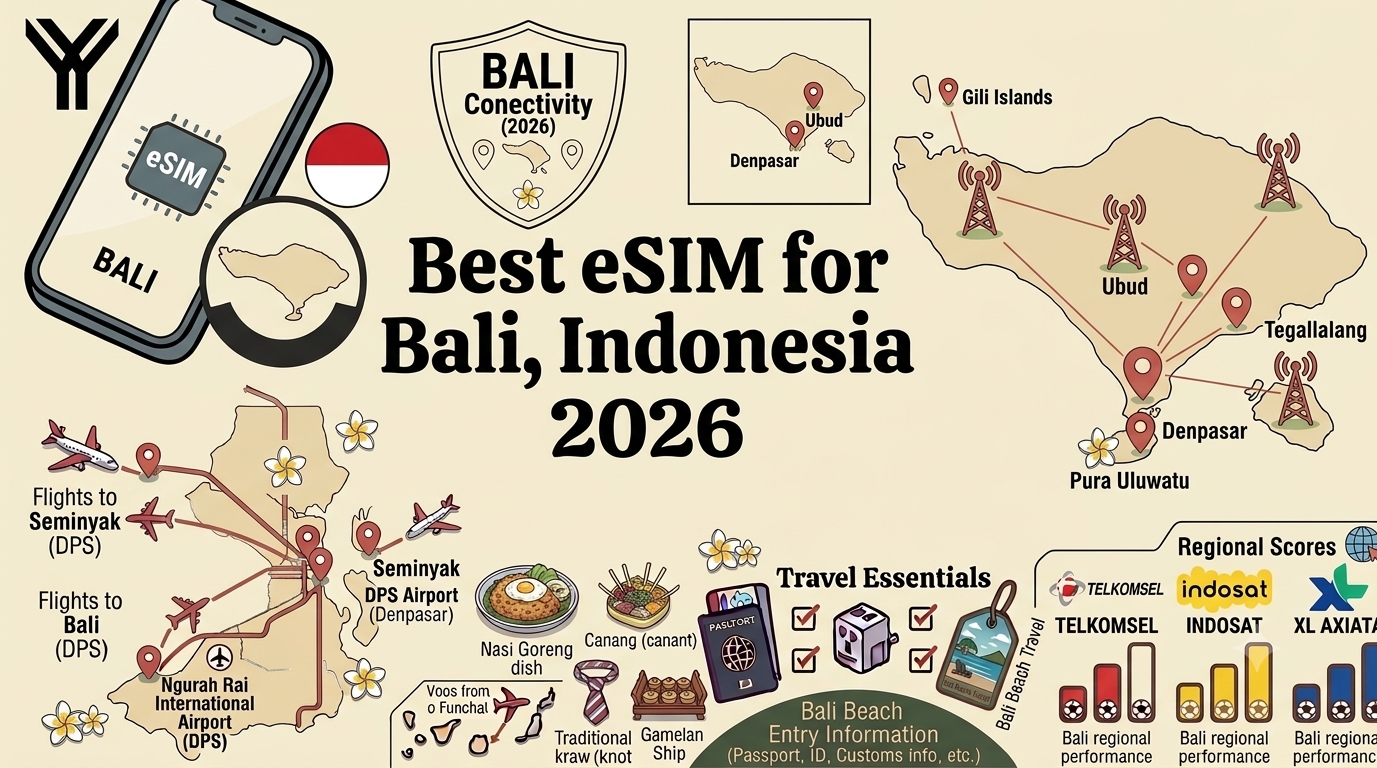
Bali remains one of the world's most popular destinations for travelers, digital nomads, and long-term visitors, and in 2026 it continues to attract a steady stream of remote workers drawn to its co-working spaces, beach towns, and relatively low cost of living. Whether you are visiting for a week of temple-hopping and surfing, or settling in for a few months of remote work from Canggu or Ubud, getting connected as soon as you land at Ngurah Rai International Airport makes everything from rideshares to visa paperwork easier.
This guide covers everything you need to know about using an eSIM in Bali in 2026: which networks offer the best coverage across the island's main areas, what to expect at the airport, how coverage holds up in rural and mountain areas, and practical recommendations for tourists, digital nomads, surfers, and families.
TLDR: Best eSIM for Bali in 2026
- Bali has strong 4G and growing 5G coverage from Telkomsel, XL Axiata, and Indosat Ooredoo Hutchison across the south of the island, including Denpasar, Kuta, Seminyak, Canggu, and Ubud.
- Ngurah Rai International Airport (DPS) has reliable coverage throughout its terminals.
- Coverage thins out in more remote areas, including parts of Nusa Penida, the slopes of Mount Batur and Mount Agung, and some inland rice terrace areas.
- An eSIM activated before you fly means you are connected the moment you land, useful for rideshare apps, accommodation check-in, and navigating Bali's notoriously confusing one-way street systems.
- Recommended starting point: 5-10GB for a one to two week trip; 20GB or more, or a renewable plan, for digital nomads staying a month or longer.
Why You Need an eSIM for Bali
If you are traveling to Bali from outside Indonesia, your home carrier's roaming charges can be very high, often with daily fees that make a multi-week trip prohibitively expensive. While local SIM cards are cheap and widely available, buying one requires finding a kiosk, registering with your passport, and waiting in line, none of which you want to do after a long-haul flight.
An eSIM lets you install an Indonesian or regional data plan onto your phone before you fly, activated via a QR code or link, without swapping your physical SIM. You keep your home number active for calls and texts while using the eSIM for fast data throughout your trip, which is particularly useful for ridesharing apps like Gojek and Grab, both of which are essential for getting around Bali's traffic.
Who This Guide Is For
- Tourists visiting Bali's temples, beaches, and rice terraces for one to two weeks.
- Digital nomads basing themselves in Canggu, Ubud, or Sanur for weeks or months at a time.
- Surfers chasing waves along the Bukit Peninsula and beyond.
- Families visiting resort areas in Nusa Dua or Seminyak.
- Island hoppers combining Bali with Nusa Penida, the Gili Islands, or Lombok.
Mobile Networks in Bali: Coverage Overview
Indonesia's mobile network infrastructure is most developed in Bali's southern tourist areas and the capital region around Denpasar, with coverage thinning as you move into mountainous interior areas and outlying islands.
Telkomsel
Telkomsel is Indonesia's largest carrier and generally offers the most extensive coverage across Bali, including rural and mountainous areas where other carriers may struggle. It is often the recommended choice for travelers planning to explore beyond the main tourist areas.
XL Axiata
XL Axiata offers strong coverage in Bali's main tourist areas and is known for competitive data pricing, making it a popular choice for budget-conscious travelers and digital nomads.
Indosat Ooredoo Hutchison
Indosat has been expanding its network significantly in recent years and offers good coverage in southern Bali, with competitive 5G rollout in Denpasar and surrounding areas.
Network Coverage by Area
| Area | Best Coverage | 5G Availability | Notes |
|---|---|---|---|
| Denpasar and Ngurah Rai Airport (DPS) | Telkomsel, XL Axiata, Indosat | Strong 5G in Denpasar | Best overall infrastructure on the island |
| Kuta, Seminyak, and Canggu | All major carriers | Good 4G, growing 5G | Dense coverage in these popular tourist and nomad areas |
| Ubud and surrounding rice terraces | Telkomsel, XL Axiata | Good 4G | Some rural rice terrace viewpoints have weaker signal |
| Bukit Peninsula (Uluwatu, Padang Padang) | Telkomsel, XL Axiata | Good 4G | Coverage strong near cliff temples and surf spots |
| Mount Batur and Mount Agung | Telkomsel | Variable, weaker at higher elevations | Popular sunrise hikes may have intermittent signal near summits |
| Nusa Penida and Nusa Lembongan | Telkomsel | Good in main areas, weaker inland | Coverage near harbors and beaches better than interior cliffs |
| Gili Islands and Lombok (day/multi-day trips) | Telkomsel | Good in main areas | Smaller Gili islands have limited but functional coverage |
Area-by-Area Connectivity Guide
Canggu and the Digital Nomad Hub
Canggu has become synonymous with Bali's digital nomad scene, packed with co-working spaces, cafes with reliable WiFi, and a steady stream of remote workers. Coverage throughout Canggu is generally strong across all carriers, though as the area continues to grow rapidly, some newer developments on the outskirts may have less consistent infrastructure than the established core.
Ubud and the Cultural Heart of Bali
Ubud, known for its rice terraces, art markets, and yoga retreats, has good coverage throughout the town center. Venturing into the surrounding rice terrace areas for photos or walks can mean brief signal gaps, particularly in the more scenic, less developed viewpoints favored by photographers.
Seminyak and Kuta
Bali's most established tourist areas, Seminyak and Kuta, have dense coverage from all major carriers, reflecting their status as the island's longest-running beach resort districts.
The Bukit Peninsula: Uluwatu and Surf Beaches
The southern Bukit Peninsula, home to Uluwatu Temple and famous surf breaks like Padang Padang and Bingin, has good coverage near the main roads and clifftop areas, useful for checking surf forecasts and tide times before heading down to the beach.
Nusa Penida and Island Day Trips
Nusa Penida, famous for Kelingking Beach and its dramatic cliffs, has decent coverage near the harbor and main villages, but many of the island's most photographed viewpoints are in less developed areas where signal can be weaker. Most day-trip itineraries from Bali involve enough time near covered areas that this is rarely a major issue.
Mount Batur Sunrise Trek
One of Bali's most popular activities is the pre-dawn hike up Mount Batur for sunrise. Coverage on the lower slopes is generally reliable, though it can become intermittent closer to the summit, which is worth knowing if you are planning to livestream or video call during the climb.
Choosing the Right eSIM Plan for Bali
Short Trips (1-2 Weeks)
For a typical one to two week holiday focused on the main tourist areas, a 5-10GB plan is usually sufficient for navigation, rideshares, messaging, and social media.
Digital Nomads (1+ Months)
For remote workers planning to stay a month or longer, look for plans with larger data allowances or the ability to top up, since video calls and cloud-based work tools consume data quickly, especially as a backup when co-working space WiFi has issues, which does happen occasionally even in well-established hubs like Canggu.
Surfers and Adventure Travelers
If your days are spent checking surf forecasts, navigating to remote breaks, and sharing footage, a mid-range plan of 8-12GB covers most one to two week trips comfortably.
Island Hoppers
If your itinerary includes Nusa Penida, the Gili Islands, or Lombok, a slightly larger allowance helps cover navigation in areas where coverage may be less consistent than mainland Bali's tourist centers.
Real-World Scenarios: How Travelers Use eSIMs in Bali
Scenario 1: The Two-Week Vacationer
Sophie flies in from Australia for a two-week trip split between Seminyak and Ubud. With her eSIM activated before departure, she is online as soon as she lands at DPS, booking a Gojek ride into Seminyak. Throughout her trip, she uses her eSIM constantly for navigation, restaurant recommendations, and sharing photos, using about 6GB on a 10GB plan.
Scenario 2: The Digital Nomad in Canggu
Jonas, a software developer, spends six weeks working from Canggu, splitting time between his rented villa and local co-working spaces. He relies on his eSIM as a reliable backup for video calls when co-working WiFi occasionally drops, and uses it constantly for navigation around Canggu's confusing back roads. He opts for a larger renewable plan to cover his extended stay.
Scenario 3: The Surf Trip
A group of friends spends ten days chasing waves around the Bukit Peninsula, checking surf forecast apps each morning before heading to different breaks. They find coverage reliable near all the main surf spots, using their eSIMs for forecast checking, navigation, and sharing footage from each session.
Scenario 4: The Nusa Penida Day Tripper
Mei takes a day trip from Bali to Nusa Penida to see Kelingking Beach and the famous cliff viewpoints. She finds coverage good near the harbor and main roads, with brief gaps at some of the more remote viewpoints. Her eSIM reconnects quickly each time the van returns to the main road, and she uses less than 1GB for the day.
Tips and Best Practices
Before You Travel
- Install your eSIM profile over WiFi before departure, since activation requires an internet connection.
- Confirm your phone is unlocked and eSIM-compatible. Most iPhones from the XS onward and recent flagship Android phones support eSIM.
- If your trip includes Mount Batur, Nusa Penida, or other less developed areas, download offline maps in advance, since coverage can be intermittent.
While in Bali
- Download Gojek or Grab before you arrive, since these apps are essential for getting around and rely on a stable connection for accurate pickup locations.
- Bali's traffic can be unpredictable, and having reliable navigation data helps avoid getting stuck on the wrong side of a one-way system, a common frustration in areas like Seminyak and Canggu.
- Many cafes and co-working spaces in Canggu and Ubud offer free WiFi, which can help conserve your data allowance, though speeds vary considerably between venues.
Common Issues and Troubleshooting
- No signal after landing: Make sure data roaming is enabled for your eSIM line in your phone's settings, the most common cause of connectivity issues on arrival.
- Weak signal near Mount Batur summit or Nusa Penida cliffs: This is a genuine coverage gap in remote areas rather than an eSIM issue, and resolves once you move back toward main roads or villages.
- eSIM not activating: Confirm your device's date and time are set to automatic, as incorrect settings can prevent network registration.
- Slow speeds during peak season: During July, August, and the December holiday period, network congestion in busy tourist areas can slow speeds temporarily, particularly in the evenings.
Bali Travel Recommendations Beyond Connectivity
Beyond the well-known beach clubs and temples, Bali rewards visitors who explore its quieter corners: the waterfalls around Munduk in the island's north, the less crowded beaches of the east coast near Amed, and the rice terraces of Jatiluwih, which see far fewer visitors than the more famous Tegalalang terraces near Ubud. If you are visiting during the rainy season, which runs roughly from November to March, afternoon downpours are common but usually brief, and having reliable weather data helps you plan around them.
Visa Requirements and Practical Considerations
Most visitors to Bali can obtain a visa on arrival or an e-visa in advance, depending on nationality, and having a working connection from the moment you land makes it easier to handle any digital paperwork, show confirmation emails, or use immigration-related apps. For longer stays, digital nomads should research Indonesia's specific visa options for remote workers, as requirements have continued to evolve and vary by passport.
Working Remotely from Bali
Bali's appeal to remote workers goes beyond its scenery, the combination of a lower cost of living, an established expat and nomad community, and a growing number of co-working spaces with reliable infrastructure has made areas like Canggu and Ubud genuine alternatives to working from home for months at a time. A dependable eSIM is part of the infrastructure that makes this lifestyle work, providing a backup connection for video calls and a way to stay reachable while moving between cafes, co-working spaces, and accommodation.
Getting Around Bali
Renting a scooter is the most common way to get around Bali, and having a working data connection for navigation is almost essential given how confusing some of the island's roads can be, particularly in densely packed areas like Canggu where new roads and shortcuts appear faster than paper maps can keep up. Ridesharing apps are widely used for longer trips or for visitors who prefer not to drive themselves.
Frequently Asked Questions
Does my phone support eSIM in Bali?
Most smartphones from 2019 onward, including iPhone XS and later and most flagship Samsung and Google Pixel devices, support eSIM. Check your device settings under "Mobile Data" or "Cellular," or search your phone model plus "eSIM compatible" to confirm.
Which carrier has the best coverage in Bali?
Telkomsel generally offers the most extensive coverage across Bali, including more remote and mountainous areas, making it a popular choice for travelers planning to explore beyond the main tourist zones.
How much data do I need for a trip to Bali?
For typical tourist use over one to two weeks, including navigation, rideshares, and social media, 5-10GB is usually sufficient. Digital nomads staying longer should look for larger or renewable plans.
Is Ngurah Rai Airport well covered for eSIM activation?
Yes, DPS has reliable coverage from major Indonesian carriers throughout its terminals, so your eSIM should connect automatically as soon as your phone detects a local tower after landing.
Will my eSIM work on Nusa Penida or the Gili Islands?
Generally yes in main areas near harbors and villages, though coverage can be weaker in more remote viewpoints and on smaller islands. Download offline maps before day trips to these areas.
Can I use Gojek and Grab with an eSIM?
Yes, these apps work normally over eSIM data, the same as they would over a local physical SIM, and are essential tools for getting around Bali.
Is it better to buy a local SIM card in Bali instead of using an eSIM?
An eSIM is generally more convenient, since it activates automatically before you even leave the airport, whereas buying a local SIM requires finding a registered kiosk, showing your passport, and waiting for registration, which can take time after a long flight.
Will I have signal during the Mount Batur sunrise hike?
Coverage on the lower slopes is generally reliable, but it can become intermittent closer to the summit. This is a function of the remote terrain rather than your eSIM provider.
Conclusion
Bali's southern tourist areas and main towns have well-developed mobile networks that make staying connected straightforward for most visitors, with coverage thinning out mainly in remote mountain and island areas that most itineraries only pass through briefly. Setting up an eSIM before you travel means you can be online from the moment you land at DPS, ready for rideshares, navigation, and everything the island has to offer.
Whether you are visiting for a two-week holiday, settling into Bali's digital nomad scene for a few months, or island-hopping to Nusa Penida and beyond, choosing the right eSIM plan keeps your trip running smoothly. Browse Esimify's eSIM plans for Indonesia and Southeast Asia, and check out the Esimify travel blog for more guides, including our coverage of Thailand and other top Southeast Asian destinations.