Best eSIM for Croatia 2026: Staying Connected from Dubrovnik to Plitvice Lakes
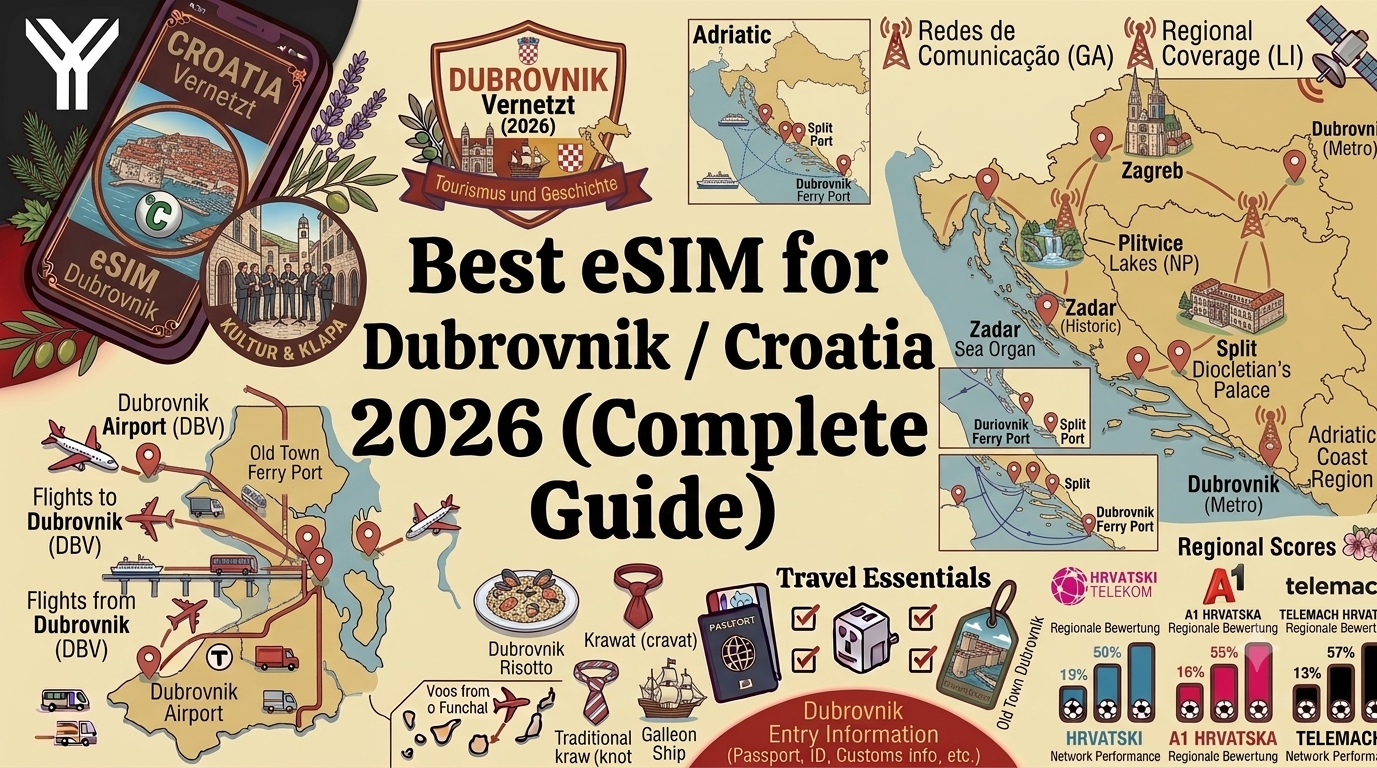
Croatia has become one of the most searched European summer destinations of 2026, and it is easy to understand why. The walled old town of Dubrovnik, the waterfalls of Plitvice Lakes National Park, the Roman ruins of Split, and a coastline dotted with hundreds of islands draw travelers looking for history, nature, and beach time in one trip. With Google Flights data showing Dubrovnik among the top trending destinations for US summer travelers in 2026, more visitors than ever are planning Croatian itineraries, and getting connected from the moment you land matters more than ever for navigating ferries, booking restaurants, and staying in touch.
This guide covers everything you need to know about using an eSIM in Croatia in 2026: which networks offer the best coverage in major cities and on the islands, what to expect at Dubrovnik and Split airports, how coverage holds up on ferries and along the coastal highway, and practical recommendations for tourists, island hoppers, sailors, and digital nomads.
TLDR: Best eSIM for Croatia in 2026
- Croatia has strong 4G and growing 5G coverage from Hrvatski Telekom (HT), A1, and Telemach across major cities and along the coast.
- Dubrovnik Airport and Split Airport both have reliable coverage throughout their terminals.
- Coverage along the Adriatic coastal highway is generally strong, though some inland mountain sections and remote islands have weaker signal.
- Ferries between the mainland and popular islands like Hvar, Korčula, and Brač generally maintain coverage close to shore, with brief gaps in open water.
- An eSIM activated before you fly means you are connected the moment you land, ready for ferry schedules, restaurant bookings, and navigating old town streets where GPS can be tricky.
- Recommended starting point: 5-10GB for a one-week trip; more if you plan extensive island hopping or video calls for remote work.
Why You Need an eSIM for Croatia
If you are traveling to Croatia from outside the European Union, your home carrier's roaming charges can be steep, often with daily fees and data caps that get throttled to unusable speeds once exceeded. Even EU residents whose plans include "roam like at home" benefits should check the fine print, since Croatia's status within the EU roaming zone means EU SIM cards typically work normally, but the same is not true for visitors from the UK, US, Canada, Australia, and most of Asia.
An eSIM lets you install a local or regional data plan onto your phone before you fly, activated via a QR code or link, without swapping your physical SIM. You keep your home number active for calls and texts while using the eSIM for fast data throughout your trip, including for navigating Dubrovnik's old town, where narrow stone streets can confuse GPS without a stable connection.
Who This Guide Is For
- Tourists visiting Dubrovnik's old town, Split's Diocletian's Palace, and Plitvice Lakes National Park.
- Island hoppers traveling by ferry between Hvar, Korčula, Brač, and other Adriatic islands.
- Sailors and charter guests exploring the Dalmatian coast by boat.
- Digital nomads using Croatia as a base for remote work, particularly in Split or Zagreb.
- Multi-country travelers combining Croatia with neighboring Slovenia, Montenegro, or Bosnia and Herzegovina.
Mobile Networks in Croatia: Coverage Overview
Croatia's mobile network infrastructure is well developed along the coast and in major cities, reflecting the country's heavy reliance on tourism, though some inland and mountainous regions have patchier coverage.
Hrvatski Telekom (HT)
Hrvatski Telekom, part of the Deutsche Telekom group, has the most extensive network in Croatia, with strong 4G and expanding 5G coverage across Zagreb, Split, Dubrovnik, and most of the coastline, including many of the larger islands.
A1 Croatia
A1 offers solid coverage in major cities and along the coast, with competitive data plans that make it a popular choice for both locals and eSIM providers.
Telemach
Telemach, the newest of the three major operators, has been expanding its network rapidly, with good coverage in urban areas and along main travel corridors, though it can be less consistent in remote inland areas compared to HT.
Network Coverage by Area
| Area | Best Coverage | 5G Availability | Notes |
|---|---|---|---|
| Dubrovnik Old Town and Airport | HT, A1 | Strong 4G, growing 5G | Old town's stone walls can cause minor signal dips in narrow alleys |
| Split and Diocletian's Palace | HT, A1, Telemach | Excellent 4G/5G | Dense coverage throughout the city center and ferry port |
| Zagreb | HT, A1, Telemach | Excellent 5G | Capital city has the country's most developed network infrastructure |
| Plitvice Lakes National Park | HT, A1 | Good near entrances, weaker on trails | Some forested trail sections have intermittent signal |
| Hvar, Korčula, and Brač (islands) | HT, A1 | Good in towns, variable inland | Coverage strong in port towns, weaker in island interiors |
| Adriatic coastal highway (A1 motorway) | HT, A1, Telemach | Strong along most of the route | Brief gaps possible in tunnel sections through coastal mountains |
| Ferries between islands | HT, A1 | Good near shore, gaps in open water | Coverage generally returns quickly as ferries approach ports |
City and Region Connectivity Guide
Dubrovnik
Dubrovnik's old town, a UNESCO World Heritage Site enclosed by massive stone walls, is one of Croatia's most photographed destinations. Coverage throughout the old town is generally strong, though the dense stone construction and narrow alleys can occasionally cause brief signal dips, particularly for GPS accuracy. Dubrovnik Airport, about twenty kilometers from the old town, has reliable coverage throughout its terminal, and the airport bus route into the city maintains good signal along the way.
Split
Split serves as both a major destination in its own right, home to the Roman-era Diocletian's Palace, and a key transit hub for ferries to the islands. The city center and ferry port have excellent coverage, making it easy to check ferry schedules and book last-minute accommodation while waiting to board.
Zagreb
Croatia's capital, often overlooked by coastal-focused itineraries, has the country's best network infrastructure, reflecting its role as the business and administrative center. Visitors combining a few days in Zagreb with coastal travel will find the transition from excellent inland coverage to slightly more variable coastal and island coverage notable.
Plitvice Lakes National Park
One of Croatia's most visited natural attractions, Plitvice Lakes features a network of turquoise lakes and waterfalls connected by wooden walkways. Coverage near the park entrances and visitor centers is generally good, but some of the longer forested trail sections have intermittent signal, so downloading the park map in advance is a sensible precaution.
The Dalmatian Islands: Hvar, Korčula, and Brač
Croatia's islands are a major draw for ferry-hopping itineraries, with Hvar known for its nightlife and lavender fields, Korčula for its old town and wine, and Brač for the famous Zlatni Rat beach. Coverage in the main port towns of each island is generally reliable, but venturing into island interiors, particularly for hiking or exploring smaller villages, can mean weaker or no signal in places.
Choosing the Right eSIM Plan for Croatia
Short Trips (3-5 Days)
For a quick trip focused on Dubrovnik or Split alone, a 3-5GB plan is usually sufficient for navigation, messaging, and browsing.
Island-Hopping Itineraries (1-2 Weeks)
If your trip includes multiple islands by ferry, plus stops in Split, Dubrovnik, and possibly Zagreb, a 8-12GB plan gives comfortable headroom, particularly for checking ferry schedules, booking accommodation on the fly, and sharing photos.
Sailors and Charter Guests
If you are sailing the Dalmatian coast, a slightly larger allowance is useful for checking weather forecasts and marina information regularly, since conditions can change quickly and many marinas rely on online booking systems for berths.
Digital Nomads
For remote workers basing themselves in Split or Zagreb for several weeks, a larger data plan or a plan with the option to top up is worth considering, particularly if your accommodation's WiFi is inconsistent, which can happen in older buildings in historic centers.
Real-World Scenarios: How Travelers Use eSIMs in Croatia
Scenario 1: The First-Time Dubrovnik Visitor
Emma flies into Dubrovnik from the UK for a five-day trip focused on the old town and a day trip to the Elaphiti Islands. With her eSIM activated before departure, she is online as soon as she lands, using the airport bus's route information and booking a restaurant for her first evening. She uses about 2GB over five days on a 5GB plan, finding coverage strong throughout the old town and on the day trip boat.
Scenario 2: The Island-Hopping Couple
Marco and Sofia spend ten days traveling from Split to Hvar, then Korčula, before returning to Split. They rely on their eSIMs constantly for ferry booking apps, restaurant recommendations, and sharing photos with family. They find coverage strong in all three port towns, with brief gaps during the ferry crossings themselves. An 8GB plan covers their trip comfortably.
Scenario 3: The Sailing Charter Group
A group of friends charters a sailboat from Split for a week, island-hopping along the central Dalmatian coast. They use their eSIMs daily for weather forecasts and marina booking apps, finding coverage generally good near the coast and in marinas, with predictable gaps in more remote anchorages. A 10GB plan shared across the group's devices proves sufficient.
Scenario 4: The Remote Worker in Split
Aiko, a digital nomad, spends three weeks working from a co-working space in Split while exploring the surrounding area on weekends. She finds her eSIM's data useful as a backup when the co-working space's WiFi occasionally drops, and uses it for video calls during a weekend trip to Plitvice Lakes, where coverage near the visitor center is strong enough for calls, though she avoids scheduling calls during the hiking portions of the day.
Tips and Best Practices
Before You Travel
- Install your eSIM profile over WiFi before departure, since activation requires an internet connection.
- Confirm your phone is unlocked and eSIM-compatible. Most iPhones from the XS onward and recent flagship Android phones support eSIM.
- If your itinerary includes Plitvice Lakes or remote island areas, download offline maps in advance, since coverage in these areas can be intermittent.
While in Croatia
- Expect brief signal gaps during ferry crossings between islands, particularly in open water away from shore. This is normal and coverage typically returns as you approach the next port.
- Dubrovnik's old town has narrow stone streets that can confuse GPS even with good signal. Cross-referencing your map with visible landmarks helps when navigating.
- Many cafes and restaurants along the coast offer free WiFi, which can help conserve your data allowance, though speeds can vary significantly between venues.
Common Issues and Troubleshooting
- No signal after landing: Make sure data roaming is enabled for your eSIM line in your phone's settings, the most common cause of connectivity issues on arrival.
- Signal drops on ferries: This is typically a genuine coverage gap in open water rather than an eSIM issue, and resolves as the ferry approaches port.
- GPS seems inaccurate in Dubrovnik's old town: This is common in dense historic centers with tall stone walls. Use visible landmarks alongside your map app for the most reliable navigation.
- eSIM not activating: Confirm your device's date and time are set to automatic, as incorrect settings can prevent network registration.
Croatia Travel Recommendations Beyond Connectivity
Beyond the well-known highlights, Croatia rewards visitors who explore beyond Dubrovnik and Split. The Pelješac Peninsula, known for its vineyards and oyster farms, makes for an excellent day trip from Dubrovnik, while the Istrian Peninsula in the north offers a different pace entirely, with hilltop towns, truffle hunting, and a noticeably Italian-influenced food culture. If you are visiting during peak summer months, July and August bring large crowds to Dubrovnik's old town and the most popular islands, so visiting in June or September, when Dubrovnik was trending for 2026 travel, can mean a more comfortable experience with similar weather.
Sailing, Ferries, and the Dalmatian Coast
Croatia's coastline, with its more than a thousand islands, is one of the most popular sailing destinations in Europe, and ferry travel is a normal part of most itineraries even for travelers not chartering their own boat. Jadrolinija, Croatia's main ferry operator, runs routes connecting the mainland to nearly all inhabited islands, and most of these routes maintain coverage close to shore, with predictable gaps during the middle of longer crossings. For sailors, marinas along the coast generally have good coverage, useful for checking weather forecasts before setting out each day, since conditions on the Adriatic can change with little warning.
Inland Croatia: Zagreb and the Continental Interior
While most international visitors focus on the coast, Croatia's interior offers its own appeal, from Zagreb's café culture and museums to the rolling hills of the Zagorje region near the Slovenian border. Coverage throughout inland Croatia is generally excellent, particularly around Zagreb, and travelers combining a coastal trip with a few days inland will find the transition seamless from a connectivity standpoint.
Combining Croatia with Neighboring Countries
Croatia's location makes it a natural base for exploring neighboring Slovenia, Montenegro, and Bosnia and Herzegovina, all reachable by road in a few hours from the coast. If your itinerary crosses borders, check whether your eSIM plan covers the specific countries on your route, since coverage and plan validity can vary by provider even within otherwise similar regional plans. A regional Europe eSIM from Esimify can simplify multi-country itineraries by covering several Balkan and EU destinations under a single plan.
Frequently Asked Questions
Does my phone support eSIM in Croatia?
Most smartphones from 2019 onward, including iPhone XS and later and most flagship Samsung and Google Pixel devices, support eSIM. Check your device settings under "Mobile Data" or "Cellular," or search your phone model plus "eSIM compatible" to confirm.
Will my eSIM work on ferries between Croatian islands?
Generally yes near the coast and as ferries approach ports. Brief gaps during open-water crossings are normal and not specific to any eSIM or carrier.
How much data do I need for a week in Croatia?
For typical tourist use, including navigation, messaging, and browsing, 5-8GB is usually sufficient for a week. If your trip involves extensive island hopping or remote work video calls, consider 10GB or more.
Is Dubrovnik Airport well covered for eSIM activation?
Yes, Dubrovnik Airport has reliable coverage from major Croatian carriers throughout its terminal, so your eSIM should connect automatically as soon as your phone detects a local tower after landing.
Will my eSIM work inside Dubrovnik's old town?
Yes, coverage throughout the old town is generally strong, though the dense stone walls and narrow alleys can occasionally cause brief signal dips that affect GPS accuracy more than data connectivity itself.
Do I need a different eSIM for Plitvice Lakes National Park?
No, the same eSIM that covers the rest of Croatia works at Plitvice Lakes, though coverage on some of the longer forested trails can be intermittent. Download the park map in advance as a precaution.
Can I use the same eSIM for Croatia and neighboring countries like Slovenia or Montenegro?
It depends on your plan. Some eSIM plans are country-specific, while regional Europe plans cover multiple countries, including several Balkan destinations. Check your plan's coverage list before crossing borders, and consider a regional Europe eSIM for multi-country trips.
Is it better to buy a physical SIM card in Croatia instead of using an eSIM?
An eSIM is generally more convenient, since it activates automatically before you even reach the arrivals hall, whereas buying a physical SIM means finding a kiosk or shop, which can take time, especially during peak tourist season when local stores can be busy.
Conclusion
Croatia's coastline and major cities have well-developed mobile networks that make staying connected straightforward for most of your trip, with the main exceptions being open-water ferry crossings, some island interiors, and forested trail sections at Plitvice Lakes. Setting up an eSIM before you travel means you can be online from the moment you land in Dubrovnik, Split, or Zagreb, ready to navigate, book, and share your trip from day one.
Whether you are exploring the old town walls of Dubrovnik, island-hopping the Dalmatian coast, or basing yourself in Split for a few weeks of remote work, choosing the right eSIM plan keeps your trip running smoothly. Browse Esimify's eSIM plans for Croatia and Europe, and check out the Esimify travel blog for more guides, including our coverage of other top 2026 European destinations.