Best eSIM for Vietnam 2026: Staying Connected from Hanoi to Da Nang and Ho Chi Minh City
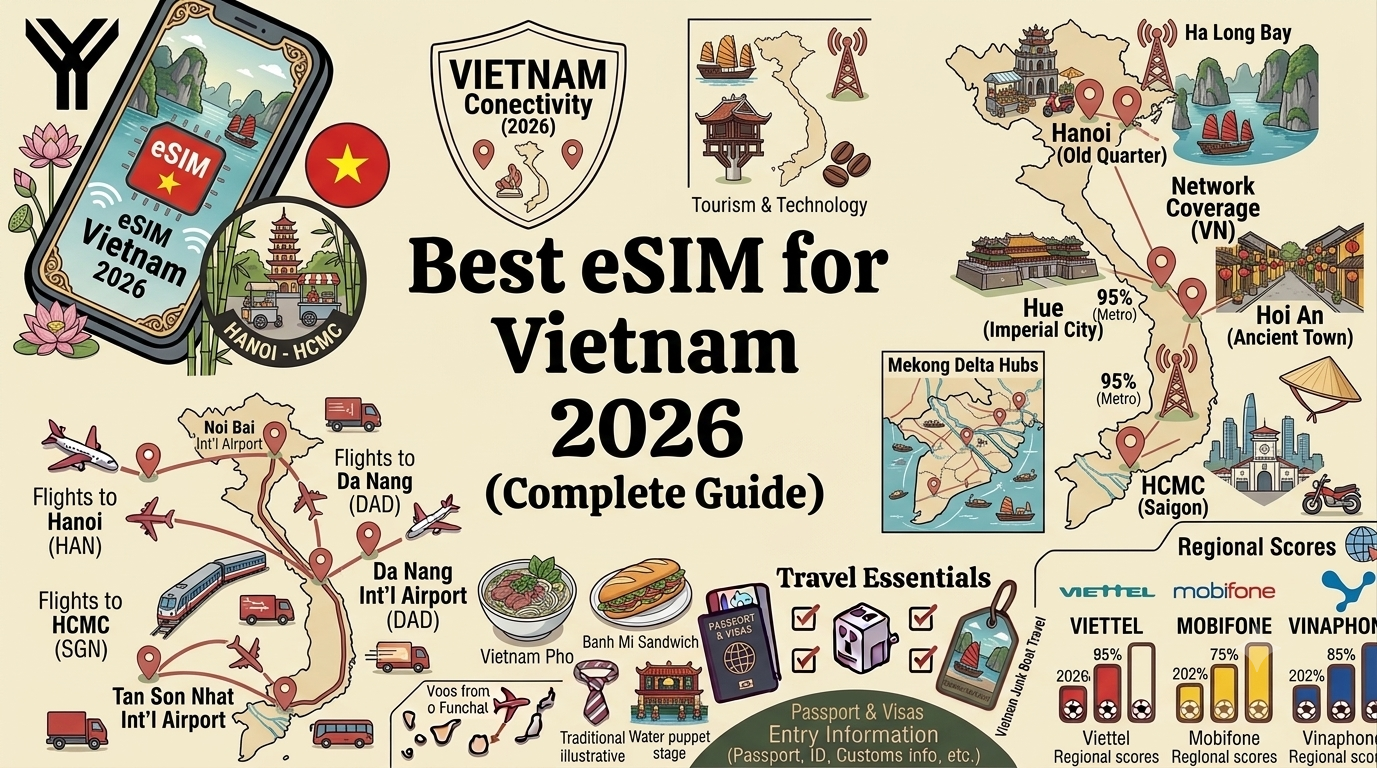
Vietnam has become one of the most talked-about destinations for travelers and digital nomads heading into 2026, combining a low cost of living, fast urban internet, rich culture, and easy e-visa access for most passport holders. From the chaotic charm of Hanoi's Old Quarter to the beaches and growing nomad scene in Da Nang, and the energy of Ho Chi Minh City in the south, Vietnam offers a wide range of experiences across a relatively compact country, and a reliable connection makes navigating all of it considerably easier.
This guide covers everything you need to know about using an eSIM in Vietnam in 2026: which networks offer the best coverage in major cities and along popular travel routes, what to expect at the country's main international airports, how coverage holds up in rural and mountainous areas, and practical recommendations for tourists, digital nomads, and motorbike travelers.
TLDR: Best eSIM for Vietnam in 2026
- Vietnam has strong 4G and expanding 5G coverage from Viettel, Vinaphone, and Mobifone across all major cities and most of the country.
- Noi Bai International Airport (Hanoi), Tan Son Nhat International Airport (Ho Chi Minh City), and Da Nang International Airport all have reliable coverage throughout their terminals.
- Viettel generally offers the most extensive coverage in rural and mountainous areas, making it a strong choice for travelers planning routes through Sapa, Ha Giang, or the Central Highlands.
- An eSIM activated before you fly means you are connected the moment you land, useful for rideshare apps, hotel bookings, and navigating cities where traffic and street layouts can be overwhelming for first-time visitors.
- Recommended starting point: 5-10GB for a one to two week trip; more for digital nomads or motorbike travelers covering long distances.
Why You Need an eSIM for Vietnam
If you are traveling to Vietnam from outside the country, your home carrier's roaming charges can be high, often with daily fees that add up quickly over a multi-week trip. While local SIM cards are inexpensive and widely available, buying one at the airport can mean navigating unfamiliar kiosks and registration requirements right after a long flight.
An eSIM lets you install a Vietnamese or regional data plan onto your phone before you fly, activated via a QR code or link, without swapping your physical SIM. You keep your home number active for calls and texts while using the eSIM for fast data throughout your trip, including for ridesharing and food delivery apps like Grab, which are widely used across Vietnam's major cities.
Who This Guide Is For
- Tourists visiting Hanoi, Ho Chi Minh City, Hoi An, and Ha Long Bay.
- Digital nomads basing themselves in Da Nang or Ho Chi Minh City for weeks or months.
- Motorbike travelers riding routes through the Central Highlands, Ha Giang Loop, or the full north-to-south Vietnam route.
- Backpackers traveling overland between Vietnam and neighboring Cambodia or Laos.
- Business travelers visiting Vietnam's growing manufacturing and tech hubs.
Mobile Networks in Vietnam: Coverage Overview
Vietnam's mobile network infrastructure is among the more developed in Southeast Asia, with all three major carriers offering strong 4G and growing 5G coverage in cities, and reasonably good coverage even in many rural areas thanks to years of infrastructure investment.
Viettel
Viettel is Vietnam's largest carrier, both state-owned and the most extensive in terms of coverage, particularly in rural, mountainous, and remote areas. For travelers planning routes through northern mountain regions like Sapa or Ha Giang, Viettel is generally the most reliable choice.
Vinaphone
Vinaphone offers strong coverage in cities and along major travel routes, with competitive data plans popular among both locals and tourists.
Mobifone
Mobifone provides good coverage in urban areas and is known for strong performance in Vietnam's larger cities, including Hanoi and Ho Chi Minh City.
Network Coverage by Area
| Area | Best Coverage | 5G Availability | Notes |
|---|---|---|---|
| Hanoi and Old Quarter | Viettel, Vinaphone, Mobifone | Strong 4G, growing 5G | Dense coverage throughout the capital's busy streets |
| Ho Chi Minh City | All major carriers | Strong 4G, growing 5G | Vietnam's largest city has extensive infrastructure |
| Da Nang and Hoi An | Viettel, Mobifone | Good 4G, 5G in Da Nang | Da Nang's growing nomad scene benefits from solid infrastructure |
| Ha Long Bay | Viettel | Good near shore, weaker on open water | Coverage drops between karst islands during boat tours |
| Sapa and Ha Giang Loop (mountains) | Viettel | Variable, weaker at higher elevations | Most towns have coverage, mountain passes can have gaps |
| Noi Bai, Tan Son Nhat, Da Nang Airports | All major carriers | Full coverage across terminals | Reliable connection immediately upon arrival |
| Mekong Delta | Viettel, Vinaphone | Good in towns, variable on rivers | River-based travel can have intermittent coverage |
City-by-City Connectivity Guide
Hanoi
Vietnam's capital, with its chaotic but charming Old Quarter, has dense network coverage throughout, even in the narrow alleyways packed with street food vendors and motorbikes. Navigation apps are essential here given how confusing the Old Quarter's street layout can be for first-time visitors, and coverage remains reliable even in the busiest areas.
Ho Chi Minh City
As Vietnam's largest and most economically dynamic city, Ho Chi Minh City has excellent coverage throughout its districts, from the backpacker hub of District 1 to the more residential areas further out. The city's scale means rideshare apps are particularly useful here, and a stable connection makes coordinating pickups much easier.
Da Nang and Hoi An
Da Nang has emerged as a particular favorite among digital nomads who want beach access alongside reliable work infrastructure, and the city's coverage reflects this, with strong 4G and growing 5G availability. Nearby Hoi An, known for its lantern-lit old town, also has good coverage throughout its compact center.
Ha Long Bay
Ha Long Bay's dramatic limestone karsts are one of Vietnam's most iconic sights, typically visited via overnight boat cruises. Coverage near the shore and departure points is generally good, but signal can drop intermittently between the islands during the cruise itself, which is worth knowing if you are hoping to share photos in real time.
Sapa and the Ha Giang Loop
Vietnam's northern mountain regions, popular for trekking and motorbike loops through dramatic terraced rice fields, have more variable coverage. Towns along these routes generally have signal, but mountain passes between them can have gaps, making offline maps essential for anyone riding the Ha Giang Loop independently.
Choosing the Right eSIM Plan for Vietnam
Short Trips (1-2 Weeks)
For a typical one to two week trip covering Hanoi, Hoi An, and Ho Chi Minh City, a 5-10GB plan is usually sufficient for navigation, rideshares, messaging, and social media.
Digital Nomads (1+ Months)
For remote workers basing themselves in Da Nang or Ho Chi Minh City, look for plans with larger data allowances or the ability to top up, particularly useful as a backup for video calls when co-working space or accommodation WiFi has issues.
Motorbike and Overland Travelers
If your trip includes the Ha Giang Loop, Central Highlands, or a full north-to-south overland route, a larger allowance helps cover navigation through areas where coverage may be less consistent, and downloading offline maps for mountain sections is strongly recommended regardless of plan size.
Multi-Country Southeast Asia Trips
If your itinerary extends into Cambodia, Laos, or Thailand, a regional Southeast Asia eSIM can simplify border crossings by covering multiple countries under a single plan, avoiding the need to switch eSIMs at each border.
Real-World Scenarios: How Travelers Use eSIMs in Vietnam
Scenario 1: The Classic North-to-South Itinerary
Tom and Lena spend three weeks traveling from Hanoi to Ho Chi Minh City, stopping in Hoi An and Da Nang along the way. With their eSIMs activated before departure, they are online from the moment they land in Hanoi, using Grab for rides and navigation throughout. They find coverage strong in every city, with brief gaps only during their Ha Long Bay cruise. An 8GB plan each covers their trip comfortably.
Scenario 2: The Digital Nomad in Da Nang
Anya, a freelance designer, spends two months working from Da Nang, splitting time between a co-working space and a rented apartment near the beach. She relies on her eSIM as a backup connection for client calls, particularly useful during occasional power outages that affect her apartment's WiFi router but not her phone's cellular connection.
Scenario 3: The Ha Giang Loop Motorbike Trip
A group of friends rents motorbikes for a four-day loop through Ha Giang province, riding through some of Vietnam's most dramatic mountain scenery. They find coverage reliable in towns where they stop for the night, but experience gaps on several mountain passes. Having downloaded offline maps in advance proves essential, and their eSIMs reconnect as soon as they descend into the next valley.
Scenario 4: The Business Traveler in Ho Chi Minh City
Raj visits Ho Chi Minh City for a week of meetings with manufacturing partners, staying in District 1 and traveling to factories on the outskirts of the city. He finds coverage strong throughout the city center and reasonably consistent even in the more industrial outer districts, using his eSIM for email, navigation, and video calls between meetings.
Tips and Best Practices
Before You Travel
- Install your eSIM profile over WiFi before departure, since activation requires an internet connection.
- Confirm your phone is unlocked and eSIM-compatible. Most iPhones from the XS onward and recent flagship Android phones support eSIM.
- If your trip includes the Ha Giang Loop, Sapa, or other mountain routes, download offline maps in advance, since coverage on mountain passes can be intermittent.
While in Vietnam
- Download Grab before you arrive, since it is widely used for rides, food delivery, and even some courier services across major cities.
- Traffic in Hanoi and Ho Chi Minh City can be intense, and having reliable navigation data helps when crossing busy streets or finding specific addresses, which can be tricky given how Vietnamese addresses are sometimes structured.
- Many cafes in Da Nang, Hanoi, and Ho Chi Minh City offer free WiFi, which can help conserve your data allowance, particularly useful for digital nomads working from cafes.
Common Issues and Troubleshooting
- No signal after landing: Make sure data roaming is enabled for your eSIM line in your phone's settings, the most common cause of connectivity issues on arrival.
- Signal drops on Ha Long Bay cruises or mountain passes: This is a genuine coverage gap in remote or open-water areas rather than an eSIM issue, and resolves once you return to areas with better infrastructure.
- eSIM not activating: Confirm your device's date and time are set to automatic, as incorrect settings can prevent network registration.
- Slow speeds in very crowded areas: During major holidays like Tet, network congestion in busy areas can slow speeds temporarily, particularly in city centers.
Vietnam Travel Recommendations Beyond Connectivity
Beyond the well-trodden Hanoi to Ho Chi Minh City route, Vietnam rewards visitors who venture further: the Phong Nha-Ke Bang National Park in central Vietnam has some of the world's largest caves, the Mekong Delta offers a slower-paced look at rural Vietnamese life via boat trips through floating markets, and the Central Highlands around Da Lat offer a cooler climate and coffee plantations that feel worlds away from the coastal cities. If you are visiting during the rainy season, which varies by region but generally affects central and southern Vietnam from May through November, having reliable weather data helps you plan around sudden downpours.
E-Visa Requirements and Practical Considerations
Vietnam's e-visa system has made entry considerably more straightforward for most passport holders, with online applications processed in advance of travel. Having a working connection from the moment you land makes it easier to show e-visa confirmations, complete any arrival paperwork digitally, and access accommodation booking confirmations, all of which can otherwise mean fumbling with printed documents or relying on spotty airport WiFi.
Vietnam's Growing Digital Nomad Scene
Da Nang's emergence as a nomad destination reflects a broader trend across Vietnam, where the combination of low costs, improving infrastructure, and a growing number of co-working spaces has made extended stays increasingly practical. Ho Chi Minh City offers a more urban alternative with a larger expat community and more extensive business infrastructure. In both cases, a dependable eSIM serves as a backup connection for the inevitable moments when local WiFi is unreliable, which remains more common in Vietnam than in some neighboring countries despite rapid improvements.
Getting Around Vietnam
Domestic flights connect Vietnam's major cities quickly, while overnight trains and buses are popular for budget travelers covering longer distances. Motorbike rental is extremely common, both for short trips within cities and for multi-day loops through scenic regions, and having a reliable data connection for navigation is close to essential given how different Vietnam's road systems can be from what many international visitors are used to.
Frequently Asked Questions
Does my phone support eSIM in Vietnam?
Most smartphones from 2019 onward, including iPhone XS and later and most flagship Samsung and Google Pixel devices, support eSIM. Check your device settings under "Mobile Data" or "Cellular," or search your phone model plus "eSIM compatible" to confirm.
Which carrier has the best coverage in Vietnam?
Viettel generally offers the most extensive coverage, particularly in rural and mountainous areas, making it a strong choice for travelers planning routes through Sapa, Ha Giang, or the Central Highlands. Vinaphone and Mobifone both offer strong coverage in cities.
How much data do I need for a trip to Vietnam?
For typical tourist use over one to two weeks, including navigation, rideshares, and social media, 5-10GB is usually sufficient. Digital nomads or motorbike travelers covering long distances should consider larger plans.
Are Vietnam's international airports well covered for eSIM activation?
Yes, Noi Bai (Hanoi), Tan Son Nhat (Ho Chi Minh City), and Da Nang International Airport all have reliable coverage from major carriers throughout their terminals, so your eSIM should connect automatically as soon as your phone detects a local tower after landing.
Will my eSIM work on the Ha Giang Loop or in Sapa?
Coverage in towns along these routes is generally reliable, particularly on Viettel, but mountain passes between towns can have gaps. Download offline maps before riding these routes independently.
Can I use Grab with an eSIM in Vietnam?
Yes, Grab works normally over eSIM data, the same as it would over a local physical SIM, and is widely used across Vietnam's major cities for rides and food delivery.
Is it better to buy a local SIM card in Vietnam instead of using an eSIM?
An eSIM is generally more convenient, since it activates automatically before you even leave the airport, whereas buying a local SIM requires finding a registered vendor and completing registration, which can take time after a long flight.
Can I use the same eSIM for Vietnam and neighboring Cambodia or Laos?
It depends on your plan. Some eSIM plans are country-specific, while regional Southeast Asia plans cover multiple countries. Check your plan's coverage list before crossing borders, and consider a regional Southeast Asia eSIM for multi-country trips.
Conclusion
Vietnam's major cities and most travel routes have well-developed mobile networks that make staying connected straightforward for the majority of your trip, with coverage gaps mainly limited to mountain passes, open water during boat cruises, and the most remote stretches of routes like the Ha Giang Loop. Setting up an eSIM before you travel means you can be online from the moment you land in Hanoi, Ho Chi Minh City, or Da Nang, ready to navigate, book, and share your trip from day one.
Whether you are exploring Hanoi's Old Quarter, settling into Da Nang's growing nomad scene, or riding through the mountains of the north, choosing the right eSIM plan keeps your trip running smoothly. Browse Esimify's eSIM plans for Vietnam and Southeast Asia, and check out the Esimify travel blog for more guides, including our coverage of Thailand, Bali, and other top Southeast Asian destinations.