Best eSIM for California 2026: Coverage in Los Angeles, San Francisco, San Diego & Beyond
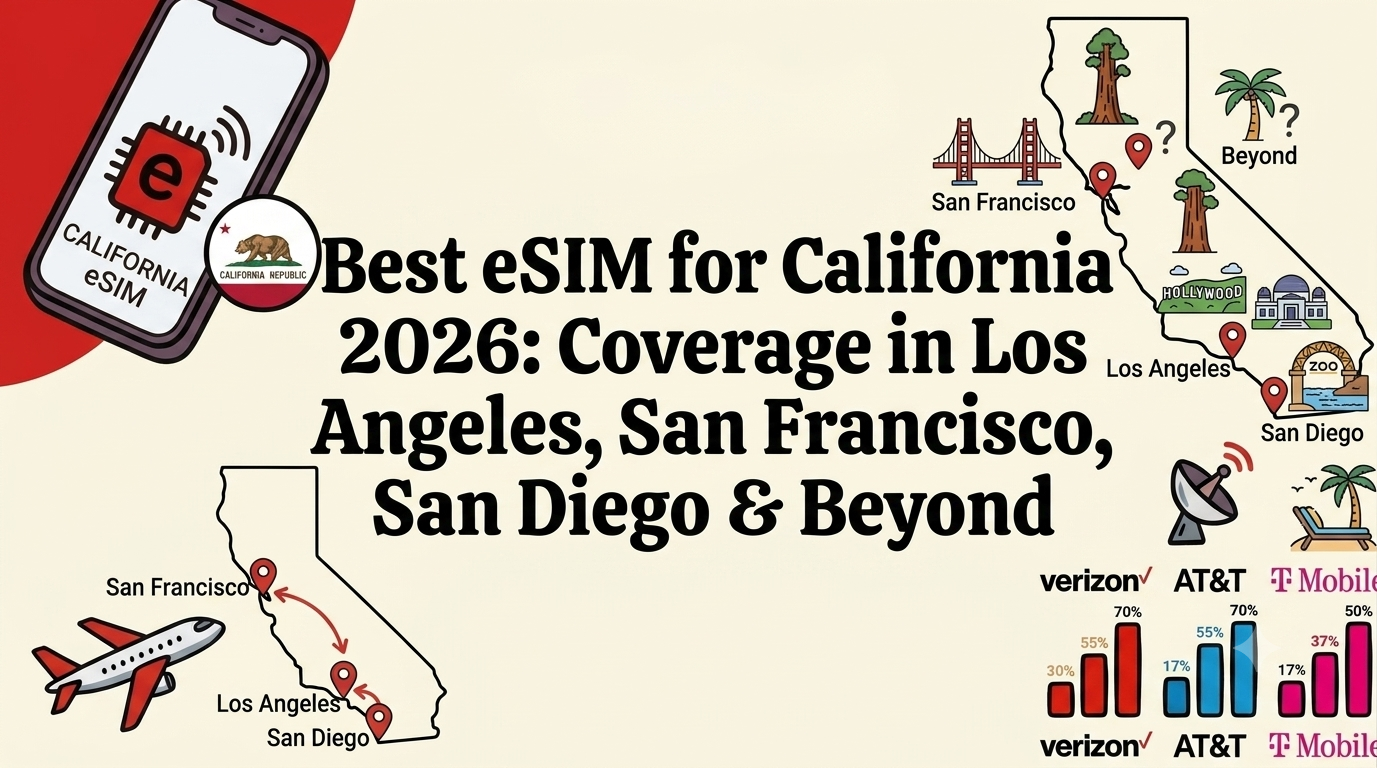
California is the most visited state in the US, receiving over 260 million domestic and international visitors annually. It is also one of the most geographically varied: you can drive from the Pacific Coast Highway in Malibu to the granite peaks of Yosemite in about four hours, from the wine country of Napa Valley to the deserts of Joshua Tree in under five. That variety is what makes California extraordinary and it is also what makes planning your connectivity essential.
International visitors arriving in Los Angeles or San Francisco face a state that is simultaneously one of the best-connected places on Earth (downtown LA, San Francisco's Financial District, Silicon Valley) and one that hides some serious coverage dead zones (Yosemite Valley in high season, Highway 1 through Big Sur, Death Valley). An eSIM set up before you leave home means you have data from the moment you step off the plane at LAX, SFO, or SAN.
This guide covers the best eSIM options for California in 2026, including which networks perform best in Los Angeles, the San Francisco Bay Area, San Diego, and the state's iconic outdoor destinations.
TLDR: eSIM for California at a Glance
- Best for Los Angeles: T-Mobile and AT&T both offer excellent 5G across the LA metro
- Best for San Francisco Bay Area: T-Mobile and Verizon both perform strongly; AT&T solid
- Best for San Diego: All three networks are excellent
- Yosemite Valley: Limited signal; download offline maps and trails before you arrive
- Big Sur / Highway 1: Extended coverage gaps; treat this as an offline zone
- Recommended data: 10GB to 20GB for a week in California cities; unlimited for a month-long stay
- Activate before departure: eSIM works from the moment you land
Why You Need an eSIM for California
California runs on apps. Parking in Los Angeles requires ParkMobile or SpotHero. Riding the BART subway in the Bay Area uses Clipper Card. Getting around San Diego's Gaslamp Quarter means Uber or Lyft. Getting into Yosemite National Park since 2023 requires a timed-entry reservation booked through recreation.gov, which requires internet access. Even getting a table at many of California's top restaurants requires an app-based reservation through Resy or OpenTable.
For international travelers, the path of least resistance is a travel eSIM. You purchase it online before leaving home, receive a QR code by email, scan it on your phone, and activate a data plan that runs on T-Mobile or AT&T infrastructure. No carrier store visit, no US credit card required, no SIM card to lose on a beach in Santa Monica.
The Esimify platform offers US data plans that connect to these major US networks, giving you the same infrastructure as local carrier customers without the local contract.
California Network Coverage: T-Mobile, AT&T, and Verizon
California is T-Mobile's home turf in many ways: the company has invested aggressively in its 5G mid-band (2.5GHz) network along the state's major coastal corridors and in the Central Valley. AT&T also has strong infrastructure throughout the state. Verizon's strength in California is particularly evident in rural and inland areas.
T-Mobile in California
T-Mobile leads for 5G performance in Los Angeles, the San Francisco Bay Area (including Silicon Valley), San Diego, Sacramento, Fresno, Bakersfield, and along the I-5 and I-101 corridors. The network's extended range 5G (low-band) keeps you connected across much of the state's geography. T-Mobile is usually the recommendation for travelers focused on California's major cities and the coastal route.
AT&T in California
AT&T has strong 5G in Los Angeles (including Disneyland in Anaheim), San Francisco, San Jose, San Diego, and along the major freeway corridors. AT&T also performs well in the Sacramento metro and Central Valley agricultural communities. Its coverage in the mountainous areas of the Sierra Nevada (around Lake Tahoe, Mammoth Lakes) can be solid where T-Mobile fades.
Verizon in California
Verizon has the broadest geographic footprint in California and performs particularly well in rural inland areas, the Central Valley wine country, and stretches of the desert. In cities, Verizon's 5G Ultra Wideband is available in dense downtown areas of LA and San Francisco but the mmWave coverage is limited in range. For travelers prioritizing coverage breadth over raw speed, Verizon is a strong choice.
California Coverage Comparison by Region
| Region / City | T-Mobile | AT&T | Verizon | Verdict |
|---|---|---|---|---|
| Los Angeles (downtown, Hollywood, Santa Monica) | Excellent 5G | Excellent 5G | Strong 5G | T-Mobile and AT&T tie; both excellent |
| San Francisco (SOMA, FiDi, Mission, Castro) | Excellent 5G | Strong 5G | Excellent 5G | T-Mobile and Verizon both top choices |
| Silicon Valley (San Jose, Palo Alto, Mountain View) | Excellent | Excellent | Strong | Any network works well |
| San Diego (Gaslamp, La Jolla, Balboa Park) | Excellent | Excellent | Excellent | All three are outstanding |
| Disneyland / Anaheim | Excellent | Excellent | Good | T-Mobile and AT&T perform better in high-density park environment |
| Yosemite National Park | Patchy (Valley floor only) | Patchy | Patchy | Download offline maps before arriving |
| Napa Valley / Wine Country | Good to strong | Good to strong | Strong | All three usable; Verizon broadest |
| Big Sur / Highway 1 | Very limited | Very limited | Very limited | Plan for no coverage on most of this route |
| Lake Tahoe / Sierra Nevada | Good in town | Good in town | Strong in town | Signal drops significantly on mountain trails |
| Joshua Tree National Park | Weak | Weak | Weak | Offline-only zone; download maps ahead of time |
Los Angeles: Connectivity in the World's Entertainment Capital
Los Angeles is one of the most sprawling metropolitan areas in the world, covering over 4,700 square miles when you include the greater metro. Getting around without Google Maps is essentially impossible, and rideshare apps are a daily necessity for most visitors given LA's limited public transit network compared to European cities.
5G coverage across the core of Los Angeles is excellent on T-Mobile and AT&T. This includes Downtown LA and the Arts District, Hollywood and the Hollywood Hills, West Hollywood, Beverly Hills, Santa Monica and Venice Beach, Culver City, Koreatown, Silver Lake, Los Feliz, Echo Park, and Griffith Park. The I-405 and I-10 freeway corridors are well covered throughout.
For international visitors, the key data-hungry moments in Los Angeles include booking same-day restaurant reservations (LA's dining scene runs on Resy), navigating to attractions like the Getty Center, LACMA, the Broad Museum, and the Grammy Museum, using the Metro subway system via the TAP card app, and navigating parking situations with SpotHero or ParkMobile. Coverage in Disneyland in nearby Anaheim is strong, and T-Mobile performs particularly well inside the park itself.
The Pacific Coast Highway between Santa Monica and Malibu has good coverage throughout, making the scenic drive up through Malibu Creek State Park and Zuma Beach fully connected. One area to be aware of: Mulholland Drive through the Santa Monica Mountains has coverage gaps in some stretches due to the terrain.
San Francisco Bay Area: Silicon Valley's Wireless Infrastructure
It should come as no surprise that the San Francisco Bay Area has some of the best wireless infrastructure in the country. The region is home to the headquarters of T-Mobile's partner companies, Google, Apple, Meta, and most of the major US tech sector. Coverage in San Francisco proper, Silicon Valley, and the East Bay is consistently strong across all three major networks.
San Francisco covers 47 square miles and is one of the most walkable and transit-connected cities in the US. The BART rail system, Muni buses and streetcars, and the iconic cable cars all serve the city well, and having data is essential for planning routes, checking transit apps, and navigating between neighborhoods. Popular visitor areas including Fisherman's Wharf, the Embarcadero, the Ferry Building, North Beach, Chinatown, Union Square, the Haight-Ashbury, the Castro, Mission District, and SoMa all have excellent 5G coverage.
The Golden Gate Bridge and the Marin Headlands on the northern side have solid coverage throughout. Alcatraz Island, accessible by ferry from Pier 33, has good AT&T and T-Mobile signal from the island itself. The bay crossing on the ferry from the Ferry Building to Sausalito or Tiburon maintains signal throughout.
In Silicon Valley, the communities of San Jose, Palo Alto, Mountain View, Sunnyvale, and Cupertino (home to Apple's headquarters and the Apple Park Visitor Center) all have exceptional coverage. The Computer History Museum in Mountain View and the Tech Interactive in San Jose are both in strong 5G zones.
East Bay cities including Oakland and Berkeley are well served by T-Mobile and AT&T. The drive across the Bay Bridge and the BART tunnels under the bay have signal throughout (a genuine technical achievement).
San Diego: Where Coverage Meets the Pacific
San Diego is California's second-largest city and sits just 20 miles from the US-Mexico border at Tijuana. The city has excellent wireless coverage across all three major networks, making it one of the easiest places in California to stay connected. The Gaslamp Quarter downtown, Little Italy, Balboa Park and its cluster of world-class museums, the Zoo San Diego, La Jolla Cove, Pacific Beach, Mission Bay, and Old Town San Diego all sit within strong 5G zones.
The USS Midway Museum on the harbor and the New Children's Museum downtown are both well covered. If you are visiting Torrey Pines State Natural Reserve for hiking above the cliffs, signal is available on the overlook trails. Point Loma and Cabrillo National Monument have T-Mobile and AT&T coverage throughout.
Coronado Island, connected to downtown San Diego by the distinctive Coronado Bridge, has strong coverage across the island including the beach and the Hotel del Coronado. The Silver Strand beach corridor down to Imperial Beach maintains coverage throughout.
Yosemite National Park: Planning Your Offline Visit
Yosemite is one of the most photographed places in the world and one of the most coverage-deprived. The park receives over four million visitors annually and yet wireless connectivity inside the valley remains extremely limited.
Yosemite Valley, where most visitors spend the majority of their time, has some AT&T signal near Yosemite Village and the Valley Visitor Center. T-Mobile and Verizon have very limited to no service in most of the valley. The free park Wi-Fi at Yosemite Village and at Yosemite Valley Lodge is the main connectivity option for most visitors.
Outside the valley, coverage improves as you approach entry points. The Highway 120 Big Oak Flat entrance from the west has coverage near Groveland. The Highway 41 south entrance near Wawona has some signal. The Tioga Road over the Sierra Nevada crest to the eastern side has essentially no coverage until you descend into Lee Vining on US-395.
The practical strategy for Yosemite: book your timed-entry reservation well in advance through recreation.gov (required from late spring through early fall). Download the National Park Service Yosemite app and the AllTrails app with offline maps for every trail you plan to hike. Download offline Google Maps for the park and surrounding area. Upload your photos at your hotel or lodge in the evening when Wi-Fi is available.
Napa Valley and Wine Country: Data Between the Vines
Napa Valley sees millions of wine tourism visitors each year, and the coverage here is better than many rural wine regions worldwide. The main Napa Valley corridor along Highway 29 from Napa city north to Calistoga has consistent coverage on all three networks. The Silverado Trail on the eastern side of the valley is similarly covered.
In the town of Napa itself, coverage is excellent. Yountville, St. Helena, and Calistoga all have good signal. Sonoma County wine country (Sonoma, Healdsburg, Geyserville) is similarly covered. The coastal wine regions further west toward Bodega Bay have more variable coverage, with T-Mobile and Verizon performing better than AT&T in some of the more remote canyon roads.
Big Sur and Highway 1: Prepare for Disconnection
The stretch of California Highway 1 through Big Sur, from Carmel south to San Simeon, is one of the most scenically dramatic drives in North America and one of the most reliably offline stretches you will encounter anywhere in California. The rugged Santa Lucia Mountains drop nearly straight into the Pacific, making tower placement nearly impossible for much of the route.
Coverage exists in the town of Carmel-by-the-Sea and in the area around San Simeon and the Hearst Castle further south. In between, particularly around Bixby Creek Bridge, McWay Falls at Julia Pfeiffer Burns State Park, Pfeiffer Big Sur State Park, and the Esalen Institute stretch, you are effectively offline.
This is not a problem if you plan for it. Download your route maps offline before leaving Carmel. Let someone know your planned stops and expected arrival times. Take photos without worrying about uploading them until you reach San Luis Obispo or Morro Bay where coverage resumes.
FIFA World Cup 2026 in California: Los Angeles and San Francisco Bay Area
California is hosting the 2026 FIFA World Cup across two venues, making it the only US state with multiple host cities. The tournament runs from June 11 to July 19, 2026 across 16 cities in the United States, Canada, and Mexico, and California's two venues are expected to host some of the highest-profile matches including semi-finals and potentially the final.
Los Angeles: SoFi Stadium in Inglewood
Los Angeles matches will be played at SoFi Stadium in Inglewood, the most expensive stadium ever built at a cost of approximately $5.5 billion. It seats around 70,000 for soccer configurations and is one of the flagship venues of the 2026 tournament. SoFi Stadium is located in Inglewood, about 13 miles southwest of Downtown Los Angeles and 3 miles east of LAX.
Getting to SoFi Stadium from central Los Angeles involves either the Metro C Line (Green Line) to the Inglewood station and a short shuttle, Uber or Lyft (expect heavy surge pricing on match days — book well in advance or walk a few blocks from the stadium before requesting), or a rental car with pre-booked parking. All three options require live data. Download offline Google Maps for the Inglewood area before match day as a backup when networks are congested near the venue.
T-Mobile has invested heavily in SoFi Stadium connectivity — the venue is home to the Los Angeles Rams and Chargers, and T-Mobile has worked to optimize in-stadium coverage. AT&T similarly performs well. Expect stadium Wi-Fi to be overwhelmed during goals and halftime; your eSIM cellular connection will be far more reliable for posting match moments.
San Francisco Bay Area: Levi's Stadium in Santa Clara
Bay Area matches will be played at Levi's Stadium in Santa Clara, home of the San Francisco 49ers. The stadium sits in the heart of Silicon Valley, less than two miles from Apple's headquarters. It seats approximately 68,500 for soccer configurations and is a short walk from the Santa Clara Convention Center and easily accessible via the VTA light rail from San Jose and surrounding cities.
The Silicon Valley location means Levi's Stadium sits in one of the most densely connected areas in the country. All three major networks are excellent throughout the stadium and the surrounding Santa Clara and Sunnyvale areas. From San Francisco, the Caltrain to Sunnyvale and then a bus or rideshare to the stadium is the most common route. BART to Milpitas and then VTA light rail is another option. Live navigation data is essential for planning match-day transit across the Bay Area's multi-modal transit network.
World Cup Fan Zones in California
FIFA typically establishes official Fan Zones near host city centers. In Los Angeles, the Downtown LA area around Grand Park and the LA Live complex near Crypto.com Arena are the most likely locations for fan activations and public viewing areas. In San Francisco, Justin Herman Plaza at the Embarcadero and the area around Chase Center in the Mission Bay neighborhood are possible fan zone locations. All of these areas have excellent coverage on all three networks.
For international visitors combining World Cup matches with a broader California trip, note that LA and the Bay Area are roughly 380 miles apart — a 6-hour drive or a 1.5-hour flight. Amtrak's Pacific Surfliner operates between San Diego, Los Angeles, and the Central Coast, while the Coast Starlight connects LA to Oakland. Check tournament schedules early and book accommodation well in advance; hotel prices in both cities will be substantially elevated during match weeks.
How Much Data Do You Need for California?
- Week in Los Angeles only: 8GB to 15GB. Heavy rideshare use, restaurant booking apps, beach days streaming music, Instagram from Hollywood locations.
- Week split between San Francisco and LA: 10GB to 18GB. Bay Area transit apps, SF Museum passes, LA navigation.
- Yosemite and national park trip (primarily outdoor): 3GB to 6GB. Data used mainly at trailheads and in surrounding gateway towns; most time offline in the park.
- Two-week California road trip (LA to SF via Highway 1): 12GB to 20GB. Navigation-heavy with many scenic stops, restaurant searches in each town, photo uploads at each location with Wi-Fi.
- Month-long digital nomad stay in LA or SF: Unlimited plan strongly recommended. Video calls, cloud uploads, Slack/Teams, and streaming daily add up to 30GB to 60GB or more.
Tips for Using an eSIM in California
- Timed-entry reservations for national parks: Book Yosemite timed-entry passes through recreation.gov before your trip. The system requires internet access and sells out weeks in advance during peak season. Do this before you leave home.
- LA parking app is not optional: Parking in Los Angeles is complex, with street sweeping schedules, permit zones, and metered spots everywhere. ParkMobile and SpotHero are essential. This requires your eSIM data connection.
- BART and Muni in San Francisco: Download the Clipper app or load your Clipper card before arriving. Muni Metro and BART signal is available in stations and on above-ground segments. Plan routes before entering tunnels.
- Disneyland vs. Disney World: Disneyland in Anaheim uses the Disneyland app, which is separate from the My Disney Experience app used at Disney World in Florida. Both require a reliable data connection. AT&T and T-Mobile are both strong inside Disneyland.
- Wildfires and air quality: California experiences wildfires primarily in late summer and fall. Download the AirNow app (air quality monitoring) and the CAL FIRE app for fire status. Having live data lets you check road closures and evacuation zones in real time.
- Car rental and EV charging: California leads the US in EV adoption. If you rent an electric vehicle, you will use your eSIM to find charging stations via apps like PlugShare or ChargePoint. Download these before your trip.
Real-World Scenarios: California Visitors
The Australian Family at Disneyland and Universal
Families from Australia represent one of the largest international visitor groups to California. A family of five spending two weeks in LA with a base near Anaheim needs data for the Disneyland app (Lightning Lane selections, park maps, character meet scheduling), rideshare to Universal Studios Hollywood, restaurant reservations in Burbank and Glendale, and airport transfers via the FlyAway bus app. A 20GB plan spread across two adult devices handles a two-week theme park and beach holiday comfortably.
The UK Tech Worker in San Francisco
A consultant from London working for a month from a co-working space in SoMa or Mission Bay needs an unlimited data plan. Zoom calls, Google Meet, corporate VPN, and the occasional Caltrain trip to meetings in Palo Alto or San Jose all add up. T-Mobile or Verizon both give excellent speeds throughout the Bay Area. An unlimited eSIM plan removes any concern about overages during a month-long work trip.
The German Couple on a Highway 1 Road Trip
A couple driving a rental car from San Francisco south along Highway 1 through Big Sur, Santa Barbara, and into Los Angeles wants to document every coastal viewpoint and find the best local seafood restaurants along the way. A 10GB plan works if they download their Google Maps offline before each Big Sur stretch. They will be offline for several hours at a time but can upload photos whenever they stop in a town with coverage.
Frequently Asked Questions: eSIM in California
What is the best eSIM network for Los Angeles?
Both T-Mobile and AT&T offer excellent 5G coverage across Los Angeles. T-Mobile generally has the widest 5G footprint and fastest speeds in the metro, while AT&T is slightly stronger in some suburban areas like Anaheim and Long Beach. Either is an excellent choice for an LA visit.
Is there cell service in Yosemite National Park?
Limited service exists near Yosemite Village and the Valley Visitor Center on AT&T. Most of Yosemite Valley and all of the high-country areas (Tuolumne Meadows, Tioga Pass) have no reliable signal. Always download offline maps, trail guides, and park information before entering the park.
Does my eSIM work at the Golden Gate Bridge?
Yes. The Golden Gate Bridge and the surrounding areas in San Francisco and the Marin Headlands have strong coverage from T-Mobile and AT&T. You can navigate, take photos, and use Maps throughout the area.
Can I use an eSIM on the BART subway?
BART has cell service on above-ground sections and in stations. Coverage in the trans-bay tunnel is improving, with service available in some sections. Above-ground stations and the airport connector to SFO all have full signal. Download your Clipper transit app before your trip.
How many GB do I need for a California road trip?
A two-week road trip covering Los Angeles, Big Sur, San Francisco, and Yosemite typically needs 10GB to 20GB if you use hotel Wi-Fi for heavy downloading. If you plan to stream video and music constantly on the road, choose an unlimited plan instead.
Does an eSIM work at Disneyland?
Yes. Disneyland in Anaheim has excellent coverage from T-Mobile and AT&T. The Disneyland app requires a live data connection for Lightning Lane reservations, virtual queues, and park maps. An eSIM ensures you always have a personal connection independent of the park's often-overcrowded guest Wi-Fi.
Conclusion: Your Connected California Adventure
California rewards the prepared traveler. Its scale and geographic diversity mean you will move between some of the world's best-connected cities and some of its most beautifully remote wilderness within the same trip. A travel eSIM gives you the urban connectivity you need for navigation, rideshare, restaurant booking, and park reservations while setting accurate expectations for the offline adventures ahead.
For most travelers, a T-Mobile-backed eSIM plan offers the best combination of city 5G speeds and statewide reach. AT&T is an equally strong choice for the major metropolitan areas. If you are venturing significantly into rural California or the Sierra Nevada, consider a Verizon-backed option for broader geographic coverage.
Set up your eSIM before you fly, download offline maps for Yosemite and Big Sur, and pick a data plan that honestly reflects how you travel. Explore the full range of US data plans at Esimify and start your California trip already connected. Check out the Esimify blog for guides to every other state and country on your itinerary.