






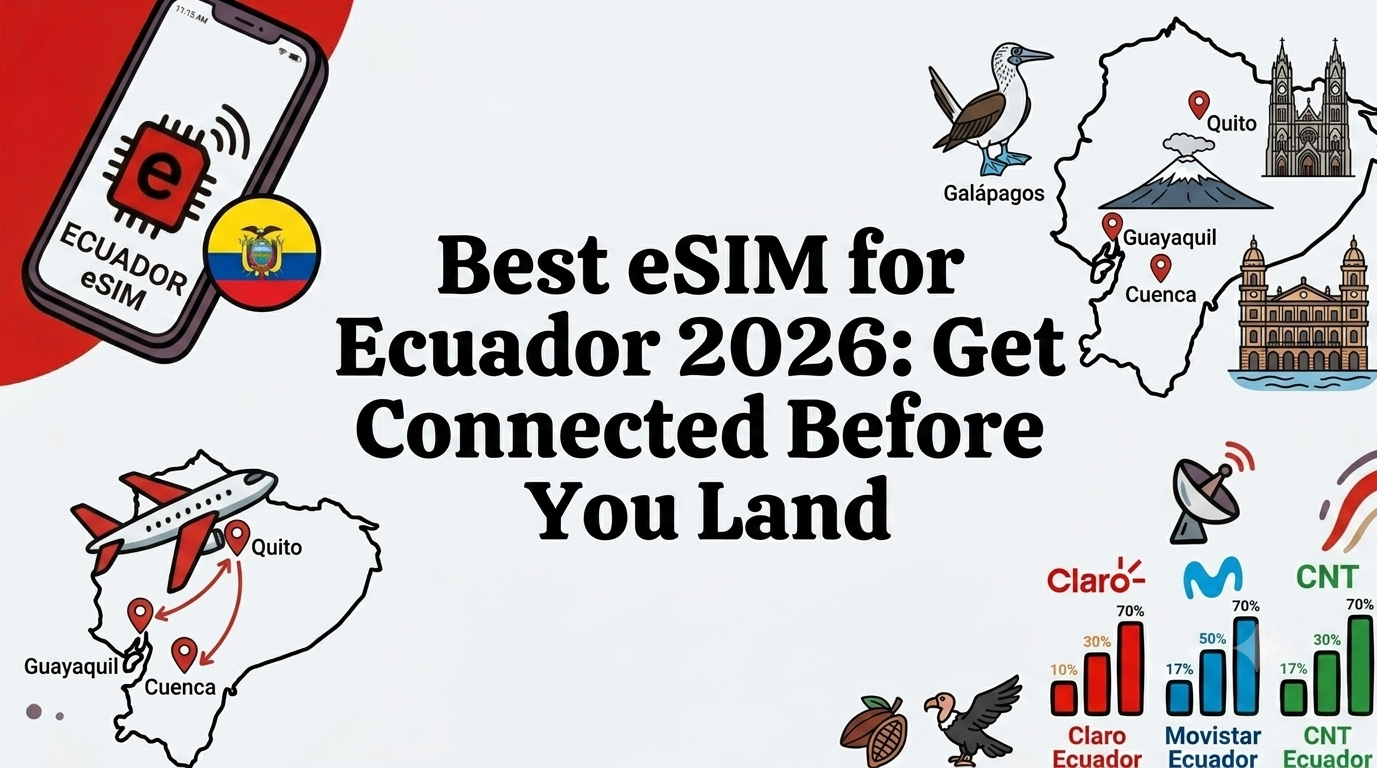
Best eSIM for Ecuador 2026: Claro, Movistar & CNT Coverage Compared
TLDR
- Ecuador has three major networks: Claro (dominant carrier with ~55% market share, best nationwide and rural coverage), Movistar (strong in cities, weaker in remote areas), and CNT (state carrier, strongest in the Amazon region, leading 5G rollout).
- Claro is the safest choice for travelers — it has the most cell towers, the widest rural and highway coverage, and the strongest signal in the Galápagos Islands, the Andes highlands, and the Amazon basin.
- 5G is now live in Quito and Guayaquil (CNT-led rollout), expanding to Cuenca, Ambato, and other cities through 2026.
- Esimify Ecuador eSIM plans connect to Claro and activate instantly before your flight.
- Download offline maps before visiting the Galápagos, the cloud forest, or any Andean route above 3,500 metres — coverage is limited in these areas on all networks.
Ecuador is one of South America's most rewarding destinations, packing extraordinary geographic and biological diversity into a country roughly the size of the United Kingdom. The capital Quito sits at 2,850 metres above sea level, a UNESCO World Heritage–listed colonial city surrounded by volcanoes. The Galápagos Islands, 900 kilometres off the Pacific coast, are one of the world's great wildlife destinations. The Amazon basin stretches east from the Andes into pristine rainforest. Between these extremes, the Avenue of the Volcanoes, the cloud forests of Mindo, and the Pacific beach towns of the Ruta del Sol offer everything from world-class birdwatching to surfing.
Staying connected across this range of environments requires the right network. Ecuador's mobile coverage is strong in its cities and improving rapidly, but the country's dramatic geography creates genuine connectivity challenges in the highlands, the Amazon, and the Galápagos. Choosing the right eSIM before you fly makes the difference between navigating confidently and being cut off in a cloud forest.
A travel eSIM purchased before your flight lets you land at Quito's Mariscal Sucre Airport or Guayaquil's José Joaquín de Olmedo Airport with data already active, skipping the SIM card queues and avoiding roaming charges.
Understanding Ecuador's Mobile Networks
Ecuador is served by three licensed carriers. The coverage gap between Claro and the other two becomes most significant outside the cities — and given Ecuador's extraordinary range of destinations, that gap matters for most travelers.
| Network | Market Share | Best For | 5G |
|---|---|---|---|
| Claro Ecuador | ~55% | Nationwide, Galápagos, highways, rural areas | Quito, Guayaquil (expanding) |
| Movistar Ecuador | ~30% | Cities, major towns, coastal areas | Limited rollout |
| CNT (state carrier) | ~15% | Amazon region, Tena, Misahuallí | Leading rollout — 422 base stations by 2026 |
Key tip: Claro Ecuador (owned by América Móvil, Latin America's largest carrier) has approximately 55% market share and the most cell towers in the country. On highways, in smaller Andean towns, and in the Galápagos, Claro is often the only carrier with signal. In the Amazon specifically, CNT can be stronger than both Claro and Movistar in some of the more remote areas like Tena and Misahuallí. For most tourist itineraries, Claro is the right call.
Coverage Across Ecuador's Top Destinations
| Destination | Coverage Quality | Best Network | Notes |
|---|---|---|---|
| Quito | Excellent | Claro / Movistar | Strong 4G/5G; good in Old Town, Mariscal, and La Floresta |
| Guayaquil | Excellent | Claro / Movistar | Strong 4G/5G throughout; good on the Malecón 2000 |
| Cuenca | Very Good | Claro / Movistar | Strong 4G; 5G expanding in 2026 |
| Galápagos Islands (Santa Cruz, San Cristóbal) | Moderate | Claro | Claro only carrier with meaningful coverage; Puerto Ayora and Puerto Baquerizo Moreno have signal. Remote islands have none. |
| Avenue of the Volcanoes (Quilotoa, Cotopaxi) | Moderate | Claro | Good in towns; crater rim and high-altitude routes can have no signal |
| Mindo (cloud forest) | Limited to Moderate | Claro | Patchy in the cloud forest; download maps before leaving Quito |
| Baños | Very Good | Claro / Movistar | Good 4G in town; surrounding volcano roads can drop |
| Amazon Region (Tena, Misahuallí) | Limited | CNT / Claro | CNT can outperform Claro in parts of the Oriente; expect gaps |
| Otavalo and the northern highlands | Good | Claro | Good in Otavalo town; rural market roads can be patchy |
| Ruta del Sol (Montañita, Puerto López) | Good | Claro / Movistar | Good in resort towns; quieter coastal stretches can drop |
| Vilcabamba | Good | Claro | Decent Claro coverage in the valley; hiking trails above town are limited |
The Galápagos Islands: What to Expect for Connectivity
The Galápagos Islands present a unique connectivity situation. The islands are 900 kilometres off the Ecuadorian mainland, and mobile coverage is limited to the inhabited islands and their main settlements. Claro has expanded its Galápagos presence and is the only carrier with meaningful data service on Santa Cruz (Puerto Ayora) and San Cristóbal (Puerto Baquerizo Moreno).
Galápagos connectivity guide: Puerto Ayora and Puerto Baquerizo Moreno have usable Claro 4G data — speeds of 15 to 30 Mbps are typical. Isabela Island (Puerto Villamil) has limited Claro signal. Fernandina, Española, Genovesa, and the uninhabited islands have no mobile coverage. Download all tour briefings, maps, and wildlife guides before leaving the inhabited island towns each morning. Wi-Fi at lodges and boats in the Galápagos is also very limited and typically satellite-based with slow speeds.
Esimify Ecuador eSIM Plans
Esimify's Ecuador eSIM plans connect to Claro, giving you Ecuador's most reliable nationwide network for both city trips and adventures into the Andes, the coast, and the Galápagos. Instant QR code delivery, no registration, connect on landing.
| Plan | Data | Validity | Best For |
|---|---|---|---|
| Starter | 3 GB | 7 days | Short Quito city visit or Galápagos pre-trip base |
| Traveller | 10 GB | 15 days | Quito, Avenue of the Volcanoes, Galápagos circuit |
| Explorer | 20 GB | 30 days | Full Ecuador — highlands, Amazon, coast, and Galápagos |
| Unlimited | Unlimited (3 GB/day high-speed) | 30 days | Long stays, digital nomads in Quito or Cuenca |
Stay connected across Ecuador from the moment you land
Instant activation. Claro network. No SIM card needed on arrival.
Get Ecuador eSIMHow Much Data Do You Need in Ecuador?
Ecuador's cities — Quito, Guayaquil, and Cuenca — have decent Wi-Fi in hotels and cafés. Outside the cities, Wi-Fi becomes scarce and often slow. For any itinerary that includes the Galápagos, the Amazon, or rural Andean routes, mobile data becomes your primary connectivity tool.
| Trip Type | Weekly Usage | Recommended Plan |
|---|---|---|
| Quito city break (5 to 7 days) | 2 to 4 GB/week | 3 GB / 7 days |
| Highland circuit (Quito, Otavalo, Baños, Cuenca) | 3 to 6 GB/week | 10 GB / 15 days |
| Full Ecuador including Galápagos (3 to 4 weeks) | 4 to 7 GB/week | 20 GB / 30 days |
| Digital nomad in Quito or Cuenca | 15+ GB/week | Unlimited plan |
Altitude tip: Above 3,500 metres on Ecuadorian Andean routes — including sections of the Quilotoa Loop, the Cotopaxi approach roads, and the páramo highlands — even Claro's signal can be weak or absent. The combination of altitude and terrain can block mobile signals completely. Download offline maps and route files from a lower-altitude Wi-Fi connection the evening before any high-altitude day.
How to Set Up Your Ecuador eSIM
- Visit getesimify.com/esim-ecuador and choose a plan that matches your trip length.
- Complete checkout — receive your QR code by email instantly.
- On your phone, go to Settings → Mobile/Cellular → Add eSIM → Scan QR Code.
- Install the eSIM profile. This takes under a minute.
- Set the eSIM as your default data line and enable data roaming.
- Land in Ecuador and connect automatically on Claro.
Compatible devices: iPhone XS and later, Samsung Galaxy S20 and later, Google Pixel 3 and later, and most flagship Android devices from 2020 onwards. Check Settings for an Add eSIM option under Mobile/Cellular Data to confirm compatibility before purchasing.
Real Use Cases: Travelers in Ecuador
The Quito City Explorer — 4 to 7 Days
Quito has excellent Claro and Movistar 4G coverage throughout. The Old Town (Centro Histórico), La Mariscal, La Floresta, and González Suárez all have strong signal. Google Maps navigation in Quito's hilly street grid is essential — the city's geography makes it easy to get disoriented, and altitude affects walking pace. A 3 GB plan handles a week in Quito including Mitad del Mundo day trips and the Teleférico cable car.
The Avenue of the Volcanoes — Quito to Cuenca
Ecuador's great north-to-south highland route passes through Otavalo, Quilotoa, Cotopaxi, Baños, Riobamba, and Cuenca — a journey through some of the Andes' most dramatic scenery. Claro covers the main towns and the Panamericana highway, but rural roads between them and the crater rims above towns can have limited signal. Download offline maps for each day's route from your previous night's accommodation. A 10 GB plan covers two weeks of this circuit.
The Galápagos Islands Visitor
Most visitors to the Galápagos spend their trip on a combination of guided boat tours and time in Puerto Ayora or Puerto Baquerizo Moreno. A Claro eSIM gives you usable data in both inhabited port towns for booking tours, messaging family, and uploading photos. On the water and at uninhabited visitor sites, there is no mobile signal — this is simply part of the Galápagos experience. A 10 to 20 GB plan covers a week in the Galápagos combined with time in Quito or Guayaquil on either side.
The Mindo Cloud Forest Birdwatcher
Mindo, two hours northwest of Quito, is one of the world's top birdwatching destinations. Claro coverage in the Mindo village is moderate. On the birding trails and canopy walks in the cloud forest, signal is patchy. Download eBird and offline species checklists before leaving Quito. A 3 to 10 GB plan handles Mindo depending on how much time you spend in Quito either side of the cloud forest visit.
The Digital Nomad — Working from Quito or Cuenca
Ecuador has become a popular base for digital nomads, particularly Quito and Cuenca. Both cities have coworking spaces, affordable accommodation, and a quality of life that appeals to location-independent workers. Speeds in Quito and Guayaquil typically run 20 to 40 Mbps on Claro 4G. An unlimited plan covers video calls, cloud work, and everyday browsing across a month-long stay without throttling concerns on most working days.
Ecuador eSIM Tips and Best Practices
- Install before you fly — scan your QR code at home and install the eSIM profile so you connect immediately on landing at Quito or Guayaquil.
- Download offline maps by region — Google Maps allows offline downloads. Before leaving each city, download maps for the next region. The Quilotoa area, the Galápagos, and Mindo are priorities.
- Download iNaturalist or Merlin Bird ID — both apps work offline for wildlife identification in the Galápagos and cloud forest once species data is downloaded. Do this on hotel Wi-Fi before heading to the reserves.
- Keep altitude sickness in mind — Quito sits at 2,850 metres and the Andes routes go much higher. Take the first day easy. Google Maps navigation and accommodation booking apps are essential, so keeping your phone charged and connected helps manage the logistics of altitude adjustment.
- Use inDriver or Cabify for rides in Quito — both ride-hailing apps work on Claro data in Quito and are safer and more reliable than street taxis.
- Enable data roaming — after installing your eSIM, enable data roaming on the eSIM line in Settings. Travel eSIMs require this setting to activate.
Frequently Asked Questions
Which network is best for Ecuador travel eSIMs?
Claro. With approximately 55% market share and the most cell towers in Ecuador, Claro has the widest coverage nationwide, on highways, in the Andes, and in the Galápagos. Movistar is a strong second in major cities. For the Galápagos Islands specifically, Claro is the only carrier with meaningful coverage on Santa Cruz and San Cristóbal.
Does eSIM work in the Galápagos Islands?
Yes, on Claro and only in the main inhabited settlements. Puerto Ayora (Santa Cruz) and Puerto Baquerizo Moreno (San Cristóbal) have usable Claro 4G. Puerto Villamil (Isabela) has limited signal. Uninhabited visitor sites — Fernandina, Española, North Seymour, and others — have no mobile coverage at all. Download all maps, tour briefings, and wildlife guides before leaving the port towns each morning.
Does eSIM work at Cotopaxi volcano?
The Cotopaxi National Park entrance and José Rivas Refuge (at around 4,800 metres) have limited Claro signal in some conditions. The crater rim and summit at 5,897 metres have no reliable coverage. Download offline maps and route information from Latacunga or your accommodation before the approach drive.
Can I use eSIM in the Amazon region (Tena, Misahuallí)?
In Tena town there is reasonable Claro coverage and CNT (the state carrier) sometimes provides signal in areas where Claro is weaker in the Oriente. Remote lodges and river tributaries deep in the Amazon have no mobile signal. Download offline maps and any essential documents before leaving Tena for the jungle.
Is Ecuador in a time zone that affects eSIM activation?
No. eSIM activation is instant regardless of time zone — you purchase, receive a QR code by email, scan it, and the profile installs in under a minute on your device at home. The eSIM activates on the local Claro network the moment you arrive in Ecuador.
Can I top up my Ecuador eSIM if I run out of data?
Yes. Add data through your Esimify account without changing your eSIM profile or purchasing a new plan. Additional data activates within minutes — particularly useful if you spend more time in Quito or Guayaquil than planned and burn through your allowance before reaching the Galápagos leg of your trip.
Ready to explore Ecuador — from the Andes to the Galápagos?
Instant activation. Claro network. No SIM registration needed.
Get Ecuador eSIMAlso read: More travel eSIM guides · eSIM for Mexico · Browse all eSIM plans