Best eSIM for Florida 2026: Stay Connected in Miami, Orlando, Tampa & Beyond
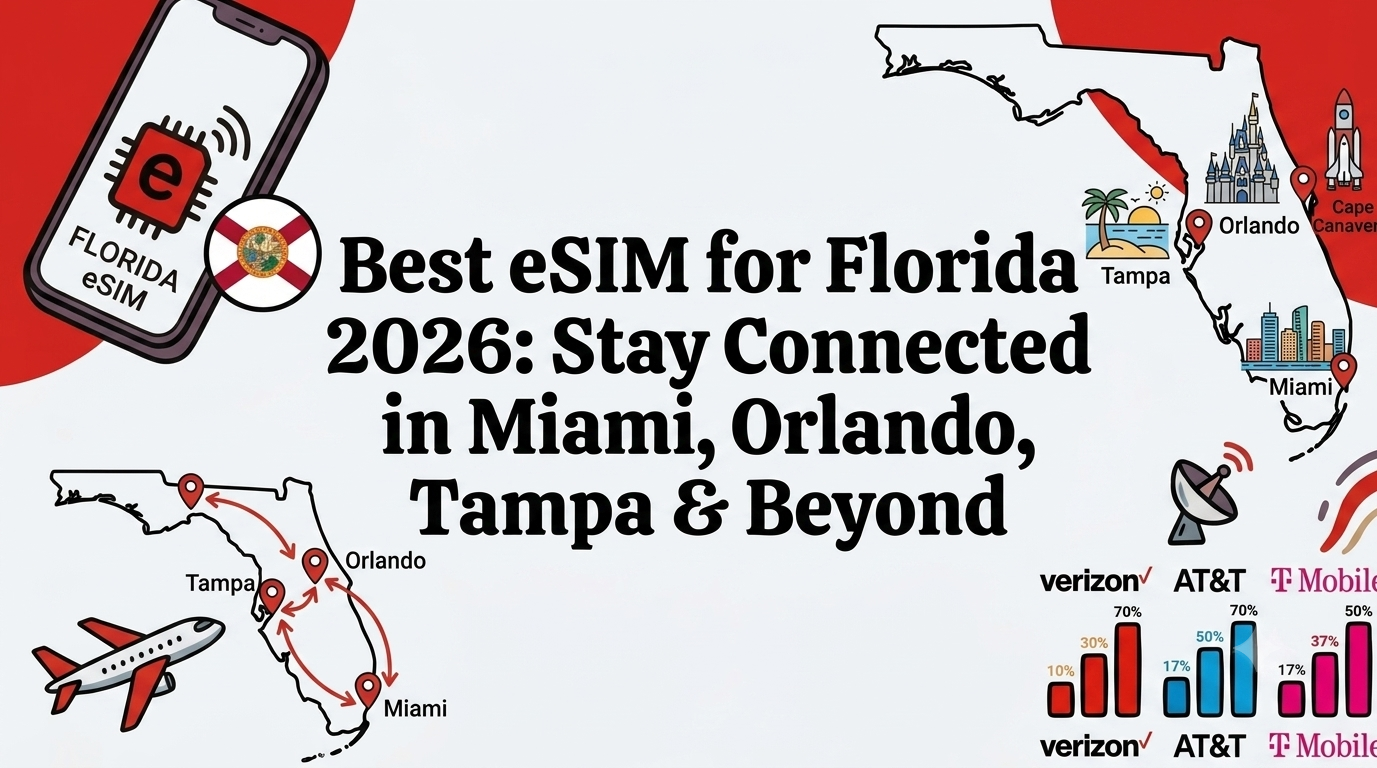
Florida draws more than 130 million visitors every year, making it one of the most visited states in the country. Whether you are heading to Miami Beach for sun and nightlife, spending a week at Walt Disney World in Orlando, driving the Overseas Highway down to Key West, or exploring the Gulf Coast from Tampa to Naples, one thing is certain: you need a reliable data connection from the moment you land.
For international travelers, getting a local SIM card used to mean hunting for a carrier store at the airport, dealing with ID requirements, and hoping the plan covers everywhere you want to go. An eSIM eliminates all of that. You activate it on your phone before you even board your flight, and by the time you touch down at Miami International or Orlando International, you are already connected.
This guide covers everything you need to know about using an eSIM in Florida in 2026, including which networks give you the best coverage, how data holds up in each major region, and what to expect in spots like the Everglades and the Florida Keys.
TLDR: eSIM for Florida at a Glance
- Best network in cities: T-Mobile leads for 5G in Miami, Orlando, and Tampa
- Best statewide coverage: Verizon covers the most rural and coastal ground
- Miami: Excellent 5G coverage across all major networks
- Orlando: Theme park zones (Disney, Universal, SeaWorld) all covered well by T-Mobile and AT&T
- Florida Keys and Key West: Good coverage on US-1 but patchy between islands — plan ahead
- Everglades: Coverage is limited to main access roads and visitor centers
- Activate before you fly: eSIMs work from the moment you land
Why International Travelers Need an eSIM for Florida
Florida sits on Eastern Standard Time (EST) and observes Eastern Daylight Time (EDT) during summer months. The state spans a massive area: from Pensacola in the Florida Panhandle to Key West at the southern tip is over 800 miles. You will likely be doing a lot of driving, using Google Maps constantly, booking restaurants, hailing rideshares, and checking wait times at theme parks. All of that burns through data.
Buying a prepaid SIM card in Florida is possible, but the major US carriers (T-Mobile, AT&T, Verizon) generally require a US billing address or payment method for their prepaid plans. International credit cards often work, but the process can be cumbersome. An international travel eSIM, purchased through a provider like Esimify before your trip, sidesteps all of that. You pick a plan, scan a QR code, and you are done.
Most Florida eSIM plans for travelers connect to either T-Mobile or AT&T infrastructure. Both networks offer strong 5G across the state's major corridors and cities.
Florida Network Coverage Overview: T-Mobile, AT&T, and Verizon
Understanding which network your eSIM runs on matters because Florida is not all city. You have dense urban areas like Miami and Tampa, sprawling suburban corridors like I-4 between Orlando and Tampa, rural farmland in the central highlands, and remote stretches through the Everglades and Big Cypress Swamp. Here is how the three major US networks perform across the state.
T-Mobile
T-Mobile has invested heavily in 5G nationwide, and Florida is one of its strongest markets. The network offers excellent mid-band 5G across Miami-Dade County, the Greater Orlando metro, Tampa Bay, Jacksonville, and Fort Lauderdale. Along the I-95 corridor from Miami to Jacksonville and the I-4 corridor between Tampa and Daytona Beach, coverage is consistently strong. T-Mobile also covers US Highway 1 through the Florida Keys reasonably well for most of the route. Where T-Mobile can be thinner is deep rural Florida, particularly inland agricultural areas between Lake Okeechobee and the Panhandle.
AT&T
AT&T offers comparable performance to T-Mobile in Florida's cities and has a strong presence at major airports including Miami International (MIA), Orlando International (MCO), Tampa International (TPA), and Fort Lauderdale-Hollywood International (FLL). AT&T's 5G footprint continues to expand, and its low-band coverage keeps you connected even when you drift away from urban centers. AT&T tends to perform particularly well along the Gulf Coast from Naples through Sarasota and into the Tampa Bay area.
Verizon
Verizon has the widest overall geographic footprint in the US and that extends to Florida. In areas where T-Mobile and AT&T have gaps, Verizon's LTE network often fills in. This matters if you plan to drive through central or northern Florida, visit smaller beach towns on the Gulf Coast like Apalachicola or Panama City Beach, or venture into less-traveled parts of the state. Verizon's 5G is strong in Miami and Orlando but trails T-Mobile in depth and consistency across the state's urban centers.
Florida Coverage Comparison by Region
| Region / City | T-Mobile | AT&T | Verizon | Verdict |
|---|---|---|---|---|
| Miami / South Beach | Excellent 5G | Excellent 5G | Strong 5G | All three are solid; T-Mobile fastest |
| Fort Lauderdale | Excellent | Excellent | Strong | Any network works well |
| Orlando (theme parks) | Excellent 5G | Strong 5G | Good | T-Mobile best for busy theme park areas |
| Tampa / St. Petersburg | Excellent | Excellent | Good | T-Mobile and AT&T tie |
| Key West / Florida Keys | Good (US-1) | Good (US-1) | Fair | Download maps offline before driving the Keys |
| Everglades NP | Patchy | Patchy | Patchy | Coverage limited to main roads and visitor centers |
| Jacksonville | Excellent | Strong | Strong | T-Mobile leads |
| Pensacola / Panhandle | Good | Good | Strong | Verizon most reliable in the Panhandle |
| Cape Canaveral / Space Coast | Strong | Strong | Strong | All three reliable |
Miami: Staying Connected in the Magic City
Miami is one of the most internationally connected cities in North America, and its wireless infrastructure reflects that. You will find 5G signals across Miami Beach, Brickell, Wynwood, Little Havana, Coconut Grove, Coral Gables, and the Design District. The Miami International Airport (MIA) is a major hub for international arrivals from Latin America, Europe, and beyond, and all three major networks are well represented throughout the terminals.
Practical uses in Miami include navigating the city via Uber or Lyft (Google Maps and Waze are both essential here given Miami's notorious traffic), checking restaurant reservations on OpenTable or Resy for spots in South Beach and Brickell, booking boat tours to the Biscayne National Park or Everglades, and streaming music on the beach. The average visitor to Miami uses between 2GB and 5GB per day depending on how much video content they consume and how reliant they are on navigation.
The Wynwood Walls art district, Miami Zoo, Pérez Art Museum Miami (PAMM), Vizcaya Museum and Gardens, and Little Havana's Calle Ocho are all well-covered. In South Beach, the Art Deco Historic District and Lincoln Road Mall both sit within strong 5G zones.
Orlando: Theme Parks, Wi-Fi Dead Zones, and Why You Need Good Data
Orlando sees approximately 75 million visitors per year and is the US capital of theme park tourism. Walt Disney World alone covers 25,000 acres across four main parks: Magic Kingdom, EPCOT, Hollywood Studios, and Animal Kingdom. Universal Orlando Resort covers its own large campus with Universal Studios, Islands of Adventure, and Epic Universe (which opened in 2025). SeaWorld Orlando rounds out the major park options.
Here is the practical challenge: inside these parks, Wi-Fi exists but is often overwhelmed by the sheer number of guests. Park-specific apps like My Disney Experience and the Universal app require a live data connection to check wait times, make Lightning Lane reservations, and navigate within the park. Relying on park Wi-Fi alone during peak season is frustrating. A travel eSIM with a solid data plan gives you a personal connection that does not compete with 50,000 other park guests.
T-Mobile has worked with Disney World on connectivity improvements and generally performs the best inside the resort. AT&T also holds up well. Both networks offer 5G coverage across the Orlando metro, International Drive, and the Convention Center corridor.
Beyond the parks, Orlando visitors frequently travel to Kennedy Space Center (about 45 minutes east on the Space Coast), Universal's CityWalk, Disney Springs, the Premium Outlets on International Drive, and Celebration town center. Coverage is strong throughout all of these areas.
Tampa Bay: Waterfront, Art, and Ybor City
Tampa is Florida's third-largest city and offers a genuinely diverse itinerary beyond what most international visitors expect. The Tampa Riverwalk stretches 2.6 miles along the Hillsborough River and connects neighborhoods from Armature Works in the north to the Tampa Convention Center in the south. Ybor City, Tampa's historic Latin Quarter, is one of only three National Historic Landmark Districts in Florida and is known for its restaurants, craft beer bars, and genuine Cuban sandwiches.
Coverage in Tampa is excellent across T-Mobile and AT&T, with 5G available throughout downtown, Ybor City, the Channelside District, and Westshore. The connected areas extend across the bay to St. Petersburg, where you will find the Salvador Dalí Museum, the Chihuly Collection, and the vibrant Central Arts District.
If you are crossing the Sunshine Skyway Bridge connecting Tampa to the Fort Myers / Naples region of the Gulf Coast, coverage is maintained throughout. The bridge has become something of a scenic drive destination in itself.
The Florida Keys and Key West: Connected but Cautious
Driving the Overseas Highway from Florida City to Key West is one of the great road trips in North America: 113 miles across 42 bridges connecting a string of coral islands above impossibly blue water. Coverage along US-1 through the Keys is better than many visitors expect, but it is not uniform.
Key Largo, Islamorada, Marathon, and Key West all have solid signal. The sections between major keys, particularly the 7-Mile Bridge stretch between Marathon and Big Pine Key, can dip to LTE or see brief gaps. T-Mobile and AT&T both generally maintain a signal, but Verizon can be more reliable in some of the mid-Keys stretches.
Key West itself is well covered. You can navigate the island, book restaurants in Old Town, check scuba diving operators at the John Pennekamp Coral Reef State Park (in Key Largo), and stream content without issue in most of the inhabited Keys.
The practical advice: download offline Google Maps for the Keys before you leave Florida City. If you lose signal in a remote stretch, you will still have navigation. Upload any photos before leaving each key, and keep location sharing on so your companions know where you are if the group separates.
The Everglades: When to Rely on Offline Tools
Everglades National Park covers 1.5 million acres in South Florida and is one of the largest protected wilderness areas in the US. It is also one of the areas where wireless coverage becomes genuinely unreliable. The main park road (SR 9336) from the Ernest F. Coe Visitor Center to Flamingo has some signal near the visitor centers but goes dark for extended stretches in between.
The Anhinga Trail near Royal Palm, Pa-hay-okee Overlook, and Flamingo Campground have limited or no signal on most networks. The Shark Valley area on the northern edge (Tamiami Trail) has better coverage because it is closer to the Miami metropolitan area, with Verizon performing slightly better than T-Mobile in this zone.
For any Everglades visit, download your maps offline, download AllTrails trail guides for any hikes, and let someone outside the park know your itinerary. Do not plan to navigate using live data inside the park interior.
FIFA World Cup 2026 in Miami: What Fans Need to Know
Miami is one of the official host cities for the 2026 FIFA World Cup, which runs from June 11 through July 19, 2026 across 16 cities in the United States, Canada, and Mexico. Matches at the Miami venue will be played at Hard Rock Stadium in Miami Gardens, the home of the Miami Dolphins, located about 16 miles northwest of Downtown Miami and South Beach.
Hard Rock Stadium has a capacity of over 65,000 and is one of the premier sporting venues in the Southeast United States. For World Cup visitors flying into Miami specifically for matches, this is a genuinely important connectivity moment: navigating an unfamiliar city, finding the stadium, getting back to your hotel after an evening match, and posting your experience to supporters at home all require a reliable data connection.
Getting to Hard Rock Stadium on Match Day
The stadium is not easily walkable from Miami Beach or Downtown Miami. The options are: Uber or Lyft (expect surge pricing on match days — book early or walk away from the stadium a few blocks before requesting a ride), the Miami-Dade Transit 2 bus route from Downtown Miami, or a rental car with parking. Whichever option you choose, live data navigation on your eSIM is essential. Download offline maps for the Miami Gardens area as a backup for periods when the network is congested near the stadium.
Stadium Data: What to Expect Inside
Hard Rock Stadium has in-stadium Wi-Fi, but with 65,000 fans all trying to upload match clips simultaneously, carrier-grade cellular is far more reliable than venue Wi-Fi during peak moments. T-Mobile has invested in coverage for major US stadiums, and AT&T similarly performs well at NFL venues. Your eSIM on either of these networks will outperform the shared stadium Wi-Fi during halftime and goal celebrations, which is exactly when you most want to share content.
Fan Zones and World Cup Events Around Miami
Beyond the stadium itself, FIFA typically designates official Fan Zones where supporters without match tickets can watch games on large screens, buy merchandise, and experience the tournament atmosphere. In Miami, the Bayfront Park area Downtown and areas around South Beach are likely locations for fan activations. Coverage in all of these areas is excellent across all three major networks.
International visitors combining World Cup matches with a broader Florida holiday should factor in the tournament schedule when booking accommodation. Miami hotel prices during match weeks will be significantly elevated. Orlando, which is 235 miles north and has excellent direct highway access, can serve as a base for theme park days between match days.
How Much Data Do You Need for a Florida Trip?
Florida trips vary enormously in data consumption. Here is a realistic breakdown by trip type:
- Theme park week (Orlando): 3GB to 8GB. Using Disney Experience or Universal app frequently, streaming music on rides, posting Instagram stories, navigating between parks.
- Miami beach holiday (5 to 7 days): 5GB to 12GB. Heavy use of Instagram, TikTok, Uber/Lyft, restaurant booking apps, and video calls home.
- Road trip (Miami to Key West and back): 4GB to 7GB. Continuous Google Maps, photo uploads, streaming music, and checking hotel bookings on the go.
- Everglades day trip from Miami: 1GB to 2GB. Most of the day offline; data used mainly in Miami before and after.
- Tampa to Pensacola Gulf Coast drive: 3GB to 6GB. Navigation, beach stops, restaurant searches.
A 10GB to 15GB plan covers most week-long Florida trips comfortably. Heavy social media users and anyone doing video calls daily should consider 20GB or an unlimited plan. You can find the right plan for your trip on the Esimify eSIM page.
Practical Tips for Using an eSIM in Florida
- Activate before you board: Set up your eSIM at home before your departure. The QR code scan takes about two minutes and having your eSIM active before landing means you are on data the moment your plane touches down.
- Download offline maps for the Keys and Everglades: These are the two areas in Florida most likely to cause navigation problems without offline maps. Google Maps lets you download entire regions for offline use.
- Use your hotel Wi-Fi for heavy downloads: Video streaming, large app downloads, and OS updates should be done on hotel Wi-Fi to preserve your data allowance for when you actually need it out and about.
- Keep your home SIM in airplane mode: To avoid roaming charges on your home carrier's plan, keep that SIM on airplane mode or activate your eSIM as the primary data line. Most dual-SIM phones let you set data preferences per line.
- Theme park connectivity tip: The Disney World and Universal apps work far better on your eSIM than on crowded park Wi-Fi during peak hours (10am to 3pm). Save the park Wi-Fi for video calls when the parks are quieter in the evening.
- Hurricane season awareness: Florida's hurricane season runs from June through November. If severe weather is possible, having a data connection is essential for emergency alerts (download the FEMA app and the Florida Division of Emergency Management app before your trip).
- Fort Lauderdale Airport is a solid alternative to MIA: FLL is close to Miami and often cheaper for international flights. Coverage at FLL is equivalent to MIA on all three networks.
Real-World Scenarios: Who Visits Florida and What They Need
The British Family on a Disney Holiday
A family of four flying from London Heathrow to Orlando needs to stay connected for two weeks across Disney World, EPCOT, Universal Studios, and a few days in Miami at the end. They need the My Disney Experience app running at all times and must coordinate Lightning Lane selections for four people simultaneously. A 15GB to 20GB plan split across parent devices would handle this comfortably. Activating the eSIM before departure means no fumbling with SIM cards after a nine-hour flight with tired children.
The Brazilian Couple in Miami
Brazil is consistently one of the top source markets for Miami tourism. A couple from São Paulo spending ten days split between South Beach, Wynwood, and a drive to Key West would use significant data for Instagram, WhatsApp with family back home, navigation via Waze, and Airbnb check-ins. A 10GB plan would likely suffice; 15GB provides comfortable headroom for video calls and streaming.
The Canadian Road Tripper
A solo traveler driving from Tampa down through Naples, then across the Everglades on the Tamiami Trail and up through the Keys to Key West needs reliable navigation across long rural stretches. Verizon's broader rural coverage is the safer bet for this particular route. A 5GB to 8GB plan covers the week.
The European Digital Nomad in Miami
A remote worker spending a month in Brickell or the Wynwood area co-working from cafés and Airbnbs. An unlimited data plan makes sense here to avoid constantly watching their data balance. Video calls on Zoom, uploading large files to cloud storage, and keeping Slack active all day add up fast. Strong 5G in Brickell keeps speeds fast enough for professional work.
How to Install and Activate Your Florida eSIM
- Purchase your eSIM plan on Esimify before traveling. Choose a US plan with enough data for your trip length and usage style.
- Receive your QR code via email immediately after purchase.
- On iPhone: Go to Settings → Cellular → Add eSIM → Use QR Code. Scan the code. On Android (Samsung, Google Pixel, etc.): Go to Settings → Connections → SIM Manager → Add eSIM. Scan the code.
- Set the eSIM as your primary data line. Keep your home SIM for calls and SMS if needed, but route all data through the eSIM.
- Put your home carrier's line in data roaming off to avoid unexpected charges.
- Test the connection before boarding by opening a browser and loading a page.
Device Compatibility: Does Your Phone Support eSIM?
Most flagship smartphones released after 2020 support eSIM. The following devices are confirmed eSIM compatible and widely used by travelers to Florida:
- iPhone XS, XR, 11, 12, 13, 14, 15, 16 series
- Google Pixel 3 and newer
- Samsung Galaxy S20, S21, S22, S23, S24, S25 series and Galaxy Z Fold/Flip series
- Samsung Galaxy A54, A55
- Most recent OnePlus, Motorola, and Xiaomi flagship models
Note: iPhones purchased in mainland China and some carrier-locked devices from other regions may not support eSIM. Check your phone's IMEI at the manufacturer's website or under Settings → General → About (iPhone) or Settings → About Phone (Android) to confirm eSIM support before purchasing a plan.
Frequently Asked Questions: eSIM in Florida
Do I need a US phone number to use an eSIM in Florida?
No. A travel eSIM provides data only. You can make calls and send messages using apps like WhatsApp, FaceTime, iMessage, Google Meet, or Zoom over your data connection. You do not need a local US phone number for most travel needs.
Which network is best for Disney World?
T-Mobile consistently offers the best 5G performance inside Disney World and Universal Orlando Resort. The network has invested in coverage improvements at theme park locations specifically. AT&T is a close second.
Is there coverage in the Florida Keys?
Yes, with caveats. The main towns (Key Largo, Islamorada, Marathon, Key West) have good to excellent coverage. The stretches of US-1 between keys, particularly around the 7-Mile Bridge, can be spotty. Download offline maps before driving the Keys.
Does my eSIM work at Florida airports?
Yes. All major Florida airports including Miami International (MIA), Orlando International (MCO), Tampa International (TPA), and Fort Lauderdale-Hollywood International (FLL) have excellent coverage from T-Mobile, AT&T, and Verizon throughout the terminals and arrivals halls.
How much data does Uber/Lyft use?
Each Uber or Lyft ride uses approximately 5MB to 15MB. If you take four rides per day for seven days, that is roughly 140MB to 420MB total. Navigation is the bigger data consumer: Google Maps uses around 30MB per hour of active navigation.
Can I use my eSIM on a cruise from Miami?
Your eSIM works on land throughout Florida, including in Miami before and after your cruise. Once the ship leaves the port and is at sea, you will be outside cellular range. Cruise ships offer their own onboard Wi-Fi packages, which operate via satellite and are separate from your eSIM plan.
Is an eSIM better than buying a prepaid SIM at the airport?
For most international travelers, yes. eSIMs are activated before you land, do not require a visit to a carrier store or kiosk, and do not require a US payment method or address. You also avoid the risk of losing or damaging a physical SIM card during your trip.
What happens if I run out of data?
Most travel eSIM providers, including Esimify, let you top up or purchase additional data from within their app. You do not need to buy a new plan from scratch. This is particularly useful for longer trips where your initial estimate was too conservative.
Conclusion: The Best Way to Stay Connected in Florida
Florida is enormous, diverse, and data-intensive. From the crowded hotel corridors of International Drive to the remote mangrove forests of Everglades National Park, your connectivity experience will vary depending on where you go. Understanding the network landscape before you arrive helps you plan smarter.
For most international visitors, a T-Mobile or AT&T-backed eSIM plan gives you the best balance of 5G speeds in cities and reliable LTE in the areas between them. If you are spending significant time in rural Florida or the Panhandle, a Verizon-backed plan may offer better coverage in the areas where T-Mobile and AT&T thin out.
The bottom line: activate your eSIM before you board your flight, download offline maps for the Keys and Everglades, pick a data plan that matches your usage honestly, and you will have one less thing to worry about from the moment you land. Check out the full range of US eSIM plans on Esimify and find the right option for your Florida trip.