Best eSIM for New York 2026: Stay Connected in NYC, New Jersey, Philadelphia & Beyond
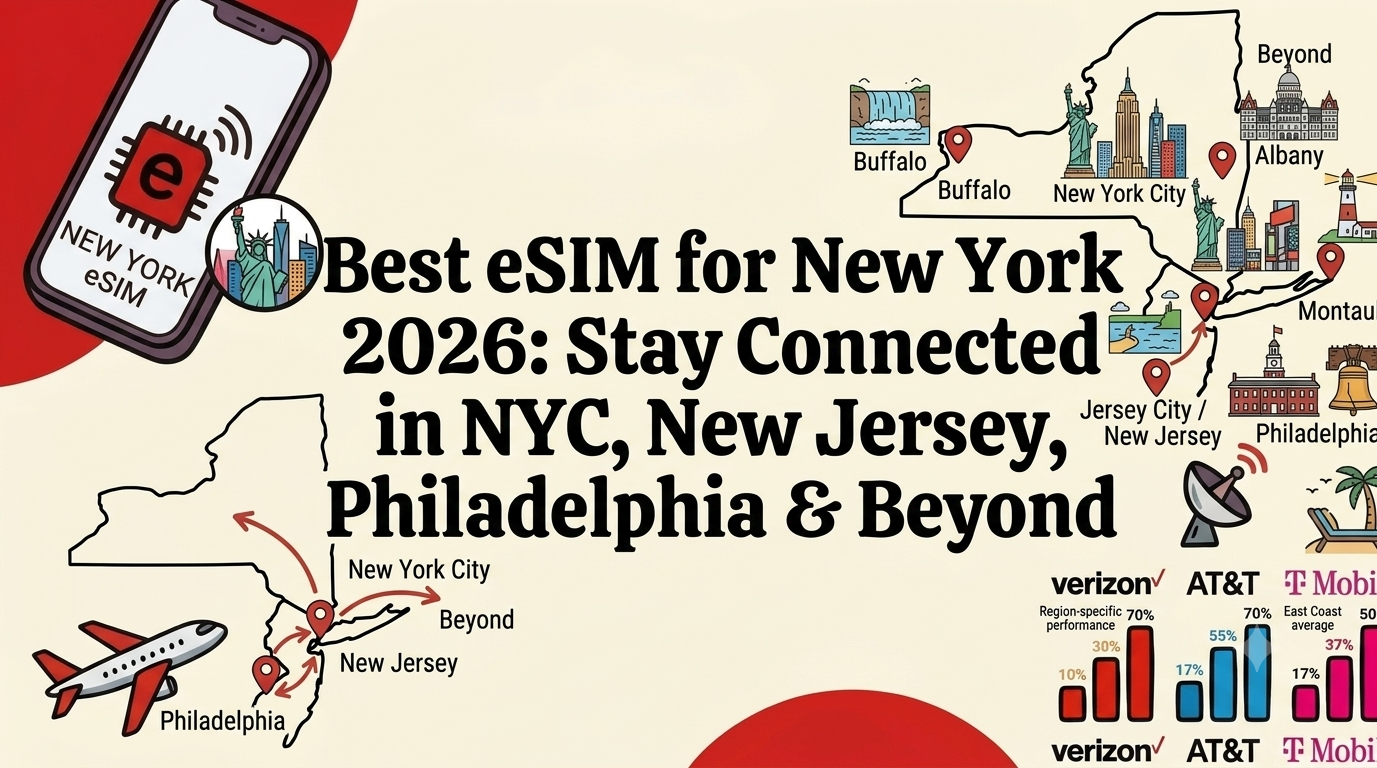
New York City is one of the most intensely connected cities on the planet. It is also a city that will ruthlessly expose any weakness in your data plan: the subway tunnels, the sprawling terminal halls of JFK and LaGuardia, the overcrowded Times Square where thousands of tourists are all trying to upload the same Instagram photo simultaneously, and the traffic-clogged streets where navigation apps are the only thing standing between you and getting hopelessly lost in Midtown.
For international visitors, the greater New York area extends well beyond Manhattan. Many visitors cross the Hudson River into New Jersey to stay in Jersey City or Hoboken, where hotels are cheaper and the views of the Manhattan skyline are genuinely better than most vantage points in the city itself. Day trips to Philadelphia — one of America's most historically rich cities and just 95 miles from Manhattan — are common. And for longer itineraries, Niagara Falls, the Catskills, the Hudson Valley, and the Hamptons on Long Island all draw international visitors into the wider region.
This guide covers eSIM options for the entire New York metro region and the wider Northeast travel circuit for 2026, including coverage in New York City, the New Jersey side, Philadelphia, and the state's most popular day-trip and weekend destinations.
TLDR: eSIM for New York at a Glance
- Best networks in NYC: T-Mobile, Verizon, and AT&T are all excellent; Verizon historically strongest in dense Midtown
- Subway coverage: All 472 NYC subway stations have cellular service (a major infrastructure upgrade completed in recent years)
- New Jersey (Jersey City, Hoboken, Newark): All three networks excellent; great Manhattan views with strong signal
- Philadelphia: T-Mobile and AT&T both outstanding across Center City, Old City, and South Philly
- Niagara Falls, NY: Good to excellent coverage; Canadian side requires a Canada-enabled plan
- Recommended data: 10GB to 15GB for a week in NYC; 15GB to 20GB if adding Philadelphia and NJ
- Activate before departure: eSIM works from the moment you land at JFK, EWR, or LGA
Why International Travelers Need an eSIM for New York
New York City's density makes it one of the most data-intensive travel destinations in the world. You will use Google Maps constantly to navigate the subway grid (the NYC subway system, while excellent, is not always intuitive for first-time visitors). Citymapper is the preferred app for many regular NYC visitors, and it requires a live connection. Checking wait times at the Empire State Building or One World Observatory, booking last-minute Broadway tickets through TodayTix, finding a table at a Manhattan restaurant via Resy, ordering through DoorDash or Seamless late at night: all of it requires data.
For international travelers, the major US carriers require a US billing address or payment method for their retail prepaid plans. An international travel eSIM — purchased through a platform like Esimify before you leave home — removes that friction entirely. You set it up on your phone at home, activate it when you board your flight, and land at JFK or Newark already connected.
New York City Coverage: The World's Most Connected City
New York City has some of the most intensely developed wireless infrastructure anywhere in the world, driven by the density of commercial activity and the competitive pressure between Verizon, T-Mobile, and AT&T, all of whom treat New York as their flagship market.
Manhattan
Coverage across all of Manhattan is outstanding on all three networks. Midtown (Times Square, Hell's Kitchen, Rockefeller Center, Grand Central Terminal, Fifth Avenue, the Museum Mile) has the highest concentration of cell towers of almost anywhere in the country. The Flatiron District, Gramercy, Union Square, Greenwich Village, SoHo, Tribeca, the Financial District, and Lower Manhattan are equally well served.
Midtown East around the UN Headquarters, Murray Hill, and Turtle Bay all have excellent signal. Central Park, which spans 843 acres in the heart of the island, has strong coverage throughout, including in the more remote northern section around the Harlem Meer. Washington Heights and Inwood in Upper Manhattan are well covered by T-Mobile and Verizon.
Brooklyn, Queens, The Bronx, and Staten Island
The outer boroughs are all well served by the major networks. Brooklyn's most-visited neighborhoods — DUMBO (with its iconic views under the Manhattan Bridge), Williamsburg, Bushwick, Park Slope, Crown Heights, and Coney Island — all have excellent coverage. Queens covers JFK International Airport (excellent coverage throughout all terminals), LaGuardia Airport (LGA), Flushing Meadows, and Astoria, all with strong signal. The Bronx includes Yankee Stadium, the New York Botanical Garden, and the Bronx Zoo, all within strong network zones. Staten Island is reached by the free Staten Island Ferry from Whitehall Terminal, and coverage is solid across the island and throughout the 25-minute crossing.
New York City Subway: Underground Coverage
One of the most significant wireless infrastructure stories in New York in recent years has been the completion of cellular service in all 472 NYC subway stations. Transit Wireless, working with the major carriers, extended Wi-Fi and cellular signal into the underground system. In 2026, you can expect to maintain your data connection in most subway stations and the platform areas. Note that signal drops when the train is in motion between stations in deep underground tunnels, but connection typically returns within seconds of pulling into the next station.
New Jersey: The Underrated Side of the New York Metro
Many international visitors stay in Jersey City, Hoboken, or Newark rather than Manhattan, attracted by lower hotel prices and the fact that PATH trains into Midtown Manhattan take just 15 to 25 minutes. From the Jersey City waterfront opposite Lower Manhattan, you get what is arguably the finest view of the New York skyline anywhere — and all three major US networks have excellent coverage throughout.
Jersey City's Exchange Place neighborhood, Liberty State Park (the departure point for ferries to the Statue of Liberty and Ellis Island), and the Grove Street and Newport PATH stations all have strong 5G. Hoboken, the one-square-mile city across from 50th Street Manhattan, is fully covered. Newark Liberty International Airport (EWR) is actually the best-connected of the three main New York-area airports for many travelers due to its direct AirTrain connection to NJ Transit and clear sightlines.
The New Jersey Turnpike from Newark south to Princeton and Trenton has strong coverage throughout. Garden State Parkway from Newark to the Jersey Shore is similarly covered, with excellent signal at popular beach destinations including Asbury Park, Belmar, Sea Bright, and Wildwood.
Philadelphia: History, Food, and Full 5G Coverage
Philadelphia sits 95 miles southwest of Manhattan, about 90 minutes by Amtrak Acela or 2 hours on the Northeast Regional. For many international visitors, a day trip or overnight to Philadelphia is the perfect complement to a New York stay. The city offers Independence Hall, the Liberty Bell, the Philadelphia Museum of Art (famous for the Rocky steps), Reading Terminal Market, the Italian Market in South Philly, and one of the most vibrant restaurant scenes in the US, all at notably more reasonable prices than New York.
Coverage in Philadelphia is outstanding across all three networks. Center City Philadelphia (the area between the Delaware and Schuylkill rivers) is fully covered with 5G. Old City, home to Independence Hall and the Liberty Bell Center, is well served. South Philadelphia, including the Italian Market on 9th Street, is covered throughout. University City, home to Penn and Drexel, has excellent coverage. The Philadelphia Museum of Art on the Benjamin Franklin Parkway and Fairmount Park beyond it are both well served.
The Amtrak journey between New York Penn Station and Philadelphia 30th Street Station passes through Newark, Trenton, and the North Jersey and Delaware Valley suburbs, and signal is maintained throughout most of the route. The NJ Transit rail option via Trenton takes slightly longer but is covered similarly.
If you extend further south from Philadelphia toward Washington DC (another 2-hour Amtrak journey), the entire Northeast Corridor has strong coverage on all three networks.
Niagara Falls: Where New York Meets Canada
Niagara Falls is one of the most visited natural wonders in North America and sits on the border between New York State and Ontario, Canada. The American side (Niagara Falls State Park) and the Canadian side (Niagara Falls, Ontario) offer dramatically different perspectives of the falls, and most visitors cross both borders.
On the New York side, coverage is excellent throughout Niagara Falls State Park, the American Falls overlooks, the Cave of the Winds (accessed by elevator down through the gorge), and the town of Niagara Falls, NY. All three networks — T-Mobile, AT&T, and Verizon — perform well here.
Important note: if you cross the Rainbow Bridge or Lewiston-Queenston Bridge into Ontario, Canada, your US-only eSIM plan will not have data service. You will need either a North America plan that includes Canada, or to connect to local Canadian networks. Many travel eSIM providers, including Esimify, offer plans that cover both the US and Canada simultaneously. If your Niagara itinerary includes any time on the Canadian side (which is strongly recommended for the best view of Horseshoe Falls), confirm your plan covers Canada before you go.
The Hudson Valley and Catskills: Weekend Escape Connectivity
International visitors staying in New York for more than a week frequently take weekend trips north into the Hudson Valley or the Catskill Mountains. The Hudson Valley corridor along Route 9 and the Metro-North Hudson Line includes towns like Yonkers, Tarrytown (Sleepy Hollow), Beacon, Poughkeepsie, Hyde Park (home to the Franklin D. Roosevelt Presidential Library), and Hudson, all with reasonable to strong coverage on T-Mobile and AT&T.
The Catskill Mountains see coverage that is good in the gateway towns (Woodstock, Saugerties, Phoenicia, Hunter, Windham) but thins considerably in the more remote valleys and on higher ridgelines. Download your trail maps on AllTrails before heading into the backcountry.
The Hamptons and Long Island: Coastal Connectivity
The Hamptons on the East End of Long Island draw international visitors in summer for beaches, art galleries, and the coastal dining scene. Coverage along the Long Island Expressway (I-495) is consistent throughout. In the Hamptons themselves, Southampton, East Hampton, Bridgehampton, and Montauk all have solid to excellent coverage. The Long Island Rail Road connects Penn Station to the Hamptons and maintains signal across most of the route.
New York Region Coverage Comparison
| Location | T-Mobile | AT&T | Verizon | Notes |
|---|---|---|---|---|
| Manhattan (Midtown, Downtown) | Excellent 5G | Excellent 5G | Excellent 5G | All three tier-1; Verizon traditionally strongest in density |
| Brooklyn, Queens, Bronx, Staten Island | Excellent | Excellent | Excellent | Any network works well in all boroughs |
| NYC Subway stations | Good to excellent | Good to excellent | Excellent | All 472 stations covered; drops in motion between stations |
| Jersey City / Hoboken / Newark | Excellent | Excellent | Excellent | Full 5G; excellent PATH train connectivity |
| Philadelphia (Center City, Old City) | Excellent | Excellent | Strong | T-Mobile and AT&T lead for 5G depth |
| Niagara Falls (NY side) | Excellent | Strong | Strong | Need Canada-capable plan for the Ontario side |
| Hudson Valley / Catskills (gateway towns) | Good | Good | Strong | Rural ridges can drop signal significantly |
| The Hamptons / Long Island East End | Good to strong | Good to strong | Strong | Solid coverage throughout summer beach towns |
| JFK / LaGuardia / Newark airports | Excellent | Excellent | Excellent | All terminals well served |
FIFA World Cup 2026 in New York / New Jersey: MetLife Stadium
The New York/New Jersey metro area is hosting FIFA World Cup 2026 matches at MetLife Stadium in East Rutherford, New Jersey — just 8 miles from Midtown Manhattan across the Hudson River. The tournament runs June 11 through July 19, 2026 across 16 cities in the United States, Canada, and Mexico. MetLife Stadium, with a capacity of over 82,500, is the largest stadium in the tournament and is expected to host the FIFA World Cup Final on July 19, 2026.
Hosting the final in the New York metro makes this the most anticipated sporting event in the region's history. If your visit to New York overlaps with the World Cup — particularly July 2026 — you are visiting during what will likely be one of the most electric weeks the city has ever seen.
Getting to MetLife Stadium on Match Day
MetLife Stadium sits in East Rutherford, New Jersey, directly adjacent to the New Jersey Turnpike (I-95). There are several ways to get there from Manhattan and the NYC metro area:
- NJ Transit train: Dedicated match-day trains run from New York Penn Station directly to the Meadowlands Sports Complex station adjacent to the stadium. This is the recommended option for most visitors: no parking, no surge pricing, direct service. The journey takes about 30 minutes from Penn Station. You will need the NJ Transit app and a live data connection to buy tickets.
- NY Waterway ferry: A special ferry service operates from the West Side of Manhattan (Pier 78 or 79 on the Hudson) to a dock near the stadium. Scenic and efficient on match days.
- Uber or Lyft: Expect extreme surge pricing on match days, particularly for the Final. The drive from Midtown Manhattan via the Lincoln Tunnel takes 20 to 40 minutes depending on traffic.
- Car and parking: Pre-booked parking passes are required. The Meadowlands area has extensive parking but fills quickly. Download offline maps for the East Rutherford area before match day.
Stadium Connectivity at MetLife
MetLife Stadium has an extensive distributed antenna system (DAS) infrastructure built into the structure, providing in-stadium cellular coverage for Verizon, AT&T, and T-Mobile. Verizon has been a longtime partner of NFL teams at MetLife (home of the New York Giants and Jets) and performs exceptionally well inside the venue. T-Mobile and AT&T are both strong as well. Expect stadium Wi-Fi to be completely overwhelmed during goals and at halftime with 82,000 fans simultaneously attempting to upload content. Your eSIM cellular connection is your reliable fallback for those moments.
World Cup Fan Zones in New York City
FIFA and New York City typically establish official Fan Zones in the city for supporters watching matches at designated public venues. Central Park's Great Lawn, Times Square, and the Intrepid Sea, Air and Space Museum's waterfront area on the Hudson are among the most likely public viewing locations for the World Cup. Bryant Park, which regularly hosts outdoor events, is another strong candidate.
The FIFA Fan Fest in New York is likely to be one of the largest public gatherings in the city's recent history, particularly for the Final weekend. If you plan to be in New York during July 2026, book accommodation far in advance — hotel prices will be among the highest of any US host city given New York's baseline room rates and the extraordinary demand for Final week.
Philadelphia: Close Enough for Match Day Trips
Philadelphia is also an official World Cup 2026 host city, with matches played at Lincoln Financial Field (home of the Philadelphia Eagles), which seats approximately 69,000 for soccer. From midtown Manhattan, Philadelphia is 95 miles south via Amtrak — about 75 minutes on the Acela. A day trip from New York to watch a World Cup match in Philadelphia and return the same night is entirely feasible. The NJ Transit North Jersey Coast Line also connects to parts of New Jersey from where you can travel south to Philadelphia via SEPTA or connecting services.
How Much Data Do You Need for a New York Trip?
New York is a high-data city. Navigation, rideshare, social media posting, and streaming are all standard parts of a New York visit. Here is a realistic estimate by trip type:
- Five days in NYC only: 8GB to 12GB. Heavy subway navigation, Uber/Lyft, Citymapper, restaurant booking, and social media posting from the city's most Instagrammable spots.
- Week including NYC and Philadelphia: 12GB to 18GB. Amtrak navigation apps, Old City walking tours with Google Maps, additional restaurant research in Philly.
- Ten days including NYC, NJ, and Niagara Falls: 15GB to 20GB. Long driving or train segments, national park apps, border crossing navigation.
- Two weeks with Hamptons weekend: 15GB to 22GB. Extra streaming on the beach, navigation in the Hamptons, ferry booking apps.
- Month-long stay working remotely in NYC: Unlimited plan. Video calls, cloud storage, corporate apps, and constant background data from a city that never stops generating things to look at on your phone.
Tips for Using an eSIM in New York
- Download Citymapper for NYC subway navigation: Citymapper is better than Google Maps for New York's complex subway system. It accounts for service changes, elevator outages (important for accessibility), and transfer timing. It requires an active data connection but caches recent routes well.
- Times Square kills your Wi-Fi but not your eSIM: The public Wi-Fi around Times Square is overwhelmed with tourists. Your personal eSIM data connection bypasses all of that.
- Confirm your plan covers Canada before visiting Niagara Falls: If you plan to cross to the Ontario side to see Horseshoe Falls, you need a North America plan. A US-only plan will have no data across the border.
- Philadelphia is a day trip, not an afterthought: If you have five or more days in New York, a day trip to Philadelphia is strongly worth it. Amtrak Acela takes about 75 minutes. Budget 2GB to 3GB for the day.
- JFK AirTrain tip: The JFK AirTrain connects the airport terminals to Jamaica station and Howard Beach, where you connect to the subway. It uses a separate MetroCard payment and the route, while confusing, is well-covered by cellular signal throughout.
- Statue of Liberty ferry books out fast: Reserve your Statue of Liberty and Ellis Island tickets at statuecruises.com well before your trip. The ferry departs from Battery Park in Lower Manhattan and from Liberty State Park in NJ. Booking requires internet access; do it before you leave home.
- Rooftop bars and observation decks: NYC's skyline experience is not just the Empire State Building anymore. The Edge at Hudson Yards, the Top of the Rock at Rockefeller Center, Summit One Vanderbilt, and One World Observatory all have their own ticketing apps and sometimes timed-entry systems. Checking availability on the day requires live data.
Real-World Scenarios: New York Visitors
The Japanese Tourist Family in New York for Two Weeks
A family from Tokyo with two teenagers spending two weeks in New York City, with a day trip to Philadelphia and a weekend at Niagara Falls. They need data for subway navigation, social media, the TodayTix app for Broadway tickets, rideshare to Brooklyn food markets, and navigation at Niagara. They need a North America plan that covers both the US and Canada. A 15GB to 20GB plan covers the two-week trip comfortably if they use hotel Wi-Fi in the evenings.
The European Solo Traveler Staying in Jersey City
A solo traveler from Germany staying in Jersey City for cost savings. They ride the PATH train into Manhattan daily, use Google Maps constantly in both Jersey City and Manhattan, post daily to Instagram, and take a day trip to Philadelphia on the Amtrak. A 10GB to 12GB plan is sufficient for a week. The PATH train and ferry to Manhattan from the waterfront are both covered.
The Australian Business Traveler at Midtown Manhattan
A consultant from Sydney staying at a Midtown hotel near Grand Central Terminal for a week-long client engagement. They need reliable data for corporate email, Slack, Zoom calls between meetings, and navigation to client offices across the city. Verizon and T-Mobile both offer the reliability needed for business use in Midtown. An unlimited plan or at minimum a 15GB plan handles a week of intensive business data use.
Frequently Asked Questions: eSIM in New York
Does my eSIM work in the NYC subway?
Yes, in stations. All 472 NYC subway stations now have cellular coverage. When the train is in motion between stations in underground tunnels, signal temporarily drops and returns when you pull into the next station. Above-ground subway lines (many sections of Brooklyn, Queens, the Bronx, and the elevated portions of Manhattan) maintain coverage throughout.
Can I use a US eSIM in New Jersey and Philadelphia?
Yes. New Jersey and Pennsylvania are both US states and any US eSIM plan covers them without additional charges or configuration. The same plan that works in Manhattan works in Jersey City, Hoboken, Newark, and Philadelphia.
Does my eSIM work at JFK, LaGuardia, and Newark airports?
Yes. All three New York-area airports have excellent coverage from T-Mobile, AT&T, and Verizon throughout the terminals. You will be connected from the moment you land and clear customs.
Do I need a special plan to visit Niagara Falls' Canadian side?
Yes. A standard US eSIM plan only covers the United States. If you cross into Ontario, Canada, you will need either a plan that includes Canada or a separate Canadian eSIM. Esimify offers North America plans that cover both countries.
What is the best network for New York City?
All three major networks are excellent in New York City, but Verizon has historically been the preferred network for density performance in Midtown Manhattan where network congestion is highest. T-Mobile leads for 5G speeds and mid-band coverage across the boroughs. AT&T is a strong choice throughout. For most travelers, any of the three will perform well.
Can I get an eSIM that works in New York and London?
Not on a single plan typically, but you can have multiple eSIM profiles on your phone simultaneously. Purchase a US eSIM for your New York visit and a UK or Europe eSIM for London, and switch between them based on which country you are in.
How do I get from JFK to Manhattan with an eSIM?
Take the AirTrain JFK from your terminal to Jamaica station ($8.25) and then the NYC subway E, J, or Z train to Midtown or downtown Manhattan. Alternatively, take the AirTrain to Howard Beach and then the A train to Lower Manhattan. Uber and Lyft are also available from the ride-share pickup zones outside each terminal. Navigation via Google Maps works throughout, including inside the AirTrain.
Conclusion: Stay Connected Across New York, New Jersey, and Philadelphia
The greater New York travel circuit — Manhattan, Brooklyn, New Jersey, Philadelphia, Niagara Falls, and the Hudson Valley — spans three US states and the Canadian border. It is one of the most densely connected regions in the world for wireless service and also one where being caught without data can turn a great day into a frustrating one.
A US travel eSIM from Esimify covers you across all three states (New York, New Jersey, Pennsylvania) without any additional setup. If Niagara Falls is on your itinerary, opt for a North America plan to cover both the US and Canadian sides of the falls. Activate before you board your flight to New York, and you land at JFK, EWR, or LGA already on data, already navigating, already connected.
For tips on travel eSIMs for other destinations on your itinerary, check out the Esimify blog.