Best eSIM for Texas 2026: Coverage in Dallas, Houston, Austin, San Antonio & Beyond
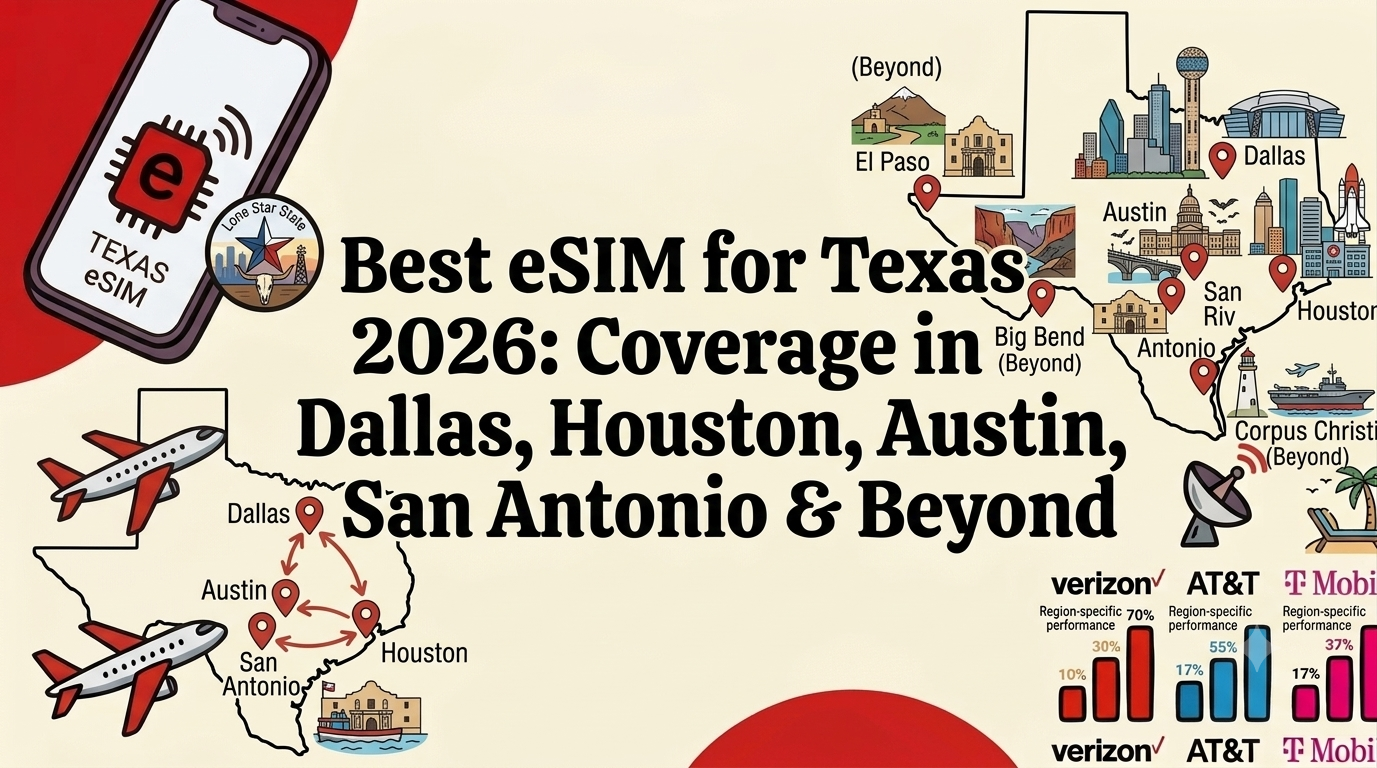
Texas is bigger than most countries. At 268,596 square miles, it is larger than France and Germany combined, larger than any nation in Western Europe, and contains within its borders some of the most diverse geography in North America: the Gulf Coast beaches of Galveston and Padre Island, the limestone hill country around Austin and San Antonio, the Big Bend desert wilderness in the far southwest, the forested Piney Woods of East Texas, and four major metropolitan areas that rank among the fastest-growing cities in the United States.
For international visitors, Texas requires more connectivity planning than almost any other US state precisely because of its size. Driving between Dallas and Houston takes nearly four hours on I-45. San Antonio to Big Bend National Park is a six-hour drive through increasingly remote terrain. You need reliable navigation, the ability to book last-minute accommodation, and a data connection that works across the entire state, not just in the major cities.
This guide covers everything you need to know about using an eSIM in Texas in 2026, including which networks cover Dallas, Houston, Austin, and San Antonio best, what to expect in remote areas like Big Bend and the Hill Country, and how much data you actually need for a Texas trip.
TLDR: eSIM for Texas at a Glance
- Best for Dallas and Houston: T-Mobile and AT&T both excellent; AT&T is Texas-born and has deep infrastructure investment here
- Best statewide coverage: AT&T and Verizon for rural Texas; T-Mobile best for urban 5G speeds
- Dallas: Excellent 5G across the entire metro including Fort Worth
- Houston: Outstanding coverage; one of the largest metros in the US, all three networks strong
- Austin: Tech hub with excellent 5G coverage
- San Antonio: Strong coverage citywide including the Riverwalk and Pearl District
- Big Bend National Park: Very limited coverage; plan to be offline for extended periods
- Recommended data: 8GB to 15GB for a week in Texas cities; unlimited for a road trip across the state
Why International Travelers Need an eSIM for Texas
Texas has seen dramatic growth in international tourism in recent years. Houston's George Bush Intercontinental Airport (IAH) is a major global hub with direct connections to over 60 international destinations. Dallas/Fort Worth International (DFW) rivals Houston as the primary gateway to the state, serving more than 75 million passengers annually and connecting to Europe, Latin America, and Asia daily. San Antonio International (SAT) serves routes from Mexico and several European cities.
For international arrivals, getting a local SIM card from a Texas carrier store takes time and requires navigating US payment systems. A travel eSIM purchased on Esimify before departure means you land at Houston or Dallas already connected, already using Google Maps, already calling your hotel or Airbnb host.
Texas also requires extensive rideshare and navigation use given that virtually every attraction requires a car or rideshare to reach. The state has essentially no intercity rail (beyond Amtrak's limited Sunset Limited and Texas Eagle services) and most cities have limited public transit. Every activity from museum hopping in Dallas to taco crawling in San Antonio requires an Uber, Lyft, or rental car with GPS, all of which need a data connection.
Texas Network Coverage: AT&T, T-Mobile, and Verizon
Texas has a unique network dynamic: AT&T was founded in Texas (its headquarters remain in Dallas) and has one of the deepest infrastructure footprints in the state of any carrier in the country. This translates to AT&T having particularly strong coverage across rural Texas where other networks thin out. T-Mobile leads for 5G speeds and urban coverage depth. Verizon rounds out coverage in areas where the other two fall short.
AT&T in Texas
AT&T's Texas coverage is comprehensive in a way that reflects the company's home-state advantage. The network is excellent in all four major metros and maintains solid LTE and 5G along the major interstate highways: I-35 from Laredo to Dallas/Fort Worth, I-10 from El Paso through San Antonio to Houston, I-45 from Houston to Dallas, and I-20 from El Paso east to Louisiana. In rural Texas, AT&T often maintains a signal where T-Mobile has dropped to a single bar or no service. For travelers doing a significant Texas road trip, AT&T-backed eSIM plans are worth considering for this reason.
T-Mobile in Texas
T-Mobile offers outstanding 5G performance in Dallas/Fort Worth, Houston, Austin, and San Antonio. The network has invested heavily in mid-band 5G across Texas's major cities, and in urban environments it typically leads for raw data speeds. Along the I-35 corridor (one of the most heavily traveled highways in the US) and I-10 between San Antonio and Houston, T-Mobile maintains consistent coverage. Where T-Mobile can underperform relative to AT&T is in the more remote regions: the Trans-Pecos desert west of the Pecos River, the brush country south of San Antonio toward Laredo and the Rio Grande Valley, and the high desert of West Texas.
Verizon in Texas
Verizon has strong coverage across Texas's cities and interstate corridors. Its performance in the big metros rivals T-Mobile and AT&T. In rural Texas, Verizon's LTE network provides coverage in many areas, though AT&T generally has the widest rural footprint in the state. For travelers primarily visiting major cities, Verizon is an excellent choice. For extensive rural travel, check coverage maps for specific destinations before committing.
Texas Coverage by City and Region
| City / Region | T-Mobile | AT&T | Verizon | Notes |
|---|---|---|---|---|
| Dallas / Fort Worth | Excellent 5G | Excellent 5G | Excellent 5G | AT&T HQ is here; all three networks outstanding |
| Houston (greater metro) | Excellent 5G | Excellent 5G | Strong 5G | One of the largest US metros; coverage is dense |
| Austin | Excellent 5G | Excellent 5G | Strong 5G | Tech hub; exceptional coverage density |
| San Antonio | Excellent | Excellent | Strong | Including the Riverwalk and Pearl District |
| I-35 (Dallas to San Antonio to Laredo) | Good to strong | Excellent | Good | AT&T most consistent along the full corridor |
| I-10 (Houston to San Antonio to El Paso) | Good (patchy west of Junction) | Good to strong | Good | Signal thins significantly west of Ozona; plan accordingly |
| Hill Country (Fredericksburg, Kerrville, Wimberley) | Good in towns | Good to strong | Good in towns | Rural stretches between towns can be spotty |
| Big Bend National Park | Very limited | Limited | Limited | Essentially offline; download everything before arriving |
| Galveston Island | Excellent | Excellent | Strong | Full coverage across the island |
| El Paso | Strong | Excellent | Strong | Good coverage; border proximity requires careful plan selection |
Dallas and Fort Worth: Where Business and Culture Meet
The Dallas-Fort Worth Metroplex is one of the most rapidly growing metropolitan areas in the United States, home to 7.8 million people and the headquarters of AT&T, American Airlines, ExxonMobil, and dozens of Fortune 500 companies. It is a sprawling region where a car or rideshare is essential for getting around.
Coverage across the DFW Metroplex is outstanding on all three networks, reflecting both the corporate investment AT&T has made in its home market and the competitive pressure from T-Mobile and Verizon. Downtown Dallas — including the Arts District, Uptown, Deep Ellum, the Pearl/Arts District, and Victory Park — all have excellent 5G. The Dallas Museum of Art, the Nasher Sculpture Center, the Perot Museum of Nature and Science, and AT&T Discovery District are all in strong coverage zones.
Fort Worth, 30 miles west on I-30, is a separate city with its own identity and strong wireless coverage throughout. The Fort Worth Stockyards National Historic District (where longhorn cattle drives still happen daily on Exchange Avenue), the Kimbell Art Museum, and the Modern Art Museum of Fort Worth are all well served. The Fort Worth Cultural District is particularly strong for T-Mobile and AT&T.
Dallas/Fort Worth International Airport (DFW) is the fourth-busiest airport in the world and has excellent coverage in all five terminals. Dallas Love Field (DAL), the closer airport serving Southwest Airlines, is similarly well covered. Both airports have strong signal throughout the international arrivals areas, so you are connected from the moment you clear customs.
Practical connectivity needs in Dallas/Fort Worth include heavy Uber/Lyft use (the DFW region has minimal public transit, with only the DART light rail serving a limited corridor), navigation between the spread-out cultural attractions, and booking restaurants via Resy or OpenTable in neighborhoods like Knox-Henderson, Bishop Arts District, Uptown, and West 7th in Fort Worth.
Houston: The Energy Capital of the World
Houston is the fourth-largest city in the United States by population and one of the most culturally diverse cities anywhere in North America. It has the largest concentration of nationalities in the US, over 145 languages spoken in the Houston Independent School District, and an international food scene that genuinely rivals any city in the country. For international travelers, Houston often feels like a city that speaks their language, literally and culinarily.
Wireless coverage in Houston is exceptional. The greater Houston metro spans Harris County and extends into eight surrounding counties, covering an area about the size of New Jersey. T-Mobile, AT&T, and Verizon all have dense coverage throughout the urban core and the major suburban corridors.
Downtown Houston, Midtown, Montrose (Houston's most walkable and restaurant-dense neighborhood), the Museum District (home to nineteen museums including the Houston Museum of Natural Science, the Museum of Fine Arts, and the Children's Museum of Houston), the Heights, East End, River Oaks, and the Galleria shopping area are all excellent for all three networks.
George Bush Intercontinental Airport (IAH) is Houston's primary international hub and has strong coverage throughout its five terminals. William P. Hobby Airport (HOU), which serves Southwest Airlines and is closer to downtown, is equally well covered.
Practical connectivity needs in Houston include navigation through what is one of the most sprawling highway systems in the US (the Loop 610, Beltway 8, and the Grand Parkway form concentric rings around the city), booking at Houston's extraordinary restaurant scene (the dining neighborhoods of Montrose and the Heights rival any US city), and using the Space Center Houston app at NASA's visitor center southeast of the city. Space Center Houston, about 25 miles from downtown along I-45, has solid coverage throughout the facility.
Austin: Live Music Capital, Tech Hub, and Outdoor Gateway
Austin has transformed from a quirky college town into one of the most internationally recognized cities in the US over the past decade. The South by Southwest festival draws hundreds of thousands of visitors each spring. The Formula 1 United States Grand Prix at Circuit of the Americas (COTA) brings a global audience each October. Austin-Bergstrom International Airport (AUS) now connects directly to London Heathrow, Frankfurt, Amsterdam, and Cancún among other international routes.
Coverage in Austin is excellent across all three major networks, with T-Mobile and AT&T both offering dense 5G coverage throughout downtown, South Congress (SoCo), East Austin, the South Lamar corridor, Rainey Street, West 6th Street, and the University of Texas campus area. Sixth Street, the most famous live music strip in Austin, is well covered — essential for checking set times, posting clips of live performances, and calling your Uber at 2am.
Barton Springs Pool in Zilker Park, the Blanton Museum of Art, the LBJ Presidential Library, and the Texas State Capitol are all in strong coverage zones. Barton Creek Greenbelt, Austin's popular hiking and swimming area along the creek, has coverage near the main access points but thins as you go deeper into the canyon.
The Hill Country west of Austin (Fredericksburg, Marble Falls, Johnson City) has reasonable coverage in the towns themselves but rural backroads between wineries and state parks can be spotty. Download offline maps before heading west from Austin.
San Antonio: The Riverwalk, the Alamo, and Beyond
San Antonio is one of the oldest cities in North America and the most visited city in Texas, drawing millions of visitors to the River Walk, the Alamo, and the Pearl District each year. Coverage in San Antonio is excellent across all three networks.
The River Walk (Paseo del Río) is a 15-mile network of walkways along the San Antonio River lined with restaurants, bars, hotels, and cultural venues. It is one of the most visited tourist attractions in the US and has excellent coverage throughout, including the underground sections where the river passes below street level. The Alamo is a ten-minute walk from the River Walk and has strong signal throughout the site and the surrounding Alamo Plaza.
The Pearl District, a redeveloped former brewery campus on the northern stretch of the River Walk, has become San Antonio's most vibrant dining and market destination. Coverage is excellent throughout. The San Antonio Museum of Art, the McNay Art Museum, and the Witte Museum in Brackenridge Park all have strong coverage. Six Flags Fiesta Texas, a major theme park northwest of downtown, is served well by T-Mobile and AT&T inside the park.
Day trips from San Antonio frequently include New Braunfels and the Guadalupe River (tubing mecca for Texas summers), Gruene (home to the oldest dance hall in Texas), Fredericksburg in the Hill Country, and Natural Bridge Caverns. Coverage varies: New Braunfels and Gruene have solid signal; Fredericksburg's main street has strong coverage; Natural Bridge Caverns obviously goes dark underground.
Big Bend: Going Off the Grid in West Texas
Big Bend National Park is the most remote national park in the contiguous 48 states, covering 801,163 acres in the Chihuahuan Desert along the Rio Grande on the US-Mexico border. It is also one of the least-connected places in the US. Coverage inside the park is essentially nonexistent on all three major networks.
The last reliable signal you will have on the approach from the north is in Marathon, Texas (a small town on US-385 about 40 miles north of the park entrance). From there, assume you are offline. Verizon occasionally shows a signal near the Panther Junction Visitor Center but it is unreliable.
Big Bend requires the same offline preparation as Yosemite or the Everglades: download the NPS Big Bend app, download AllTrails maps for every trail you plan to hike, download offline Google Maps for the entire Trans-Pecos region, and let someone know your itinerary. The Big Bend area also has no gas stations inside the park, so plan fuel as carefully as you plan data.
The drive from San Antonio or Dallas to Big Bend is a genuine road trip: 5 to 8 hours depending on your starting point. Along I-10 west of Junction and through the stretch from Ozona to Fort Stockton, coverage becomes increasingly sparse. West of Fort Stockton, service is limited but AT&T maintains signal in Pecos, Fort Stockton, and Alpine. Marfa, the famous art town between Fort Stockton and Big Bend, has solid coverage from AT&T and reasonable T-Mobile signal.
FIFA World Cup 2026 in Texas: Dallas and Houston
Texas is hosting the 2026 FIFA World Cup across two cities — Dallas and Houston — making it, alongside California, the only US state with multiple host venues in the tournament. The World Cup runs from June 11 through July 19, 2026 across 16 cities in the United States, Canada, and Mexico. For international soccer fans, Texas is one of the most compelling destinations in the entire tournament, offering world-class stadiums, enormous fan cultures, and two of the most diverse and welcoming cities in North America.
Dallas: AT&T Stadium in Arlington
Dallas World Cup matches will be played at AT&T Stadium in Arlington, Texas, the home of the Dallas Cowboys and one of the most technically advanced sports facilities in the world. The stadium sits between Dallas and Fort Worth — about 20 miles west of downtown Dallas and 15 miles east of downtown Fort Worth — and seats approximately 80,000 in its soccer configuration, with capacity expandable to over 100,000 for major events.
AT&T Stadium was built by AT&T, which means the cellular infrastructure inside the venue is exceptional. AT&T's network performs outstandingly throughout the facility. T-Mobile and Verizon are both well represented as well. This is one of the most connected stadiums in the country for in-venue cellular performance.
Getting to AT&T Stadium from downtown Dallas requires either the Trinity Railway Express (TRE) commuter rail to the CentrePort/DFW Airport station followed by a shuttle, or Uber/Lyft (expect heavy surge pricing on match days — the stadium sits directly between two major cities and demand will be extreme). Pre-book your transportation. Download offline maps for the Arlington area before match day as a backup when networks are congested near the stadium perimeter.
The Dallas World Cup experience extends beyond the stadium. The Deep Ellum neighborhood, Bishop Arts District, and Uptown Dallas are all expected to host fan activations and viewing parties throughout the tournament. AT&T's home city advantage means excellent coverage across all of these fan areas.
Houston: NRG Stadium
Houston World Cup matches will be played at NRG Stadium in the NRG Park complex, home of the Houston Texans. NRG Stadium seats approximately 72,000 for soccer and sits about 7 miles south of downtown Houston near the Texas Medical Center and Reliant Park. It is one of the only NFL venues with a retractable roof, making it ideal for Texas's unpredictable summer weather during the tournament.
Getting to NRG Stadium from downtown Houston is straightforward via the METRORail Red Line, which has a station at NRG Park. The ride from downtown takes about 20 minutes and the Red Line has strong AT&T and T-Mobile coverage throughout its elevated corridor. Uber and Lyft are available but will surge significantly on match days given Houston's traffic patterns and the density of visitors arriving at the stadium simultaneously.
Houston's World Cup significance extends beyond the matches themselves. The city's extraordinary cultural diversity means the fan experience in Houston will be genuinely multicultural in a way few US cities can match. The Midtown neighborhood, Montrose, and the areas around Discovery Green downtown are all expected to feature fan zones and public viewing events. Coverage is excellent across all of these neighborhoods.
Traveling Between Dallas and Houston for the World Cup
With both cities hosting World Cup matches, some visitors will plan to see games in both Dallas and Houston. The drive between them on I-45 takes approximately 3.5 to 4 hours without traffic, though traffic near both cities can add significant time on match days. There is no high-speed rail between the cities, but Amtrak's Texas Eagle connects Dallas and Houston via an overnight service (not practical for same-day travel). Flying between DFW/DAL and IAH/HOU takes about an hour including airport time. Plan your inter-city logistics before arriving; last-minute accommodation in either city during match weeks will be scarce and expensive.
Mexico Fans in Texas: Cross-Border Tournament Travel
Mexico is a co-host of the 2026 World Cup, with matches played in Mexico City (Estadio Azteca), Guadalajara (Estadio Akron), and Monterrey (Estadio BBVA). Many Mexican football fans will travel north to Texas to watch games in Dallas and Houston as part of a broader tournament trip. For those crossing from Mexico into Texas at Laredo, El Paso, or McAllen, your US eSIM activates the moment you cross the border. If you need data on both sides, choose a North America plan that covers the US and Mexico simultaneously.
How Much Data Do You Need for a Texas Trip?
- Week in Dallas or Houston only: 8GB to 12GB. Heavy Uber/Lyft use, restaurant apps, museum bookings, social media posting.
- Week across Austin and San Antonio: 8GB to 12GB. Similar to other Texas cities; Hill Country day trips add some navigation data use.
- Two-week Texas road trip (all four major cities plus Hill Country): 15GB to 20GB. Continuous navigation between cities, extended driving, accommodation apps.
- Big Bend expedition: 3GB to 5GB. Most of the trip is offline; data used mainly in cities before and after. Download everything before you go.
- Month-long stay (business or extended visit): Unlimited plan. Texas cities are data-dense environments and a month of professional use adds up fast.
Tips for Using an eSIM in Texas
- AT&T is the Texas carrier: AT&T's roots in Dallas give it deep rural infrastructure across the state. If you are doing a significant road trip through West Texas, the Hill Country, or along the Rio Grande Valley, an AT&T-backed eSIM plan gives you the widest statewide coverage.
- Houston and Dallas require rideshare for almost everything: These cities are built around the car. Uber and Lyft are essential. Have your eSIM active before you land and the app already installed.
- Download offline maps before entering Big Bend: The last reliable connection point heading south from the north is Marathon, TX. After that, plan to navigate entirely offline. Download the entire Trans-Pecos region in Google Maps offline mode.
- Texas summers are extreme: Average summer temperatures in Dallas and Houston exceed 95°F (35°C), with heat index values frequently above 110°F (43°C). Download the National Weather Service app or Weather Underground for localized Texas weather alerts. Heat emergencies are a real risk and having weather data is a safety issue, not just convenience.
- SXSW and Formula 1 network congestion: During South by Southwest in Austin (March) and the US Grand Prix at COTA (October), Austin's network is under enormous strain from hundreds of thousands of simultaneous users. T-Mobile has invested in temporary capacity additions for these events, but expect slower speeds and occasional connection drops in the densest areas around the venues.
- El Paso and the Mexican border: If you visit El Paso and cross into Ciudad Juárez, Mexico, your US eSIM plan will not cover Mexican data. You will need a separate Mexico plan or a North America plan that includes Mexico.
- Galveston ferry: The free Galveston-Port Bolivar ferry across Galveston Bay takes about 20 minutes and maintains AT&T and T-Mobile signal throughout the crossing.
Real-World Scenarios: Texas Visitors
The UK Family at San Antonio and the River Walk
A British family of four flying into San Antonio International (or connecting through Dallas) for a 10-day Texas holiday. They want to spend time on the River Walk, visit the Alamo, do a day trip to Natural Bridge Caverns, and then head to Houston's Space Center and Kemah Boardwalk before flying home from IAH. A 15GB plan distributed across two adult devices covers the trip comfortably, with restaurant bookings, Uber use, and social media posting from iconic Texas locations.
The German Business Traveler in Houston and Dallas
A senior executive from Frankfurt flying in for meetings at an energy company in Houston's Galleria area and then heading north to Dallas for a client event at AT&T Stadium in Arlington. They need reliable 5G for video calls between offices, Slack, corporate email, and navigation. AT&T's home network in Dallas makes it the natural choice. A 15GB plan covers a week of intensive business use across both cities.
The Mexican Tourist on a Texas Road Trip
A traveler from Mexico City on a two-week road trip covering Laredo, San Antonio, Austin, Houston, and Dallas. They entered by car at the Laredo international crossing. Their US eSIM activates automatically on the north side of the Rio Grande. AT&T coverage is strong along the I-35 corridor from Laredo north through San Antonio and Austin all the way to Dallas/Fort Worth, making it the ideal network for this itinerary.
The Adventure Traveler Visiting Big Bend
A solo traveler from Japan flying into Dallas, spending two days in the city, then driving west across West Texas to Big Bend for a five-day backcountry camping experience before returning. They need a reliable connection in Dallas (8GB worth), and then accept going essentially offline from Fort Stockton onwards. A 10GB plan covers the full trip; they use 7GB in Dallas and save 3GB for the return leg through Midland-Odessa and back to Dallas.
Frequently Asked Questions: eSIM in Texas
What is the best network for Texas?
AT&T is the best overall network for Texas if you plan to travel across the state, particularly into West Texas and rural areas. T-Mobile offers the best 5G speeds in Dallas, Houston, Austin, and San Antonio. Verizon is a strong choice for the major cities. For a mixed city and road trip itinerary, AT&T provides the most consistent statewide coverage.
Is there cell service in Big Bend National Park?
Very limited service exists near the Panther Junction Visitor Center on some networks, but coverage is unreliable and should not be counted on. Download all maps, trail guides, and park information before leaving Marathon, TX, the last town with reliable signal on the approach from the north.
Does my eSIM work at DFW and Houston airports?
Yes. Dallas/Fort Worth International (DFW), Dallas Love Field (DAL), George Bush Intercontinental (IAH), and William P. Hobby (HOU) all have excellent coverage from T-Mobile, AT&T, and Verizon throughout the terminals.
Can I use a US eSIM in Mexico from El Paso?
A standard US-only eSIM plan does not cover Mexico. If you cross from El Paso into Ciudad Juárez, you need a plan that includes Mexico or a separate Mexican eSIM. Esimify offers plans that cover both the US and Mexico for travelers visiting both sides of the border.
How is coverage along I-10 from Houston to El Paso?
Coverage is good from Houston through San Antonio and into Junction. West of Junction, coverage starts to thin significantly. Between Ozona and Fort Stockton, signal can be intermittent. From Fort Stockton to El Paso, AT&T is the most consistent network. Download offline maps for the full I-10 West Texas stretch before leaving San Antonio.
Do I need a car in Texas?
In the major cities, you can survive without a car using Uber and Lyft, though it adds cost. For any travel outside the major city cores, particularly Hill Country, Big Bend, and the Panhandle, a rental car is essential. Your eSIM is especially important for rental car GPS navigation.
Conclusion: Exploring the Lone Star State Connected
Texas rewards curiosity. Its sheer size means every region feels like a different country: cosmopolitan Houston, creative Austin, historic San Antonio, the corporate energy of Dallas and Fort Worth, the cowboy culture of the Hill Country, the austere beauty of Big Bend and West Texas. An eSIM gives you the connectivity to move between all of these with confidence.
For city-focused visits to Dallas, Houston, Austin, or San Antonio, any of the three major US networks will serve you excellently. For a statewide road trip, prioritize an AT&T-backed eSIM plan for the broadest rural coverage. For Big Bend and deep West Texas, prepare to be genuinely offline and embrace it — the lack of connectivity is part of the experience.
Find the right US eSIM plan for your Texas trip at Esimify, and explore guides for every other state and country on your American adventure in the Esimify blog.