






Best eSIM for Germany 2026: Staying Connected from Berlin to the Bavarian Alps
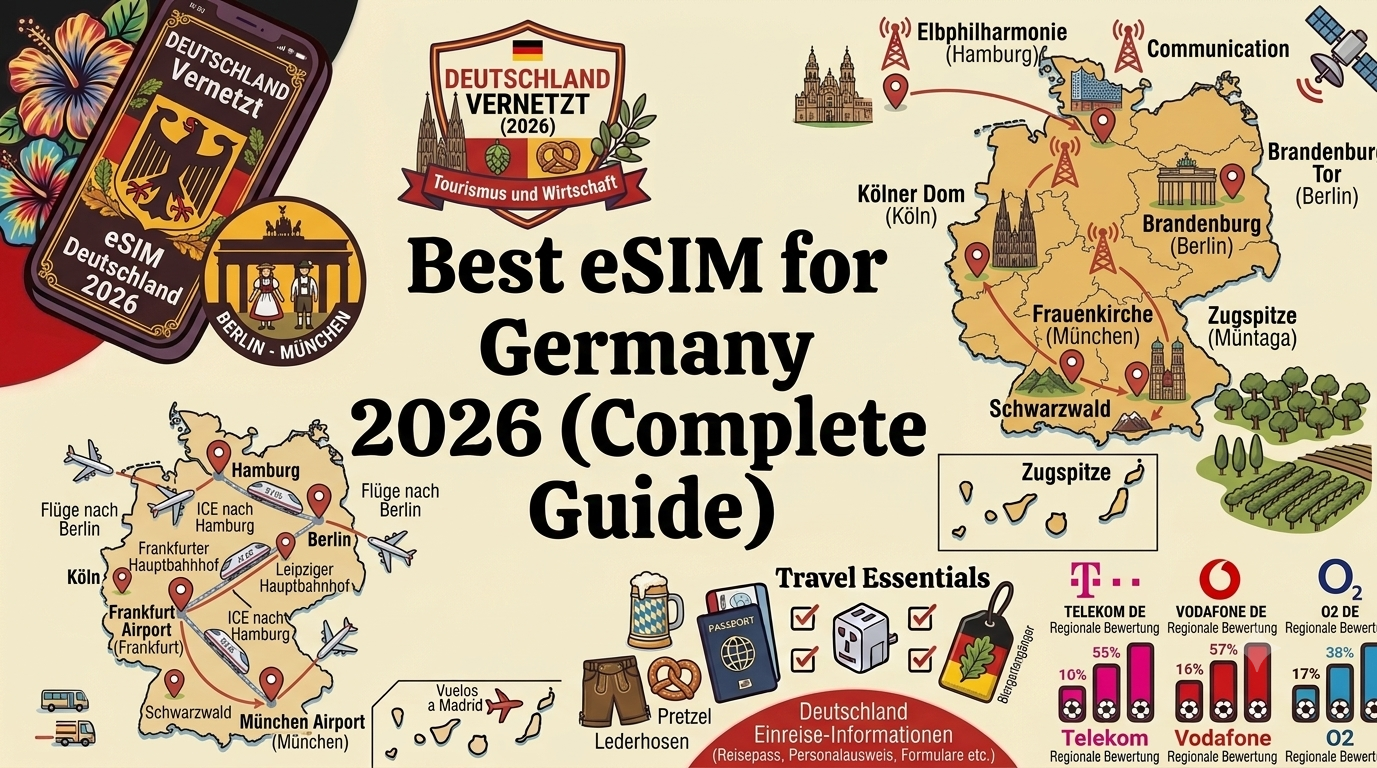
Germany sits at the heart of Europe, both geographically and as a travel hub, with Frankfurt and Munich among the busiest airports on the continent and a high-speed rail network that makes hopping between cities effortless. Whether you are attending a trade fair in Frankfurt, exploring Berlin's history and nightlife, driving the Romantic Road through Bavaria, or planning ahead for Germany's national team at the 2026 World Cup, having reliable mobile data from the moment you arrive makes everything easier.
This guide walks through everything you need to know about getting an eSIM for Germany in 2026: which networks cover which regions best, how Germany's famously patchy rural coverage compares to its excellent urban networks, what to expect on the autobahn and on trains, and how to pick the right data plan for your trip. Whether you are visiting for a few days or relocating for months, this guide will help you stay connected without surprise roaming charges.
TLDR: Best eSIM for Germany in 2026
- Germany's three main network operators are Deutsche Telekom (T-Mobile), Vodafone, and O2 (Telefonica), with Deutsche Telekom generally offering the best rural and nationwide coverage.
- Major cities (Berlin, Munich, Frankfurt, Hamburg, Cologne) have strong 4G and growing 5G coverage, but some rural areas, forests, and even sections of major highways still have coverage gaps, a long-standing issue in Germany known locally as "Funklöcher" (radio holes).
- An eSIM activated before you fly means you are connected the moment you land at Frankfurt, Munich, Berlin Brandenburg, or any other German airport.
- For multi-country trips through Europe, a regional plan from Esimify's Europe eSIM covers Germany alongside neighboring countries like France, Austria, and the Netherlands.
- Germany's national team is a perennial World Cup contender, and fans traveling to the 2026 tournament in North America should also check our FIFA World Cup 2026 eSIM guide covering all 16 host cities.
- Recommended starting point: 10-20GB for a one to two week trip; more if working remotely or relying on navigation for a road trip.
Why You Need an eSIM for Germany
Germany is part of the EU and Schengen Area, so EU residents traveling from other EU countries typically benefit from "roam like at home" rules. But for visitors from the US, UK, Canada, Australia, and most of Asia, roaming charges in Germany can add up fast, often five to fifteen US dollars per day for limited data, with many carriers throttling speeds to a crawl after a small daily allowance.
An eSIM avoids this by letting you download a German or European data plan directly to your phone before you travel. You keep your home number active for calls and texts while using the eSIM purely for data, or use a German number alongside it if your plan includes one.
Who This Guide Is For
- Business travelers attending trade fairs in Frankfurt, Hannover, Cologne, or Munich, where reliable connectivity for emails and video calls is essential.
- Tourists visiting Berlin, Munich, and other major cities, or following classic routes like the Romantic Road or the Rhine Valley.
- Road trippers driving the autobahn between cities or through the Black Forest and Bavarian Alps.
- Digital nomads based temporarily in Berlin, Munich, or other German cities with strong co-working scenes.
- Football fans following the Bundesliga during the season, or planning to support the German national team at the 2026 World Cup in North America.
- Multi-country travelers combining Germany with neighboring Austria, Switzerland, the Netherlands, France, or the Czech Republic.
Mobile Networks in Germany: Coverage Overview
Germany has three network operators that own physical infrastructure, plus numerous virtual operators (MVNOs) that resell access to these networks.
Deutsche Telekom (T-Mobile)
Deutsche Telekom, branded as T-Mobile in some contexts, operates Germany's most extensive network and is consistently rated the best for rural coverage, motorway coverage, and overall reliability. If your trip includes driving through rural Bavaria, the Black Forest, or smaller towns, Deutsche Telekom is generally your safest bet for staying connected.
Vodafone Germany
Vodafone has strong coverage in major cities and along key transport corridors, with competitive 5G rollout in urban centers including Berlin, Hamburg, and Cologne. Vodafone also has a significant presence in the former East Germany, including Leipzig and Dresden.
O2 (Telefonica Germany)
O2 has historically lagged behind Deutsche Telekom and Vodafone in rural coverage, though it has invested heavily in closing this gap and now offers solid coverage in cities and along major routes. O2 tends to be the most budget-friendly of the three networks.
Understanding Germany's "Funklöcher" (Coverage Gaps)
Despite being one of the world's largest economies, Germany has a well-documented issue with mobile coverage gaps, particularly in rural areas, forests, and along certain stretches of railway and highway. This is a frequent topic of public debate and infrastructure investment in Germany. The good news for travelers is that these gaps are concentrated in specific areas (often dense forest regions or sparsely populated agricultural areas) and rarely affect the cities, towns, and tourist routes that make up most travel itineraries. Choosing an eSIM that connects to Deutsche Telekom's network, where coverage gaps are smallest, is the best way to minimize the impact of these gaps.
Network Coverage by Region
| Region | Best Coverage | 5G Availability | Notes |
|---|---|---|---|
| Berlin | Vodafone, Deutsche Telekom | Widespread across central districts | Some U-Bahn tunnels still have limited signal |
| Munich and Bavaria | Deutsche Telekom | Strong in city, good along major routes | Alpine valleys and forest areas may drop to 4G or have gaps |
| Frankfurt | Vodafone, Deutsche Telekom, O2 | Excellent, including airport | One of the best-connected cities in Germany due to financial sector demand |
| Hamburg | Vodafone, Deutsche Telekom | Strong in city center and port areas | Good coverage along the Elbe |
| Cologne and the Rhine Valley | Deutsche Telekom, Vodafone | Good in cities, variable in valley villages | River cruise routes generally well covered |
| Black Forest | Deutsche Telekom | Limited 5G, mostly 4G | Some valleys and dense forest areas have gaps |
| Autobahn (long-distance) | Deutsche Telekom | 4G/5G along most major routes | Brief gaps possible in remote stretches, especially in eastern Germany |
City-by-City Connectivity Guide
Berlin
Berlin's connectivity is generally excellent across the city's central districts, including Mitte, Kreuzberg, Friedrichshain, and Charlottenburg. Berlin Brandenburg Airport has full coverage from all major networks. The U-Bahn and S-Bahn systems have improved underground coverage in recent years, though some older tunnel sections on the U-Bahn can still have brief dead zones. If you are visiting major sites like the Brandenburg Gate, Museum Island, or the East Side Gallery, expect strong, consistent signal.
Munich and Bavaria
Munich itself has excellent coverage, including during Oktoberfest when the Theresienwiese fairgrounds host hundreds of thousands of visitors and networks experience heavy but generally manageable congestion. If you are heading out of the city toward Neuschwanstein Castle, the Bavarian Alps, or smaller towns along the Romantic Road, Deutsche Telekom is the most reliable choice, as some valley towns and mountain areas have weaker coverage from Vodafone and O2.
Frankfurt
As Germany's financial capital and home to one of Europe's busiest airports, Frankfurt has some of the best connectivity in the country. Business travelers attending events at Messe Frankfurt (one of the world's largest trade fair venues) will find strong coverage throughout the exhibition halls, hotels, and the city center.
Hamburg
Hamburg's city center, harbor area (HafenCity), and the Reeperbahn nightlife district all have strong coverage. If you are taking a harbor cruise or visiting the Elbphilharmonie, connectivity remains solid throughout.
Cologne and the Rhine Valley
Cologne itself has strong coverage, including around the famous cathedral and main station. If you extend your trip along the Rhine Valley toward Koblenz or Mainz, popular for river cruises and castle-spotting, coverage is generally good in towns but can dip briefly in narrower sections of the valley.
The Black Forest and Southern Germany
The Black Forest region, popular for hiking, cuckoo clocks, and spa towns like Baden-Baden, has good coverage in towns but is one of the areas where Germany's rural coverage gaps are most noticeable. If you are hiking remote trails, download offline maps in advance and do not rely on constant connectivity.
Germany and the FIFA World Cup 2026
Germany is not hosting matches at the 2026 World Cup, which is being held across the United States, Canada, and Mexico, but the German national team is consistently among the tournament favorites and travels with one of the largest and most organized fan followings in international football. If you are planning to follow Die Mannschaft to North America, or simply traveling to Germany around major Bundesliga fixtures or international friendlies in the lead-up to the tournament, connectivity planning matters on both ends of the trip.
For your time in Germany, a Germany-specific or Europe-wide eSIM keeps you connected for navigation, translation, and staying in touch. If your travels then take you to North America for the tournament itself, our FIFA World Cup 2026 eSIM guide covers connectivity at all 16 host stadiums across the US, Canada, and Mexico.
Choosing the Right eSIM Plan for Germany
Short City Trips (3-7 Days)
For a typical visit to Berlin, Munich, or another major city, a 5-10GB plan is usually sufficient for maps, messaging, and social media, with some room for streaming.
Road Trips and Multi-City Itineraries (1-3 Weeks)
If you are renting a car to drive the Romantic Road, explore the Bavarian Alps, or tour the Rhine Valley, a 20GB plan gives you headroom for constant navigation use. Combining Germany with neighboring countries like Austria, Switzerland, or the Czech Republic makes a regional Europe eSIM the most practical option, since you will not need to switch profiles when crossing borders, which in the Schengen Area can happen without any checkpoint at all.
Business Travelers and Trade Fair Visitors
If you are attending a major trade fair like IFA in Berlin, the Frankfurt Motor Show, or events at Messe Munchen, a 15-20GB plan covers a typical multi-day conference with video calls, email, and navigating between venues and hotels.
Digital Nomads and Long-Term Stays
Berlin and Munich both have thriving co-working and start-up scenes, and many long-term visitors use eSIMs as a flexible alternative to signing a German mobile contract, which can require a local bank account and longer-term commitments. A 50GB or unlimited monthly plan suits most remote workers, particularly if relying on mobile data as a backup to apartment WiFi.
Real-World Scenarios: How Travelers Use eSIMs in Germany
Scenario 1: The Business Traveler at IFA Berlin
James flies into Berlin for a four-day trade show. He activates his eSIM before departure, so by the time he lands at Brandenburg Airport, he can immediately check emails, navigate to his hotel, and join a video call with colleagues back home. Throughout the trip, between conference WiFi and his eSIM data for transit and evenings out, he uses about 4GB on a 10GB plan.
Scenario 2: The Road Trip Through Bavaria and the Romantic Road
The Martinez family rents a car in Munich and drives the Romantic Road toward Rothenburg ob der Tauber and Fussen, visiting Neuschwanstein Castle along the way. With navigation running for most of the ten-day trip across multiple phones, they use a 25GB plan. They notice a couple of brief signal gaps in valley sections near the Alps, but overall connectivity holds up well thanks to their Deutsche Telekom-based eSIM.
Scenario 3: The Digital Nomad in Berlin
Priya relocates to Berlin for two months to work remotely. She sets up a 50GB monthly eSIM plan, using it as backup connectivity for her co-working space's WiFi and for video calls while commuting on the U-Bahn, where coverage has improved enough in recent years to support most calls without dropping.
Scenario 4: The Backpacker on the Rhine Valley and Black Forest Route
Olivia is backpacking through Cologne, down the Rhine Valley, and into the Black Forest over two weeks, relying on her phone for hostel bookings and train schedules via the Deutsche Bahn app. She finds coverage strong in towns along the Rhine, with occasional brief gaps in the Black Forest's denser forest sections, where she switches to offline maps she downloaded in advance.
Tips and Best Practices
Before You Travel
- Install your eSIM profile over WiFi before departure, since the activation process requires an internet connection.
- Confirm your phone is unlocked and eSIM-compatible. Most iPhones from the XS onward and recent flagship Android phones support eSIM.
- If you plan to drive, choose an eSIM running on Deutsche Telekom's network for the best rural and motorway coverage.
While in Germany
- Download the Deutsche Bahn (DB Navigator) app and offline maps before heading into rural areas, as some regional train routes pass through coverage gaps.
- Many German cafes and restaurants do not offer free WiFi as a default, unlike in some other countries, so having reliable mobile data is especially useful.
- If attending Oktoberfest or major festivals, expect some network slowdown during peak hours due to the sheer density of devices, even with strong underlying coverage.
Common Issues and Troubleshooting
- No signal after landing: Ensure data roaming is enabled for your eSIM line in your phone's settings, the most common cause of connectivity issues immediately after arrival.
- Coverage drops in rural areas: This is often a genuine "Funkloch" rather than an eSIM issue. Switching to an eSIM on Deutsche Telekom's network minimizes this, but some gaps are unavoidable in remote regions.
- eSIM not activating: Confirm your device's date and time are set to automatic, as incorrect settings can prevent network registration.
Germany Travel Recommendations Beyond Connectivity
Beyond Berlin and Munich, Germany rewards travelers who explore its regional diversity: the medieval old towns of Bamberg and Regensburg, the wine villages of the Mosel Valley, the Baltic coastline near Lubeck, and the Christmas markets that take over town squares across the country every December. Public transport is excellent and well-connected, with the Deutsche Bahn rail network linking even smaller towns efficiently, though delays are common enough that locals joke about it.
For up-to-date entry requirements, particularly for non-EU visitors, check official government travel advisories, as Schengen Area rules can change.
Frequently Asked Questions
Does my phone support eSIM in Germany?
Most smartphones from 2019 onward, including iPhone XS and later and most flagship Samsung and Google Pixel devices, support eSIM. Check your device settings under "Mobile Data" or "Cellular" to confirm, or search your phone model plus "eSIM compatible."
Which network is best for rural Germany?
Deutsche Telekom (T-Mobile) consistently has the best rural and motorway coverage in Germany, making it the safest choice if your itinerary includes road trips, hiking, or visits to smaller towns.
Will my eSIM work on German trains?
Yes, in most cases. Major routes between cities generally have good coverage, though some regional lines and tunnel sections can have brief gaps, particularly in mountainous or forested areas.
How much data do I need for a week in Germany?
For typical tourist use, including maps, messaging, and browsing, 5-10GB is usually enough for a week. If you plan to stream or make frequent video calls, consider 15-20GB.
Can I use my eSIM for a multi-country European trip?
Yes, a regional Europe eSIM that includes Germany alongside neighboring countries is generally more convenient and cost-effective than buying separate plans for each country, especially since Schengen Area borders often have no checkpoints at all.
Are there real coverage gaps in Germany, or is that a myth?
It is real, though often exaggerated for travel purposes. Coverage gaps are concentrated in rural, forested, and mountainous areas, and rarely affect cities, major towns, or popular tourist routes, which make up the vast majority of most visitors' itineraries.
Conclusion
Germany offers excellent connectivity in its cities and along major travel routes, with Deutsche Telekom providing the most reliable coverage for rural areas and road trips. Setting up an eSIM before you travel means you can be online from the moment you land at Frankfurt, Munich, Berlin, or any other German airport, without the hassle of finding a SIM card shop or facing steep roaming charges.
Whether you are attending a trade fair in Frankfurt, road-tripping through Bavaria, working remotely from Berlin, or planning to follow the German national team to the 2026 World Cup in North America, choosing the right eSIM plan makes your trip smoother from start to finish. Browse Esimify's Europe eSIM plans for Germany and the surrounding region, and visit the Esimify travel blog for more guides, including our coverage of Spain, Portugal, and the FIFA World Cup 2026 host cities.