Best eSIM for FIFA World Cup 2026: Complete Connectivity Guide for All 16 Host Cities
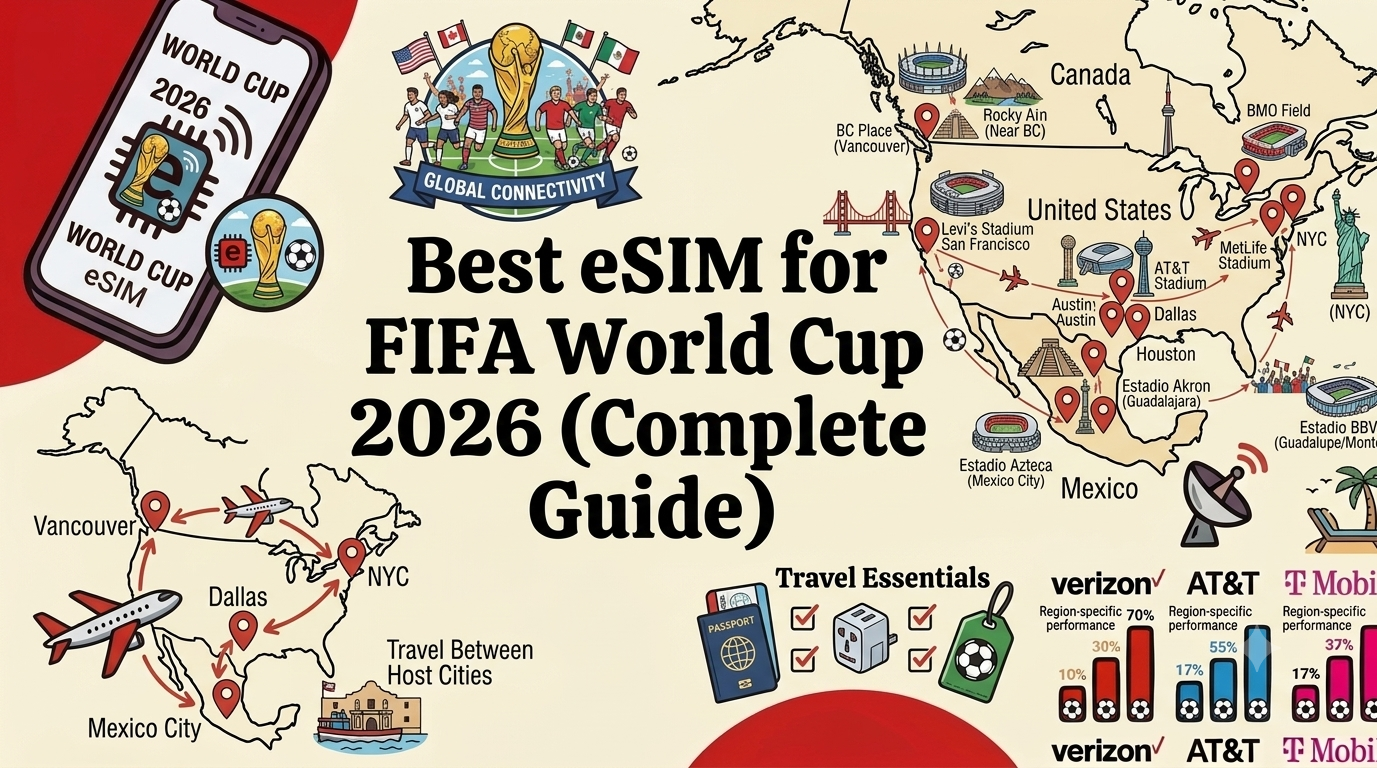
The 2026 FIFA World Cup is the most ambitious football tournament ever staged. Spread across 16 cities in three countries — the United States, Canada, and Mexico — it runs from June 11 through July 19, 2026, with 48 national teams competing across 104 matches over 39 days. Tens of millions of fans are traveling across North America to witness it, many of them crossing international borders multiple times to follow their national team from group stage through knockout rounds.
For international supporters, connectivity is not a luxury during the World Cup — it is essential infrastructure. You need live data to check match schedules and confirm lineup changes on the FIFA+ app, to navigate unfamiliar cities on match day, to book last-minute accommodation as your team advances, to order a rideshare from the stadium after an evening kick-off, and to share that goal celebration clip with supporters at home before the halftime whistle blows.
The challenge: the 2026 World Cup spans three countries with three different network infrastructures. A SIM card that works in Houston does not automatically work in Toronto or Monterrey. This guide covers everything you need to know about staying connected across every host city in the United States, Canada, and Mexico throughout the tournament.
TLDR: eSIM for the 2026 World Cup
- Three countries, one tournament: You need a North America plan covering the US, Canada, and Mexico to follow your team across borders
- Tournament dates: June 11 to July 19, 2026
- World Cup Final: July 19, 2026 at MetLife Stadium, East Rutherford, New Jersey (New York metro)
- Best US network for stadium areas: T-Mobile and AT&T; Verizon strong at several NFL venues
- Best approach for multi-country travel: Single North America eSIM plan from Esimify covering all three host nations
- Recommended data: 15GB to 25GB for a two-week tournament trip; unlimited for month-long attendance
- Activate before you travel: Set up your eSIM at home so you land in any host city already connected
Why a Standard SIM Will Not Work Across the World Cup
Most international travelers arrive with a SIM from their home country. In their home country, that SIM works fine. The moment they land in the United States, they are roaming — paying per-MB international rates or hitting a roaming data cap that runs out before they make it from the airport to their hotel. Cross into Canada for a match in Toronto or Vancouver and they are roaming on a second network. Cross south into Mexico for a match in Mexico City, Guadalajara, or Monterrey and they are on a third.
The solution for World Cup travelers following teams across borders is a dedicated North America travel eSIM that covers all three host countries under a single plan. This gives you one data allowance, one activation, and no surprise roaming charges whether you are watching a group stage match in Houston, a round-of-16 game in Vancouver, or a quarter-final in Mexico City.
Even for travelers staying entirely within one country for the tournament, a travel eSIM is the better option over trying to buy a local prepaid SIM in the US, Canada, or Mexico. US carriers require a US billing address for most retail plans. Canadian carriers have among the highest prepaid data prices in the developed world. Mexican carriers are accessible but require navigating a Spanish-language setup process. A travel eSIM purchased before departure eliminates all of that.
The 16 Host Cities: What to Expect
The 2026 World Cup is organized into three geographic regions for the group stage: the Western Region (Vancouver, Seattle, San Francisco Bay Area, Los Angeles), the Central Region (Guadalajara, Mexico City, Monterrey, Houston, Dallas, Kansas City), and the Eastern Region (Atlanta, Miami, Toronto, Boston, Philadelphia, New York/New Jersey). Here is a guide to each host city and what connectivity looks like on the ground.
United States Host Cities
New York / New Jersey — MetLife Stadium (World Cup Final, July 19)
MetLife Stadium in East Rutherford, New Jersey hosts the FIFA World Cup Final on July 19, 2026, making the greater New York area the undisputed center of the tournament's climax. The stadium seats over 82,500 and has exceptional distributed antenna system (DAS) infrastructure for all three major US carriers. Verizon, T-Mobile, and AT&T all perform well inside the venue. From Manhattan, the NJ Transit dedicated match-day train service from Penn Station is the recommended transport option, taking about 30 minutes. For a complete guide to connectivity in New York, New Jersey, and the surrounding region, see our Best eSIM for New York 2026 guide.
Los Angeles — SoFi Stadium, Inglewood
SoFi Stadium in Inglewood is one of the marquee venues of the tournament. Coverage in and around the stadium is excellent on T-Mobile and AT&T. The LA metro has outstanding 5G across the entire basin. Getting to SoFi Stadium from central Los Angeles requires the Metro C Line to Inglewood or rideshare; expect heavy surge pricing on match days so plan early. See our detailed Best eSIM for California 2026 guide for full coverage of LA, San Francisco Bay Area, and the broader state.
San Francisco Bay Area — Levi's Stadium, Santa Clara
Levi's Stadium sits in the heart of Silicon Valley, two miles from Apple's headquarters in Cupertino. Coverage is exceptional — this is, after all, the tech capital of the world. VTA light rail connects San Jose and surrounding cities to a stop adjacent to the stadium. AT&T, T-Mobile, and Verizon all perform at their best in the Bay Area's dense tech corridor. Full Bay Area coverage details are in our Best eSIM for California 2026 guide.
Dallas — AT&T Stadium, Arlington
AT&T Stadium in Arlington is one of the largest and most technically sophisticated venues in the tournament. With over 80,000 seats and a retractable roof, it is built for spectacle. AT&T's home-market investment means in-venue coverage is outstanding. T-Mobile and Verizon are strong as well. Getting there from downtown Dallas requires the Trinity Railway Express to a shuttle, or rideshare with surge pricing on match days. See our Best eSIM for Texas 2026 guide for the full Dallas and Houston coverage breakdown.
Houston — NRG Stadium
NRG Stadium's retractable roof makes it ideal for Texas summer weather during the tournament. The METRORail Red Line runs directly to the NRG Park station, making it one of the easiest US venues to reach by public transit. Coverage is excellent throughout the stadium and the surrounding Houston Medical Center area. Full Houston connectivity details are in our Best eSIM for Texas 2026 guide.
Miami — Hard Rock Stadium, Miami Gardens
Hard Rock Stadium hosts group stage and knockout matches in one of the most internationally diverse host cities in the tournament. Miami's large Latin American diaspora means the fan atmosphere for Central and South American team matches here will be extraordinary. T-Mobile and AT&T both offer excellent coverage at the stadium and throughout the Miami metro. See our Best eSIM for Florida 2026 guide for full Miami connectivity details.
Philadelphia — Lincoln Financial Field
Lincoln Financial Field, home of the Philadelphia Eagles, seats approximately 69,000 for World Cup matches. Coverage from AT&T and T-Mobile is excellent throughout the venue and surrounding South Philadelphia. The SEPTA Broad Street Line subway runs directly to the stadium from Center City Philadelphia in about 15 minutes. Philadelphia is also easily reachable from New York by Amtrak Acela (75 minutes) for fans attending matches in both cities.
Atlanta — Mercedes-Benz Stadium
Mercedes-Benz Stadium in downtown Atlanta is arguably the most architecturally distinctive venue in the US portion of the tournament, with its unique retractable roof of eight operable petals. It seats approximately 71,000 for soccer and is directly connected to the MARTA rail network (the Vine City station is a short walk from the stadium). T-Mobile and AT&T both offer excellent 5G coverage throughout Atlanta's downtown and midtown areas. The stadium sits adjacent to the historic Georgia Dome site and within walking distance of Centennial Olympic Park and the National Center for Civil and Human Rights.
Boston — Gillette Stadium, Foxborough
Gillette Stadium, home of the New England Patriots, is located in Foxborough, Massachusetts, approximately 28 miles south of downtown Boston. Coverage at the venue and along the Route 1 corridor into Foxborough is solid on AT&T and T-Mobile. Getting there from Boston requires the Providence/Stoughton MBTA commuter rail line to Foxborough (special service on event days) or a rideshare. Boston itself — the Fenway Park neighborhood, Back Bay, Beacon Hill, Cambridge — is exceptionally well served by all three networks. International fans in Boston for a match day will find one of the most walkable and transit-friendly cities in the US.
Kansas City — Arrowhead Stadium
Arrowhead Stadium in Kansas City, Missouri, home of the Kansas City Chiefs, regularly ranks as one of the loudest stadiums in the world. It seats approximately 76,000 and sits adjacent to Kauffman Stadium in the Truman Sports Complex east of downtown Kansas City. Coverage from all three networks is solid throughout the stadium and the East Village area. Getting to Arrowhead requires a car or rideshare; there is limited public transit to the venue. Downtown Kansas City's Power and Light District, the Country Club Plaza, and the River Market are all well covered by AT&T and T-Mobile for fan zone activities.
Seattle — Lumen Field
Lumen Field in downtown Seattle is one of the most accessible World Cup venues in the US, sitting directly adjacent to King Street Station and Pioneer Square in the heart of downtown. LINK Light Rail stops at International District/Chinatown station, a short walk from the stadium. Coverage from T-Mobile (headquartered in Bellevue, just across Lake Washington) is outstanding throughout Seattle, and AT&T and Verizon are both strong. Seattle's vibrant neighborhoods — Capitol Hill, Ballard, Fremont, the Pike Place Market area, and the waterfront — all have excellent connectivity. Seattle is also the closest US host city to Vancouver, making it a natural two-city stop for fans on a Western Region road trip.
US Host City Connectivity Overview
| City | Venue | Best Network | Stadium Transit | Notes |
|---|---|---|---|---|
| New York/NJ | MetLife Stadium | Verizon, T-Mobile, AT&T all excellent | NJ Transit train from Penn Station | Hosts the World Cup Final July 19 |
| Los Angeles | SoFi Stadium | T-Mobile, AT&T | Metro C Line + rideshare | Expect heavy rideshare surge on match days |
| San Francisco Bay Area | Levi's Stadium | All three excellent | VTA light rail | Silicon Valley location = exceptional coverage |
| Dallas | AT&T Stadium | AT&T (home market), T-Mobile, Verizon | Trinity Railway Express + shuttle | One of the most connected venues in the US |
| Houston | NRG Stadium | T-Mobile, AT&T | METRORail Red Line | Retractable roof; great transit access |
| Miami | Hard Rock Stadium | T-Mobile, AT&T | Rideshare or Miami-Dade bus | No direct rail to stadium; book rideshare early |
| Philadelphia | Lincoln Financial Field | AT&T, T-Mobile | SEPTA Broad Street Line | Easy train access from Center City |
| Atlanta | Mercedes-Benz Stadium | T-Mobile, AT&T | MARTA rail (Vine City) | Unique retractable roof; downtown location |
| Boston | Gillette Stadium, Foxborough | AT&T, T-Mobile | MBTA commuter rail (event service) | 28 miles from downtown Boston |
| Kansas City | Arrowhead Stadium | T-Mobile, AT&T | Rideshare only | Limited public transit to venue; plan rideshare |
| Seattle | Lumen Field | T-Mobile (home market), AT&T, Verizon | LINK Light Rail | Most accessible US venue; downtown location |
Canada Host Cities
Toronto — BMO Field
Toronto is the largest city in Canada and hosts World Cup matches at BMO Field, located on the Exhibition Place grounds along the Lake Ontario waterfront, west of downtown. The venue is accessible via the Exhibition GO Train station and the Bathurst streetcar. Toronto has excellent wireless coverage from Rogers (the primary Canadian carrier), Bell, and Telus throughout the city. However, Canadian carrier data plans are among the most expensive in the developed world for local prepaid options. International visitors are strongly advised to bring a travel eSIM covering Canada rather than attempting to buy a local Canadian plan.
The North America eSIM plans available on Esimify connect to Canadian networks and cover Toronto without requiring a Canadian carrier account. Coverage in downtown Toronto, the Entertainment District, Kensington Market, Distillery District, and along the waterfront is excellent. The CN Tower area, Ripley's Aquarium, and the Rogers Centre (for Toronto Blue Jays games during the tournament) all have strong signal.
Vancouver — BC Place
BC Place in downtown Vancouver is one of the most picturesque World Cup venues in the entire tournament, with the Coast Mountains rising behind the downtown skyline. The stadium is directly connected to the SkyTrain network at Stadium-Chinatown station, making it extremely accessible from across the Vancouver metro. Coverage from Rogers, Bell, and Telus in downtown Vancouver is excellent, and North America eSIM plans work seamlessly here.
Vancouver is a gateway city for World Cup travelers in the Western Region. Many fans attending matches in both Vancouver and Seattle (just 140 miles south) will cross the US-Canada border at the Peace Arch crossing or the Pacific Highway crossing. Your North America eSIM plan should cover both sides of the border without any manual switching. Vancouver's Gastown, Granville Island, Stanley Park, and Chinatown are all well covered.
Mexico Host Cities
Mexico City — Estadio Azteca
Estadio Azteca is the most historically significant venue in World Cup history — it has hosted two previous FIFA World Cup Finals (1970 and 1986) and is the only stadium to host the final match in three separate tournaments after the 2026 edition. It seats approximately 87,500, making it the largest stadium in the 2026 tournament. Coverage around Estadio Azteca is provided primarily by Telcel (owned by Carlos Slim's America Movil), which dominates Mexican wireless infrastructure and has strong LTE and 5G coverage in Mexico City. AT&T Mexico (a separate entity from US AT&T) is the second major option.
International visitors to Mexico City need a plan that covers Mexico, not just a US plan. North America eSIM plans that explicitly include Mexico will connect to Telcel or AT&T Mexico's infrastructure. The city itself is enormous, spanning over 570 square miles, and getting around requires the Metro (one of the busiest and cheapest metro systems in the world) or rideshare via Uber, which operates throughout the city. Data is essential for navigation, Uber, and checking match schedules.
Guadalajara — Estadio Akron
Estadio Akron, home of Club Deportivo Guadalajara (Chivas), is one of the most modern stadiums in Latin America. Located in the Zapopan municipality northwest of central Guadalajara, it is accessible by the city's light rail system (Tren Ligero) and rideshare. Coverage from Telcel is solid throughout Guadalajara, and AT&T Mexico has a growing presence in the city. Guadalajara is Mexico's second-largest city and a significant cultural hub, home to the birthplace of mariachi music and tequila production in the surrounding Jalisco region.
Monterrey — Estadio BBVA
Estadio BBVA, home of Club de Futbol Monterrey, seats approximately 53,000 and is widely considered one of the most beautiful club stadiums in the Americas. It sits in the San Nicolas suburb northeast of central Monterrey, backed by the dramatic Cerro de la Silla mountain. Monterrey is Mexico's industrial and business capital, and wireless coverage from Telcel and AT&T Mexico is excellent throughout the city. Monterrey is also the closest Mexican host city to the US border — it is approximately 140 miles from Laredo, Texas, making it a natural destination for US-based fans driving south.
Canada and Mexico Host City Overview
| City | Country | Venue | Primary Networks | Key Connectivity Tip |
|---|---|---|---|---|
| Toronto | Canada | BMO Field | Rogers, Bell, Telus | Canadian data is expensive locally; use a North America eSIM |
| Vancouver | Canada | BC Place | Rogers, Bell, Telus | SkyTrain directly to stadium; North America eSIM covers both sides of US border |
| Mexico City | Mexico | Estadio Azteca | Telcel, AT&T Mexico | Need a Mexico-inclusive plan; Telcel dominates |
| Guadalajara | Mexico | Estadio Akron | Telcel, AT&T Mexico | Same plan as Mexico City; Tren Ligero to stadium |
| Monterrey | Mexico | Estadio BBVA | Telcel, AT&T Mexico | Closest Mexican city to US border; 140 miles from Laredo |
Choosing the Right eSIM Plan for the World Cup
Your eSIM strategy for the 2026 World Cup depends on which countries your itinerary covers.
Staying in the United States Only
If your entire World Cup itinerary is within the US (even if you are attending matches in multiple US cities), a standard US eSIM plan is sufficient. This covers all 11 US host cities: Atlanta, Boston, Dallas, Houston, Kansas City, Los Angeles, Miami, New York/New Jersey, Philadelphia, San Francisco Bay Area, and Seattle. A 15GB to 20GB plan covers a two-week tournament trip in the US with comfortable headroom for navigation, social media, and app use.
Visiting US and Canada
If your itinerary includes both US and Canadian host cities — for example, Seattle and Vancouver, or New York and Toronto — you need a North America plan explicitly covering both countries. Do not assume a US plan will work in Canada; it will not without additional roaming arrangements.
Visiting US and Mexico
Similarly, a North America plan covering both the US and Mexico is required if you plan to attend matches in Mexican host cities. This is particularly relevant for fans based in Texas or the US Southwest who may drive south to Monterrey for a match. Your plan must explicitly list Mexico as a covered destination.
Full North America (US + Canada + Mexico)
For fans following their team through multiple rounds across all three host nations — the ultimate World Cup road trip — a full North America plan covering the US, Canada, and Mexico simultaneously is the cleanest solution. One plan, one activation, no border-crossing surprises.
Stadium Connectivity: What to Expect Inside Venues
All 16 World Cup venues will be packed with tens of thousands of fans simultaneously trying to upload match footage, check live scores on other games, and video call family back home. Here is what to expect from a data connectivity standpoint.
Cellular vs. Stadium Wi-Fi
Every World Cup venue offers stadium Wi-Fi, and every World Cup venue will have that Wi-Fi overwhelmed by crowd volume during peak moments — particularly at kick-off, after goals, and at half-time when everyone reaches for their phone at the same moment. Your eSIM connection to a major carrier's cellular network will consistently outperform stadium Wi-Fi during these high-demand windows. The major US carriers (T-Mobile, AT&T, Verizon) have all invested in distributed antenna systems inside NFL and MLS stadiums specifically to handle these conditions.
FIFA+ App: Your Essential Tournament Companion
The FIFA+ app is the official platform for the 2026 World Cup and requires a live data connection for match schedules, group standings, lineup notifications, and ticketing. Download the app before your trip and log in to your FIFA account. The app uses minimal data for most functions (checking schedules, reading match reports), but live match streaming on FIFA+ can consume 1GB to 3GB per hour depending on video quality. If you plan to watch other matches live on the app while attending a game in person, budget your data accordingly or use the stadium Wi-Fi for streaming while relying on cellular for everything else.
Crossing Borders: Practical Tips for Multi-Country Travel
US to Canada (and Back)
The main border crossings relevant to World Cup fans are the Peace Arch/Pacific Highway crossings between Blaine, Washington and Surrey, BC (for the Seattle to Vancouver route) and the Niagara Falls crossings between New York and Ontario (for fans in the New York area). At major land crossings, expect significant delays during tournament match days as tens of thousands of fans travel simultaneously. Your North America eSIM activates on the Canadian network automatically once you cross. No manual switching or new SIM required.
US to Mexico (and Back)
For US-based fans driving to Monterrey, the most common crossing is the Colombia-Solidarity International Bridge or the World Trade International Bridge at Laredo. For fans flying from US cities to Mexico City or Guadalajara, the major international airports in both cities have solid cellular coverage in the terminals. Your North America eSIM switches to Mexican Telcel or AT&T Mexico network automatically upon crossing.
How Much Data Do You Need for the World Cup?
- Weekend trip for one match in a US city: 5GB to 8GB. Navigation, rideshare, fan zone activity, social media posting from the stadium.
- Two-week group stage and round-of-16 trip across multiple US cities: 15GB to 20GB. Multi-city navigation, accommodation apps, heavy social media, FIFA+ app use between matches.
- Full tournament trip spanning US, Canada, and Mexico: 25GB to unlimited. Multiple border crossings, three different city navigation systems, extended accommodation searching as the tournament progresses, daily video calls home.
- Digital nomad working remotely while attending the World Cup: Unlimited plan essential. Professional data use plus tournament data use combines to easily exceed 40GB to 60GB over a month.
World Cup eSIM Tips
- Activate your eSIM before you leave home: Setting up an eSIM takes two minutes at home and zero minutes at a foreign airport. Land in any host city already connected.
- Download offline maps for every city before you arrive: Match day networks near stadiums are congested. Offline Google Maps for Philadelphia, Kansas City, or Guadalajara means you can navigate to the ground even if live data slows down near the stadium perimeter.
- Check border wait times before crossing: Apps like CBP One (US border) and Arrive CAN (Canada border) require internet access. Check them before you approach the border.
- Book rideshare before leaving the stadium: Request your Uber or Lyft while you are still inside the ground, before 82,000 people simultaneously try to do the same thing outside the gates. This requires your eSIM data connection to work reliably inside the venue.
- FIFA ticketing app requires live data: Your match ticket is digital and accessed through the FIFA ticketing app. This app requires a working internet connection to display your QR code at the stadium gate. Do not rely on stadium Wi-Fi at the entrance — use your eSIM.
- Keep a second eSIM profile for emergencies: If your primary eSIM plan runs out of data unexpectedly, most modern smartphones let you add a second eSIM. Having a backup ready on your phone gives you instant failover without scrambling for a new SIM.
Real-World Scenarios: World Cup Fans
The Brazilian Fan Following the Selecao
A supporter from Sao Paulo attending four matches across Houston, Dallas, Kansas City, and New York for the knockout stages. They need navigation across four US cities, heavy WhatsApp use with Brazilian family watching at home, FIFA+ to monitor other group results, and Uber at every stadium. A 20GB US plan covers the two-week trip. If Brazil advances to the Final at MetLife, they may need a top-up for the Final week's extended New York stay.
The English Fan on a North America World Cup Road Trip
A supporter from Manchester attending group stage matches in Philadelphia and Boston, then following England through the knockout rounds potentially as far as Vancouver. They need a North America plan covering both the US and Canada. A 20GB North America plan handles two weeks of multi-city travel with navigation, social media, and daily WhatsApp video calls to family in England.
The Mexican Family Driving from Monterrey to US Matches
A family from Guadalajara watching home matches at Estadio Akron and then driving north to Houston and Dallas for further matches. They need a plan covering both Mexico and the US. Their eSIM switches from Telcel coverage in Guadalajara to T-Mobile or AT&T as they cross into Texas at Laredo or Nuevo Laredo. A North America plan covering Mexico and the US eliminates any connectivity gap at the border.
Frequently Asked Questions: eSIM for the 2026 World Cup
Do I need a different eSIM for the US, Canada, and Mexico?
Not if you choose a North America eSIM plan that explicitly covers all three countries. A single North America plan from Esimify covers US, Canadian, and Mexican networks under one data allowance. If you are only attending matches in the United States, a US-only plan is sufficient.
Does my FIFA ticketing app work on a travel eSIM?
Yes. The FIFA ticketing app requires a working internet connection to display your match entry QR code. A travel eSIM provides this connection. Always ensure your data is active and your phone battery is charged before arriving at any stadium gate.
Which US host city has the best connectivity?
All 11 US host cities have excellent wireless infrastructure. Seattle and San Francisco Bay Area arguably have the deepest overall coverage density. New York/New Jersey has the most carrier investment given it hosts the World Cup Final. All 11 venues have invested in in-stadium distributed antenna systems for the tournament.
What is the best way to get to World Cup matches in Mexico?
For Mexico City, the Metro is the most practical option for getting around and reaching Estadio Azteca. For Guadalajara, the Tren Ligero light rail connects to central Guadalajara from areas near Estadio Akron. For Monterrey, rideshare via Uber is the most common option. All three cities have good Uber availability. Your eSIM data connection is required for Uber in Mexico.
How do I watch matches I am not attending on my eSIM?
FIFA+ streams all 2026 World Cup matches. Streaming a match on FIFA+ at standard quality uses approximately 1GB per hour. At high definition, expect 2GB to 3GB per hour. If you are watching multiple matches per day while traveling between cities, an unlimited data plan prevents any stress about data consumption.
When does the 2026 FIFA World Cup start?
The 2026 FIFA World Cup begins on June 11, 2026. The World Cup Final is on July 19, 2026 at MetLife Stadium in East Rutherford, New Jersey.
Conclusion: One eSIM for the Greatest Show on Earth
The 2026 FIFA World Cup is a connectivity challenge unlike any other sporting event: 16 cities, three countries, 39 days, and tens of millions of fans who need to navigate, communicate, and share their experience across an entire continent. The right eSIM plan means you can focus on the football, not on scrambling for a local SIM card at every airport or worrying about roaming charges every time you cross a border.
A North America travel eSIM from Esimify covers the United States, Canada, and Mexico under a single plan, activated before you leave home, working from the moment you arrive in any of the 16 host cities. Check the Esimify blog for detailed guides to each individual host state and country on your tournament itinerary.